ZhanyiHu
"Art is the map of my returning..."
Awaken my soul
← return
Chapter 02 / Publication
close
← return
Chapter 03 / 3D Art
← back to the forest
Chapter 03 / 3D Art
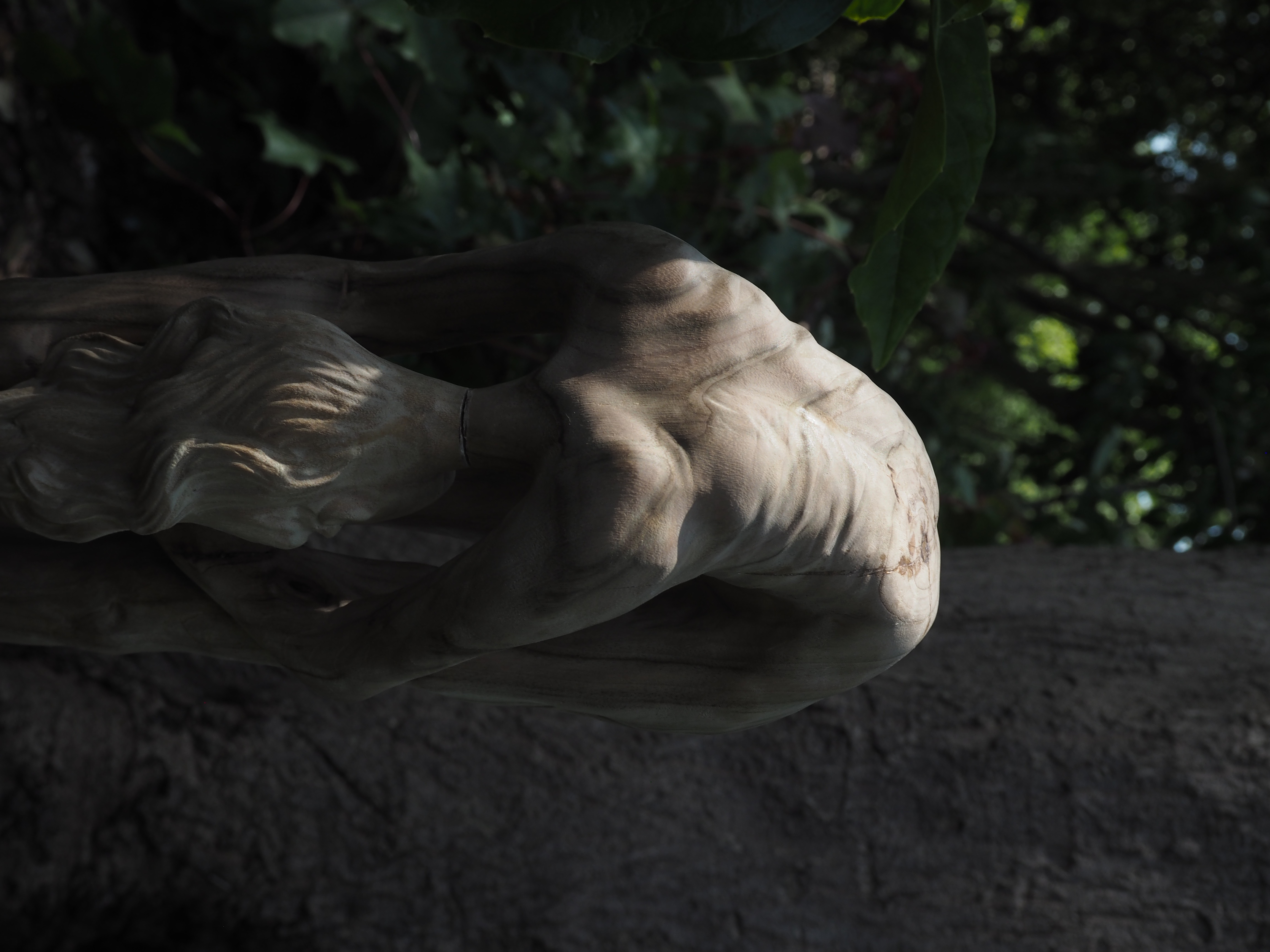
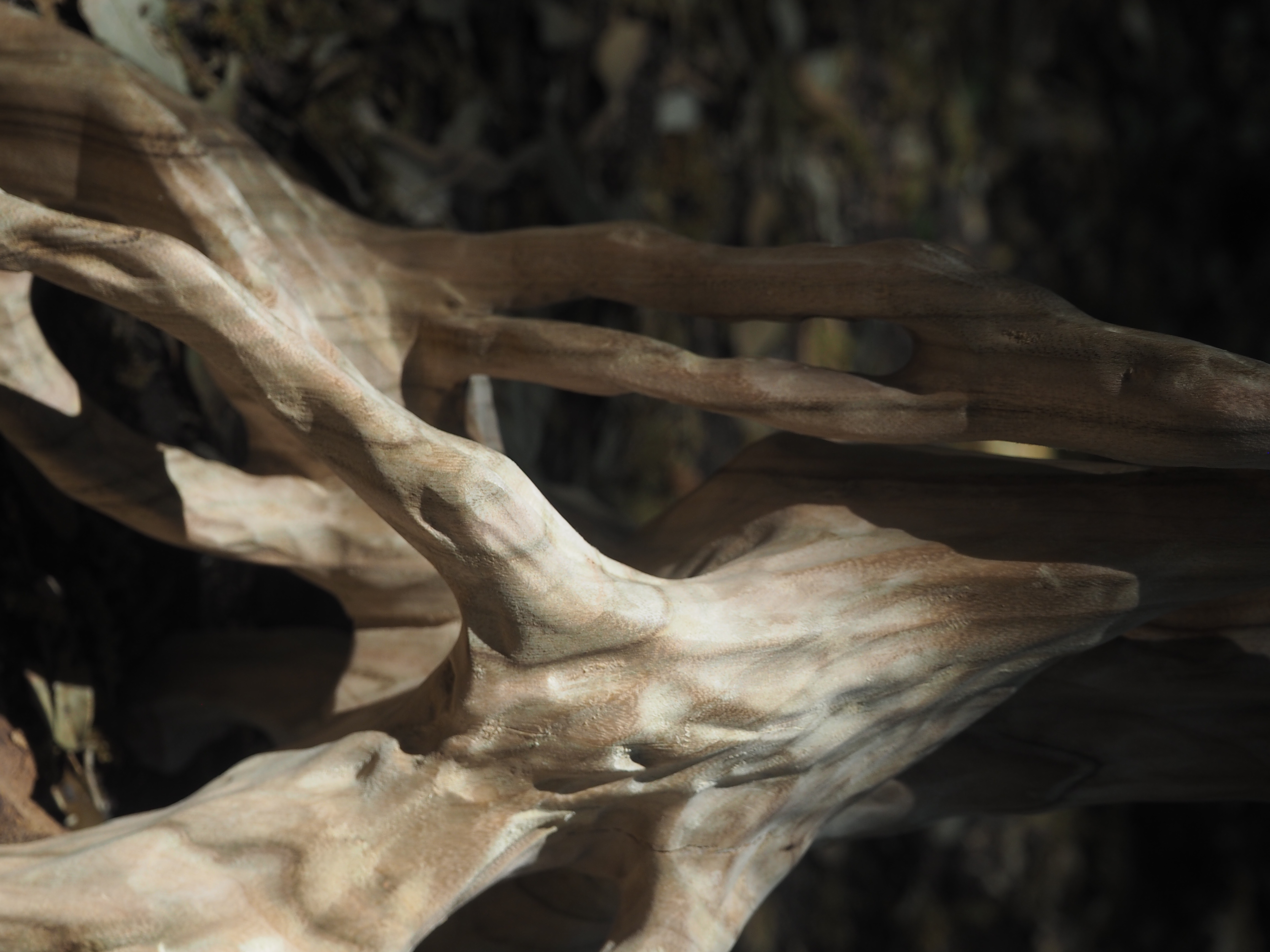
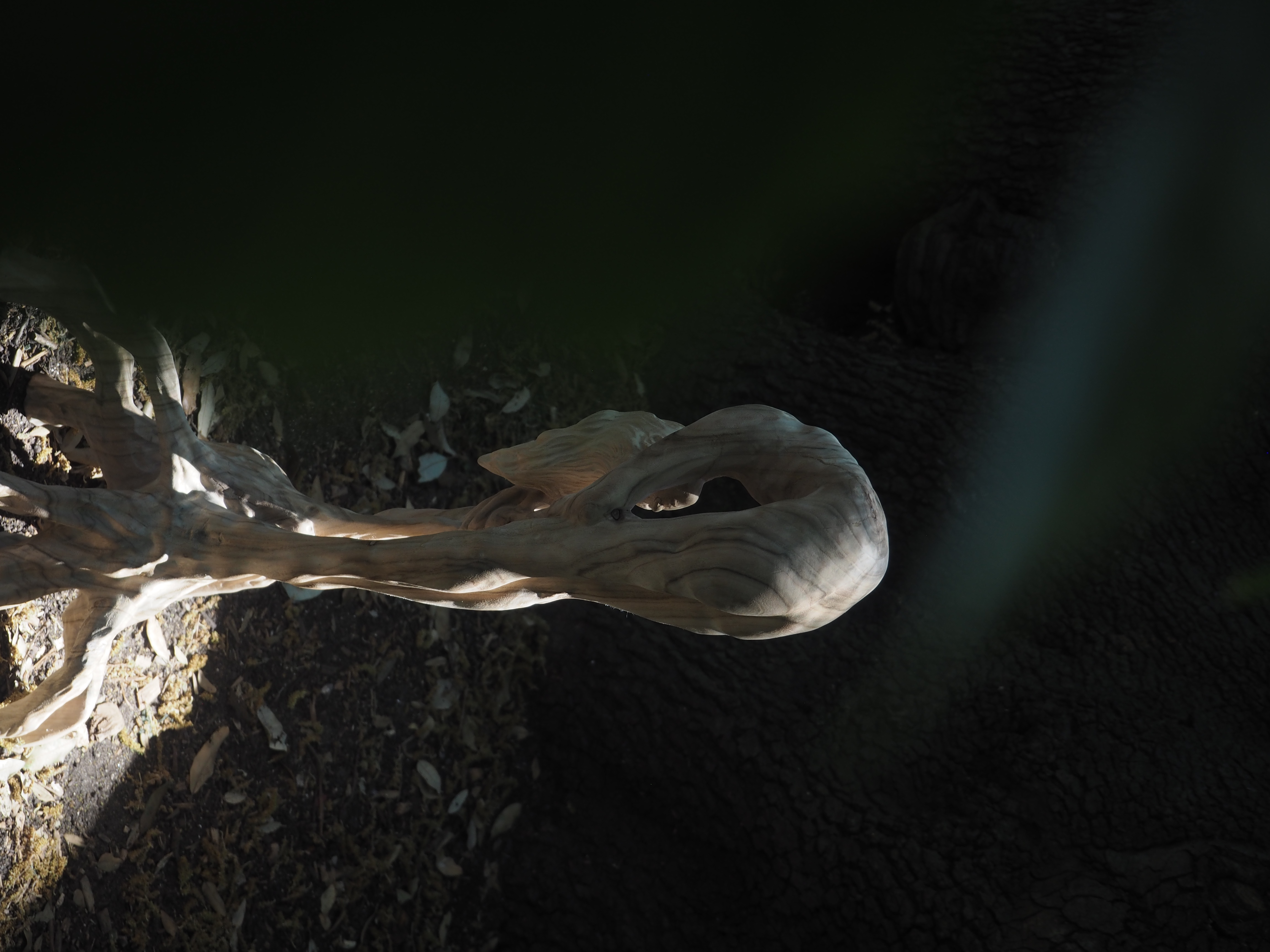
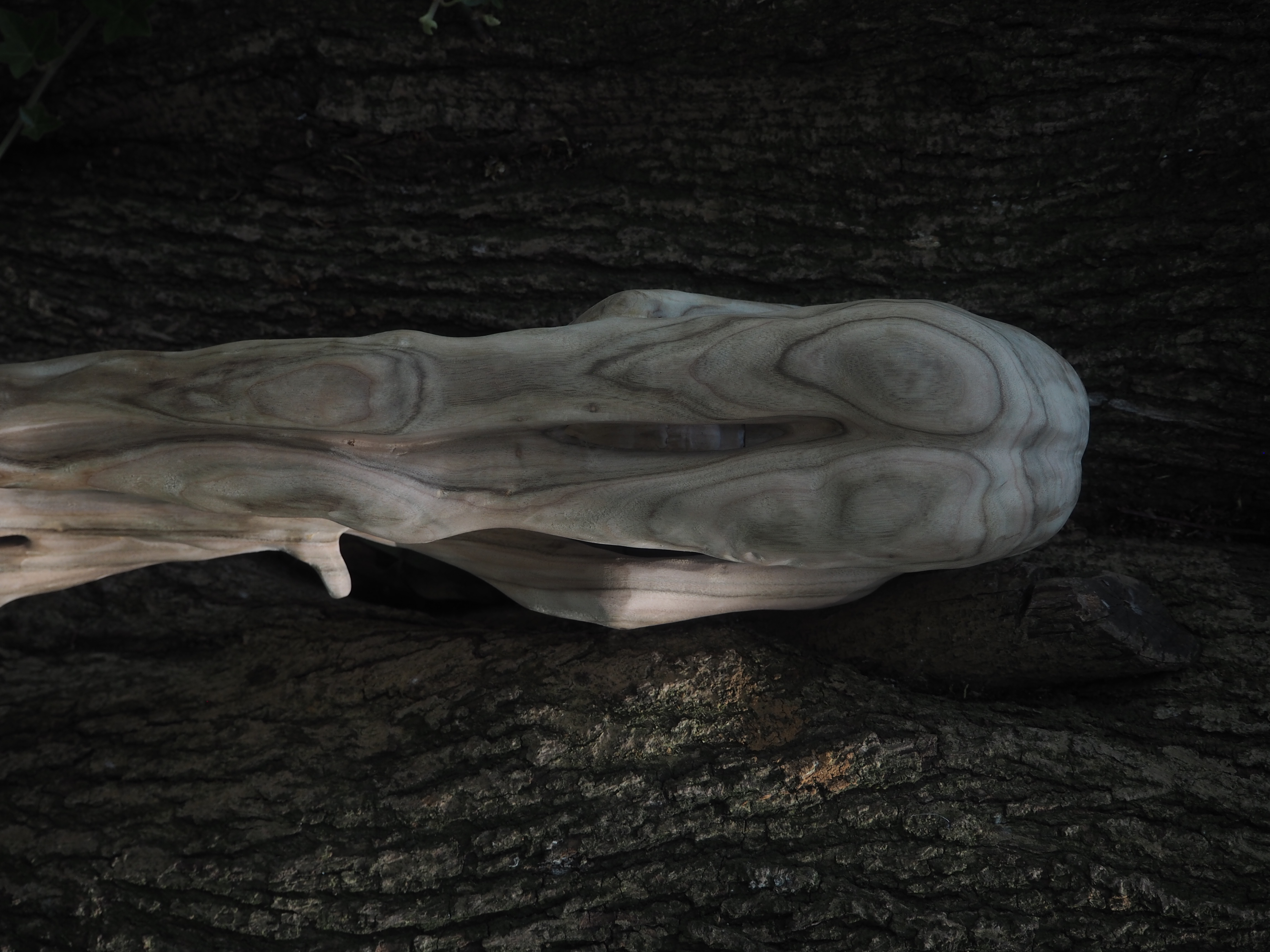
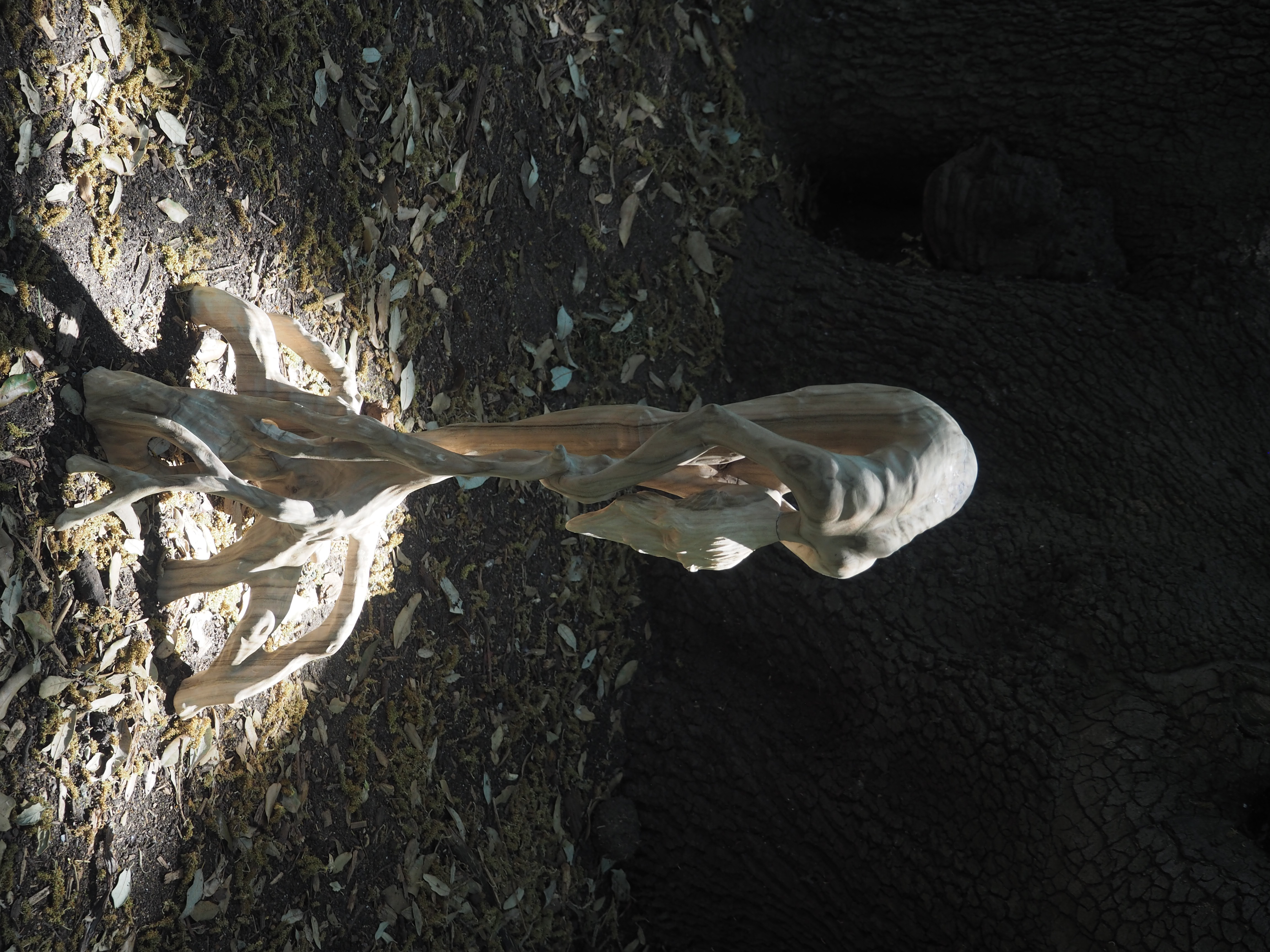
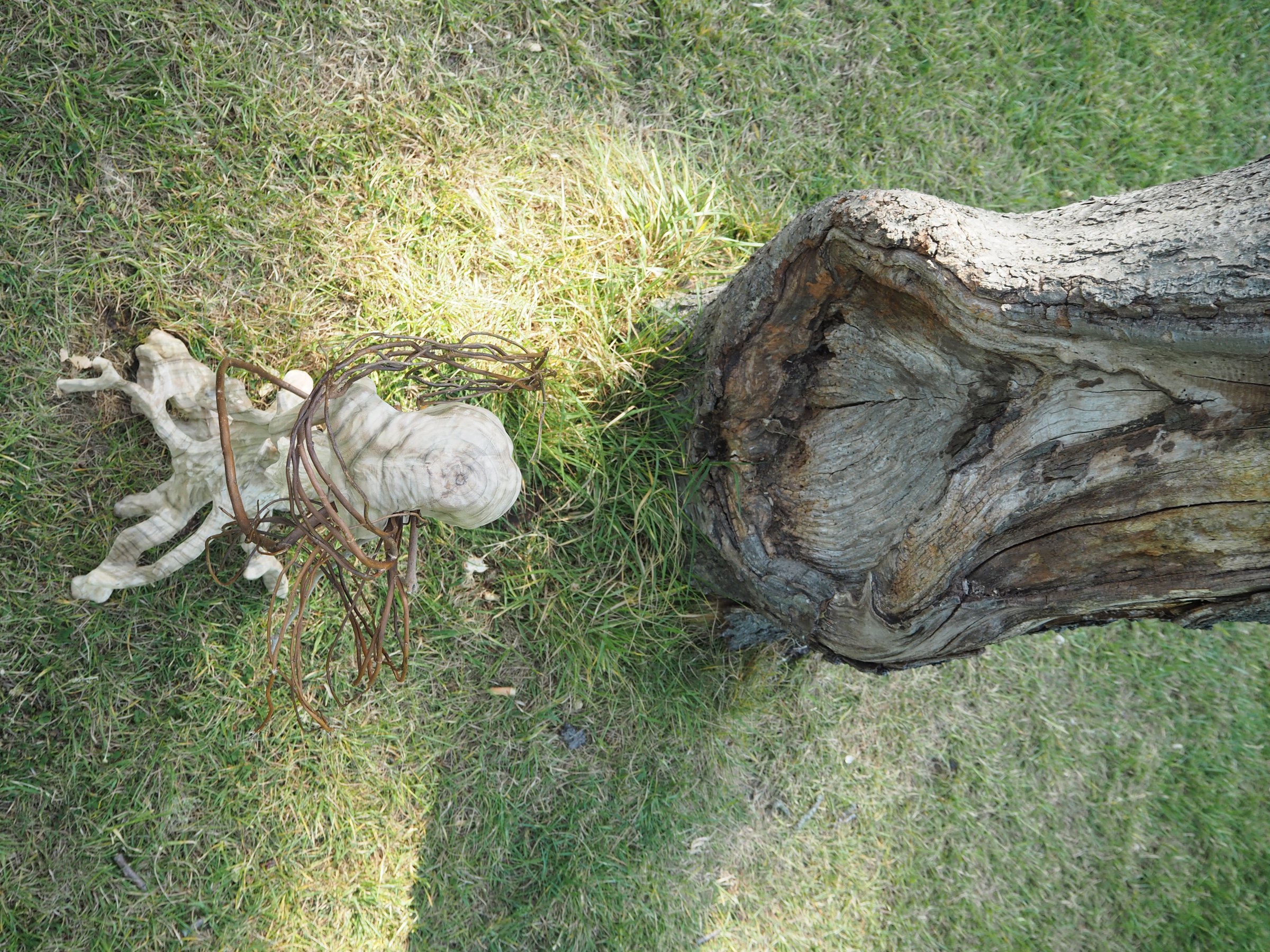
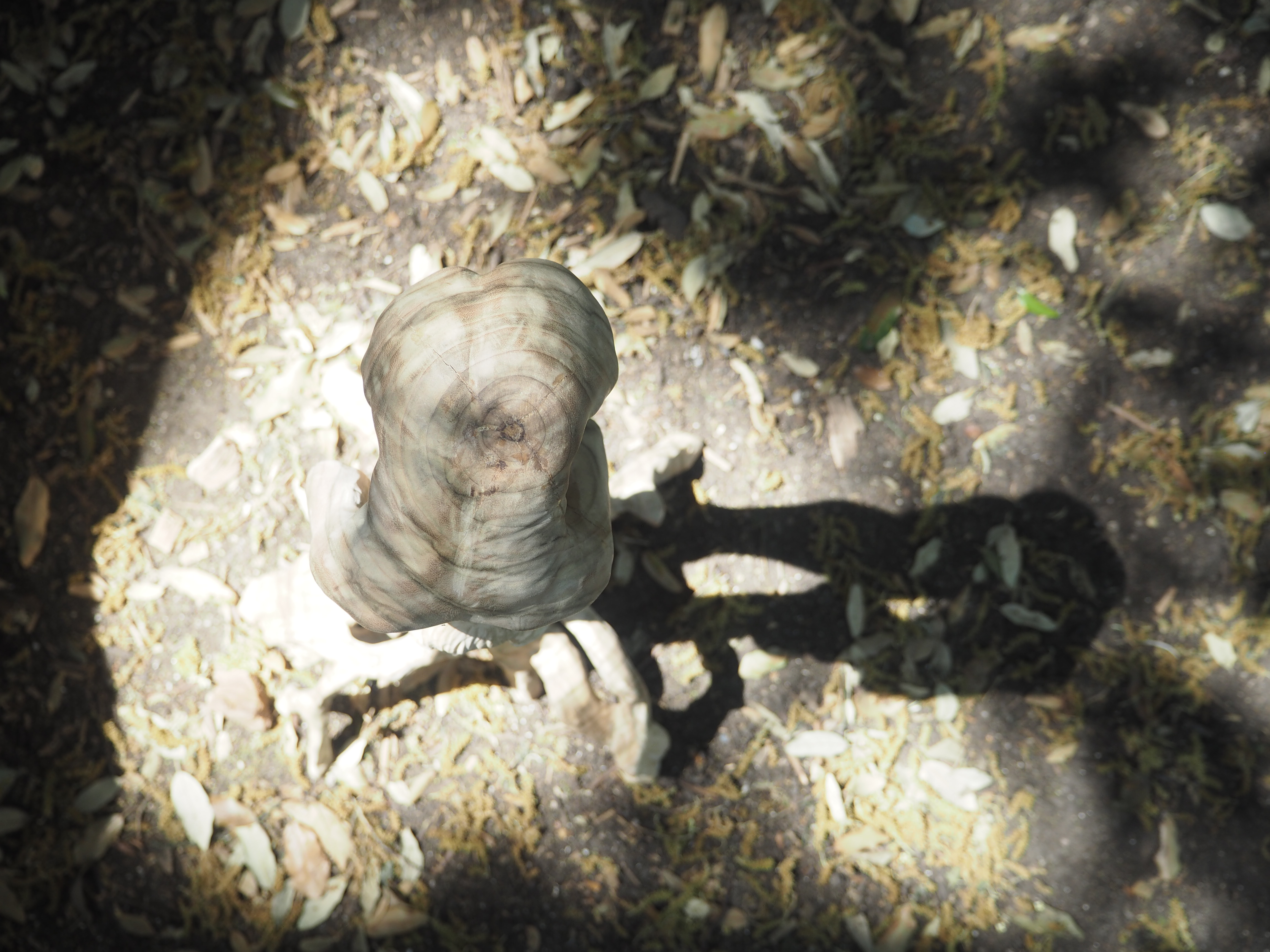
Resin, hand-painted · approx. 12 cm
Specimen No. I

← return
Chapter 04 / Audio
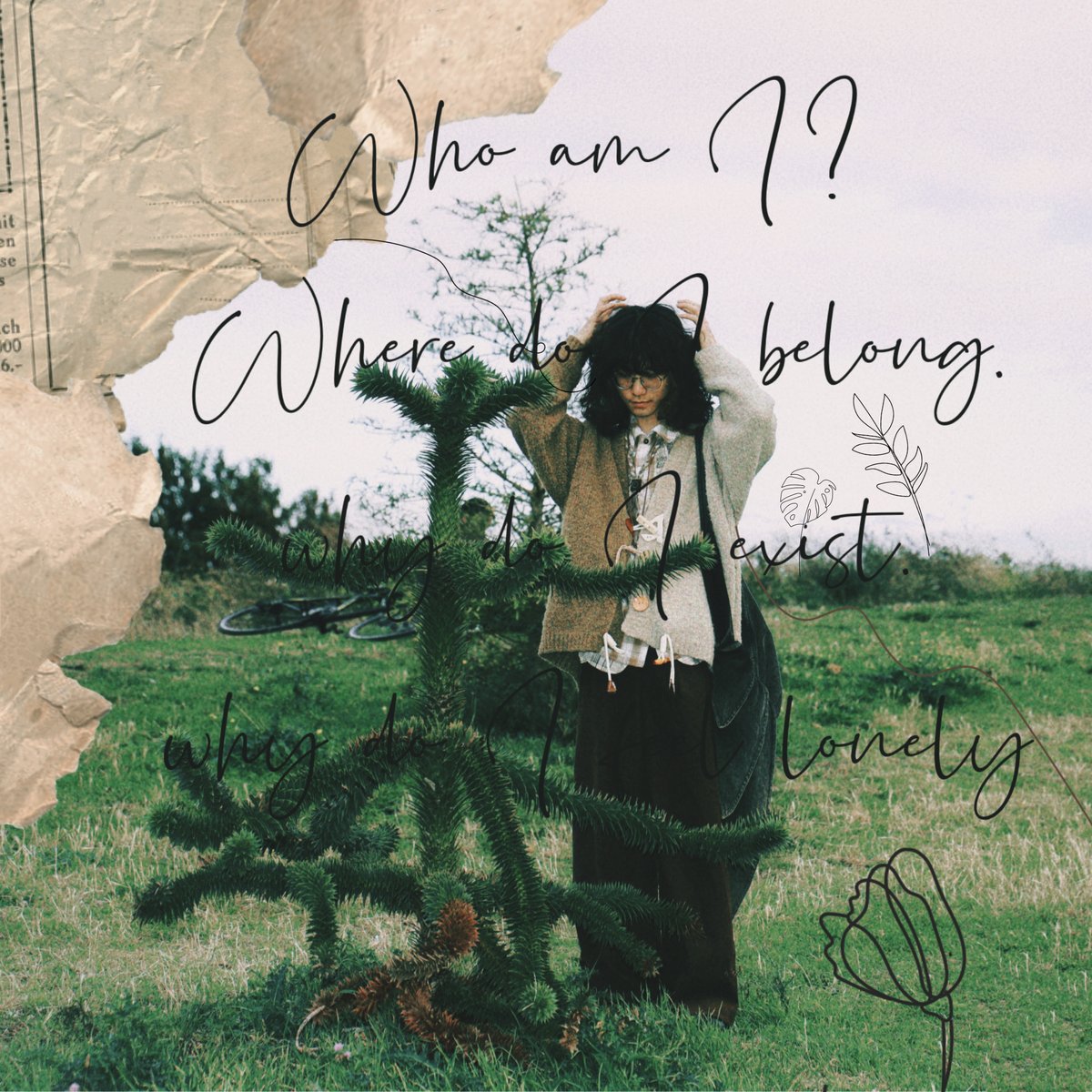
Withering — album cover
Click to play
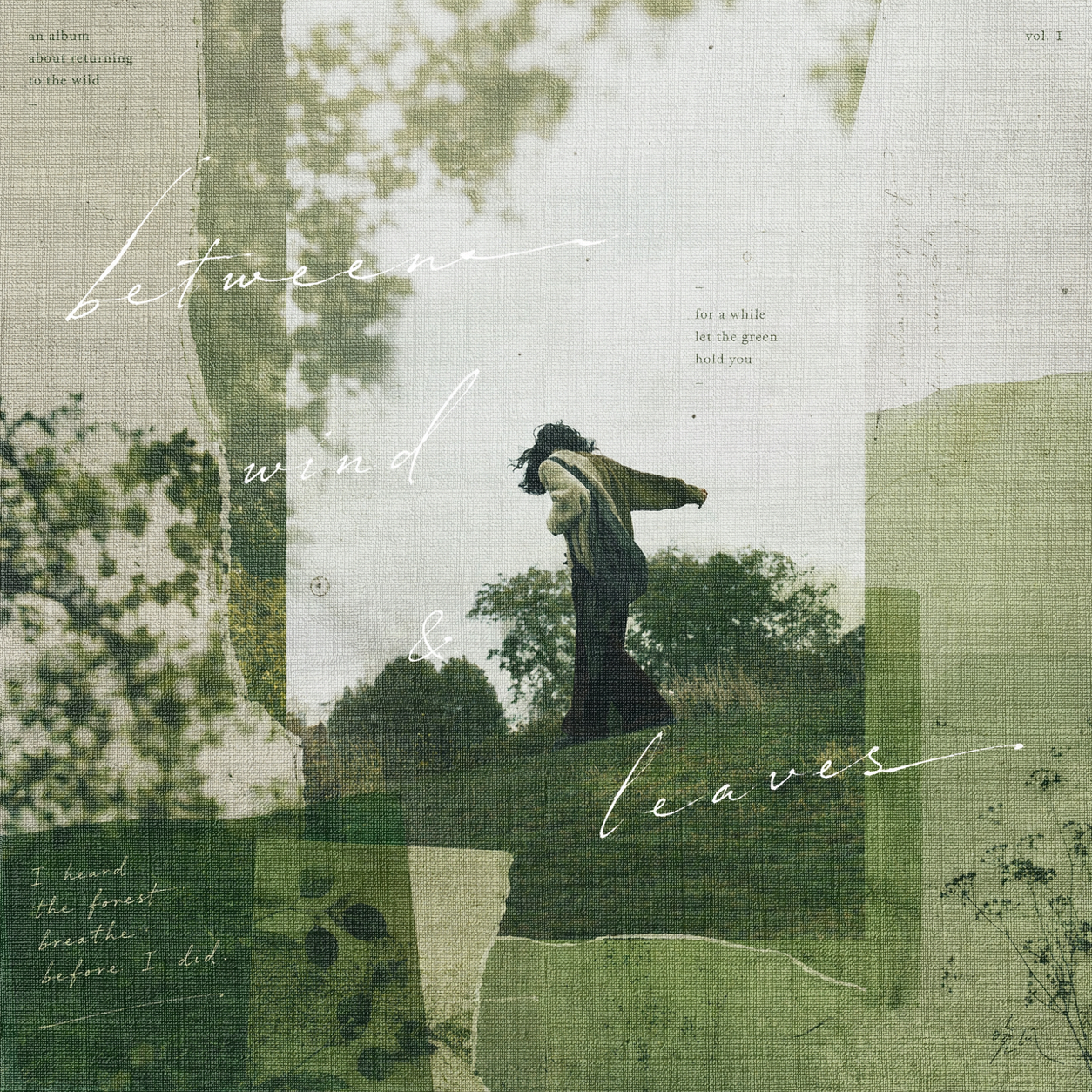
No. I — The Balcony Plant
Withering · 萎败

At March's end, the storm came down,
And broke my leaves with rain;
Yet in that wild, celestial hour,
I did not dream of pain.

I was no more a potted thing,
Forgotten, small, alone —
I was a tree the heavens loved,
By wind and water known.

The world had sung around my stem,
The rain had named me bright;
For once, I felt that I existed,
Burning softly in the night.

Then morning cleared. No hand returned.
I slept where I had lain —
A little life, by heaven lent
One dream before decay.

Original Composition · 2025 · Withering / Side A
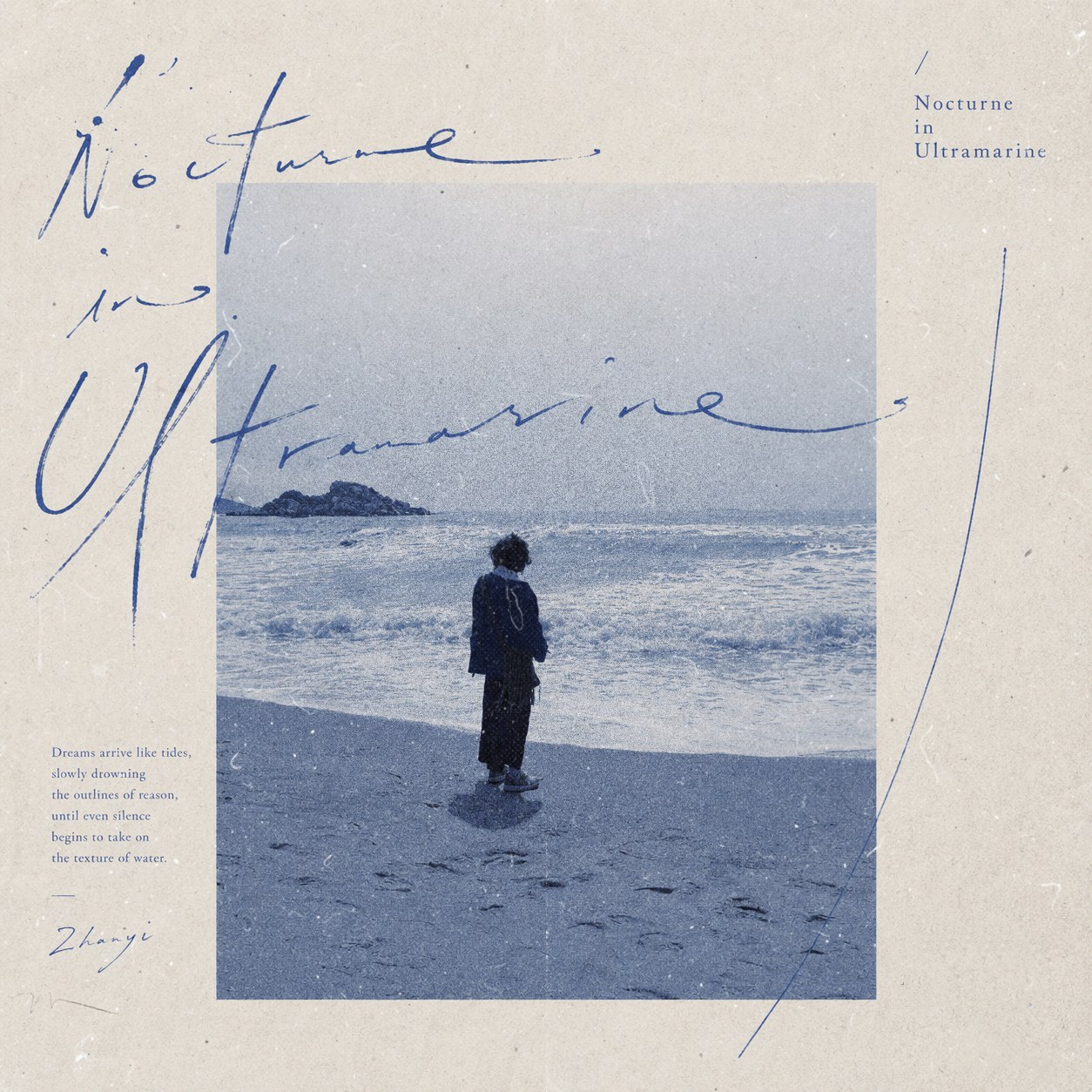
Nocturne in Ultramarine — album cover
Click to play
No. II — Nocturne in Ultramarine

Dreams arrive like tides,
slowly drowning the outlines of reason,
until even silence
begins to take on the texture of water.

Original Composition · 2025 · Side B
A Shiver of Green — album cover
Click to play
No. III — A Shiver of Green

The tires hum a low, steady prayer against the gravel.
The field is too wide, the noon too bright —
a rush of wind presses me closer to the earth.
I am moving fast, but inside, everything has stopped.

Original Composition · 2025 · Side C
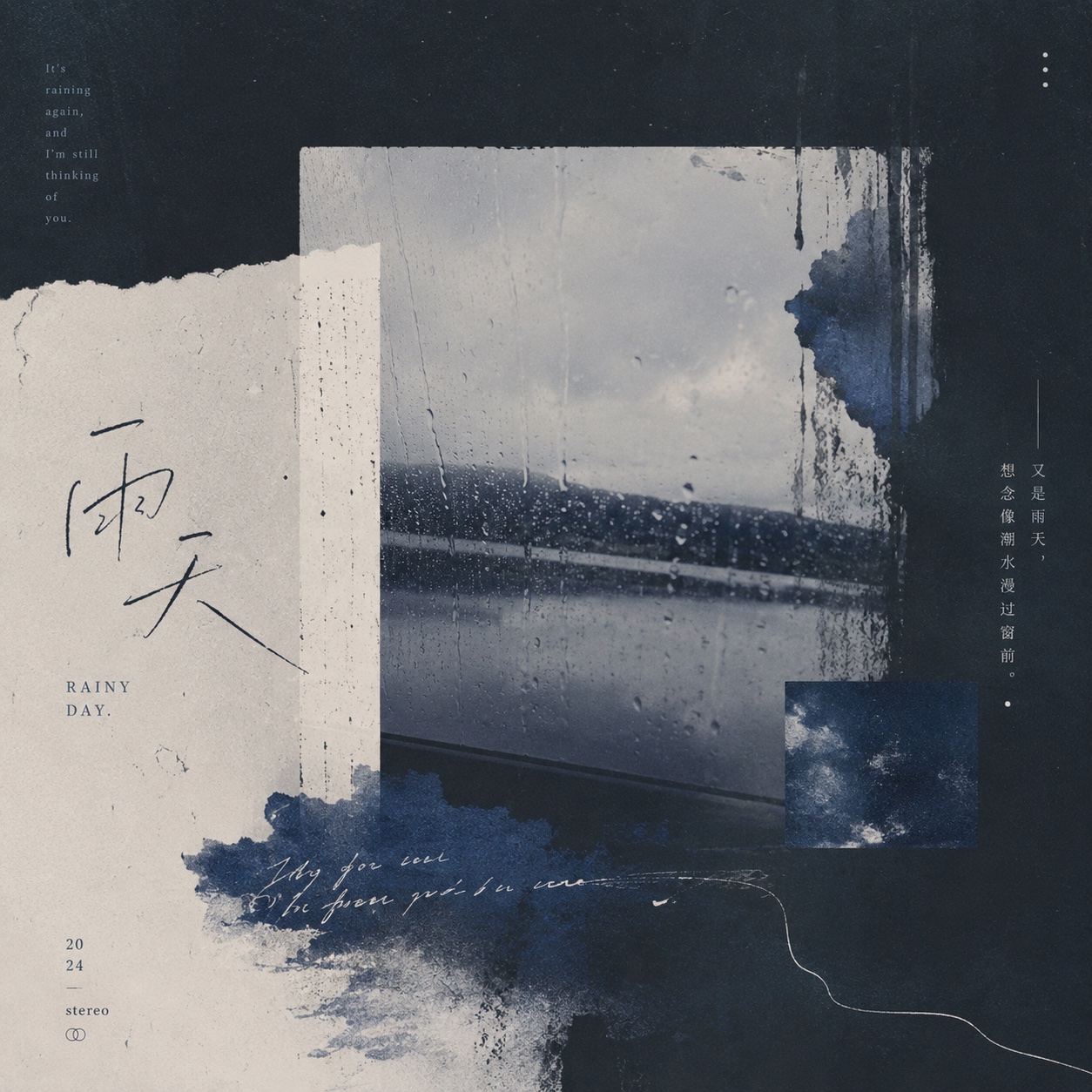
Rainy Day — album cover
Click to play
No. IV — Rainy Day · 雨天

It's raining again, and I'm still thinking of you.
The window forgets the city — only the water remembers.
Longing arrives like a tide,
slow, blue, and without permission.

Original Composition · 2024 · Side D
← back to the cabinet
Publication / 02 · Asking the ground
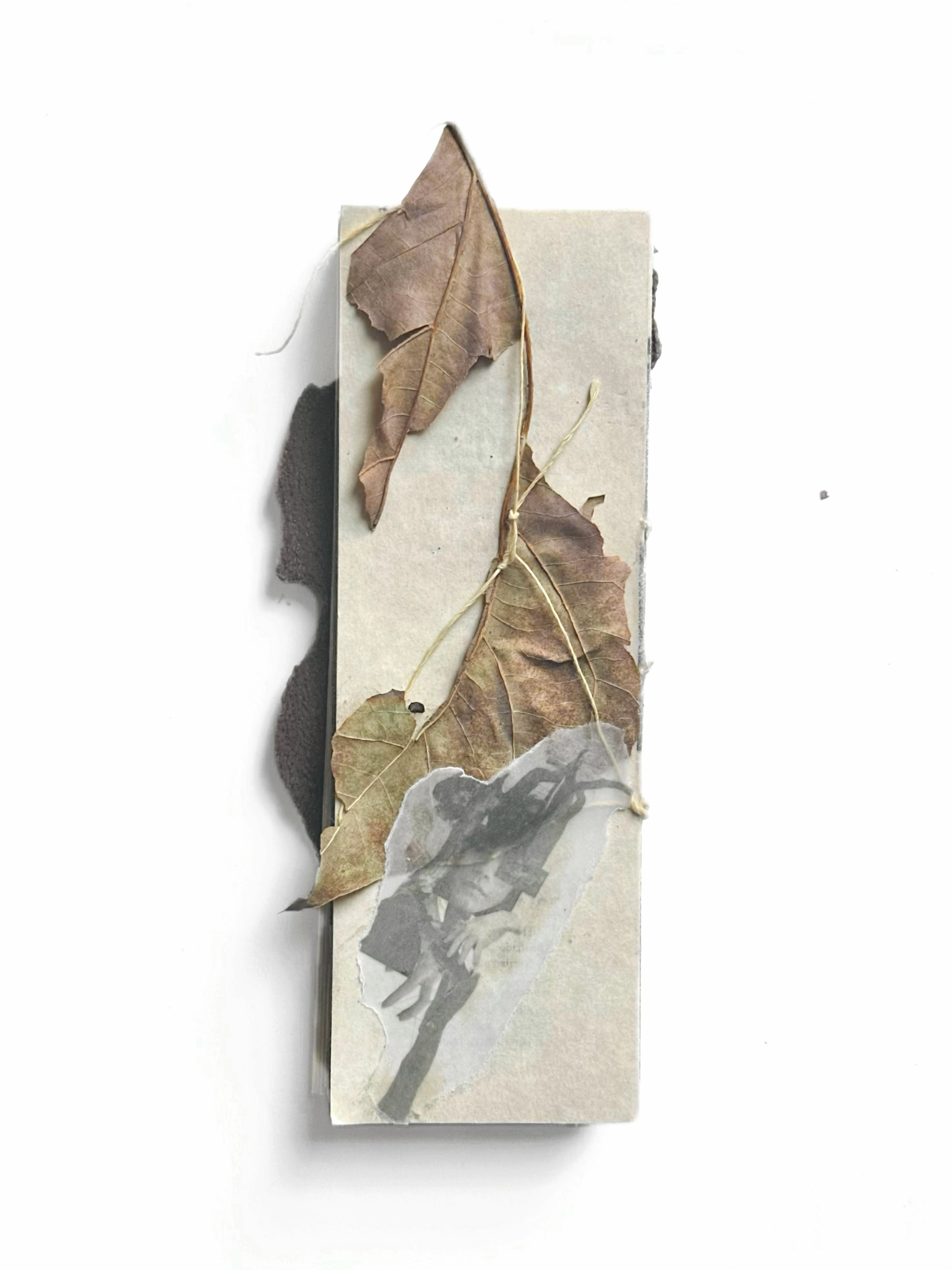
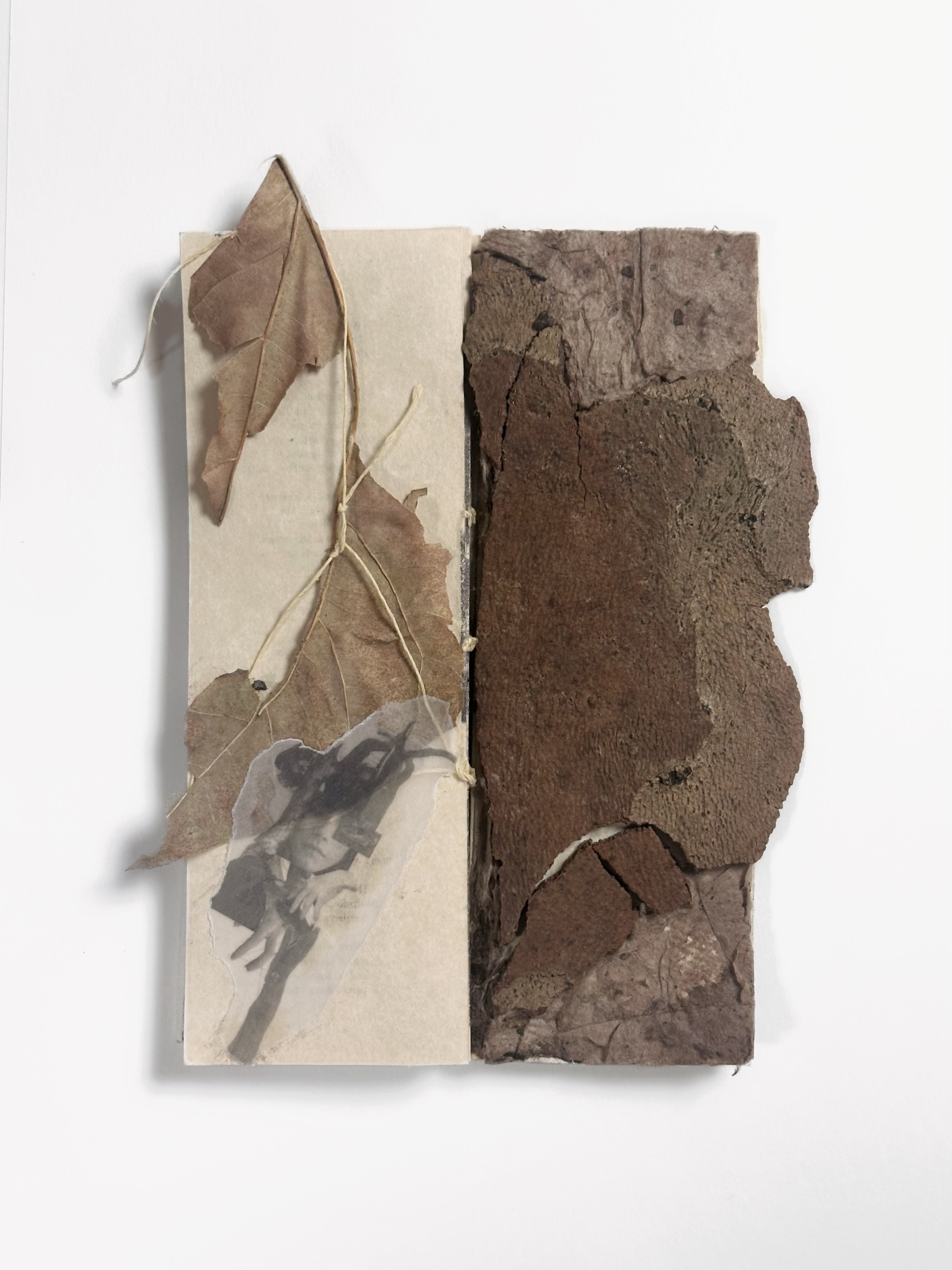
A Dialogue with Nature — cover with leaves and tracing paper
A zine · 2025

A Dialogue
with Nature

— Asking the ground
5 × 15 cm Kraft paper · 140 gsm Bark · Dried leaves Tracing paper Hand-bound
read with the hands
I · Encounter This zine emerges from my repeated encounters with the boundary between body and nature. Real traces of leaves and bark are embedded into the cover — carrying texture, fragility, and the residue of time and environment.
Through touch, handling, and reading, nature shifts — from an object of observation into something physically encountered and carried.
II · Scale The zine remains close to the scale of the hand and body. Inside, the work maintains a quiet and steady rhythm. The vertical format extends the page downward —
turning page-turning into a repetitive bodily gesture.
Paper, spacing, and typography allow the text to unfold slowly, situating reading within material contact and physical proximity.
III · Approach For me, this becomes a process of approach and perception. Through scale, touch, and repeated gestures, I reconsider the shifting relationship between the body and the natural world —
not as something simply observed,
but continuously reconfigured through contact.
Inside the zine
scroll — as if turning the page
Cover spread — bark and leaves
01 — cover
Chapter I · The Cover Where the body meets bark A torn fragment of real bark sits beside the leaf and the figure — the cover is already a threshold: skin to skin with the natural world.
Page 04 — two negative images
04
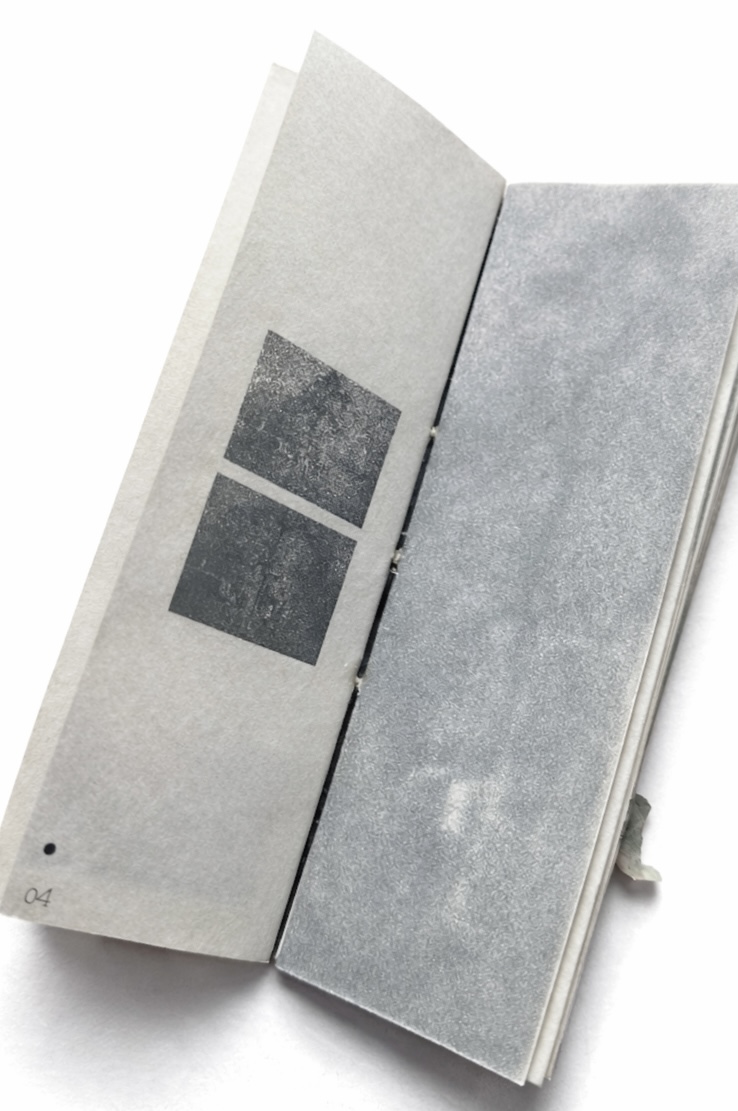
Page 04 First openings Two small windows of dark tone — the first images arrive quietly, like shadows touched lightly, not yet asking to be understood.
Page 05 — threads and four negatives
05
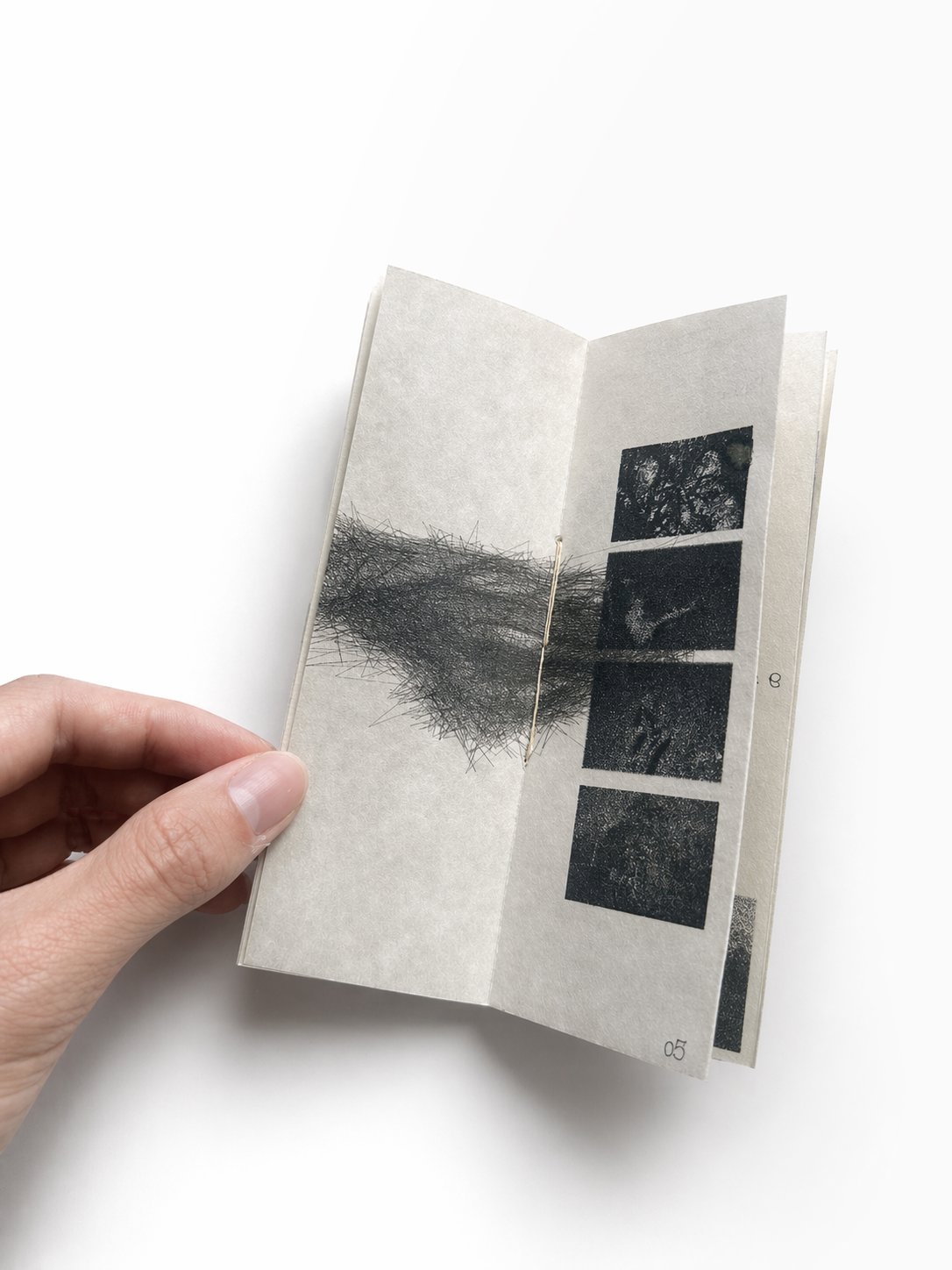
Page 05 Threads, drifting Fine graphite threads gather across the spread, spilling across the binding — the line itself becomes a nerve, a slow gesture of approach.
Chapter II — Close, A Pause
06 — 09
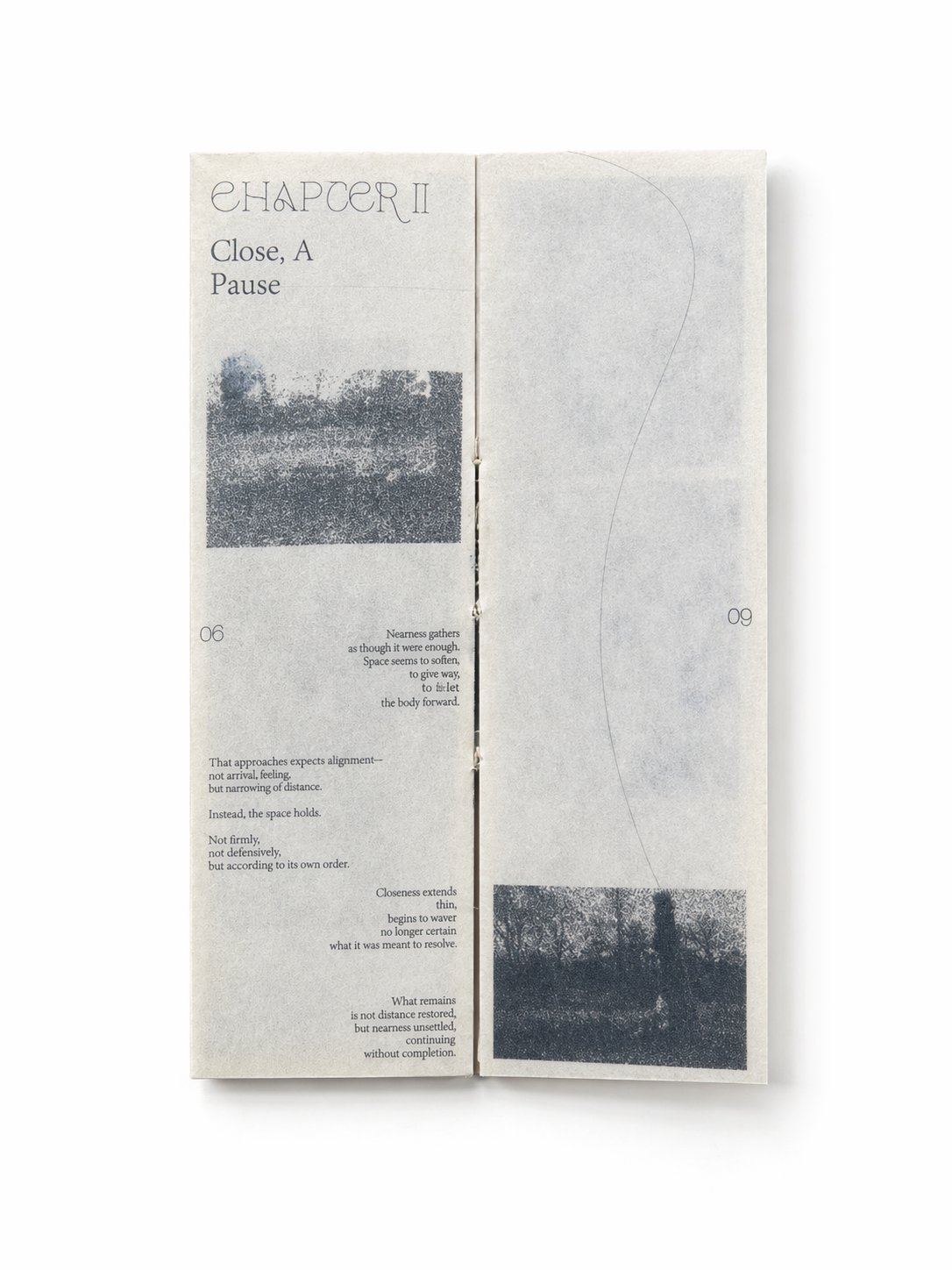
Chapter II · Close, A Pause Nearness gathers Closeness extends thin, begins to waver — what remains is not distance restored, but nearness unsettled, continuing without completion.
Page 16 — Fall, The Breath
16
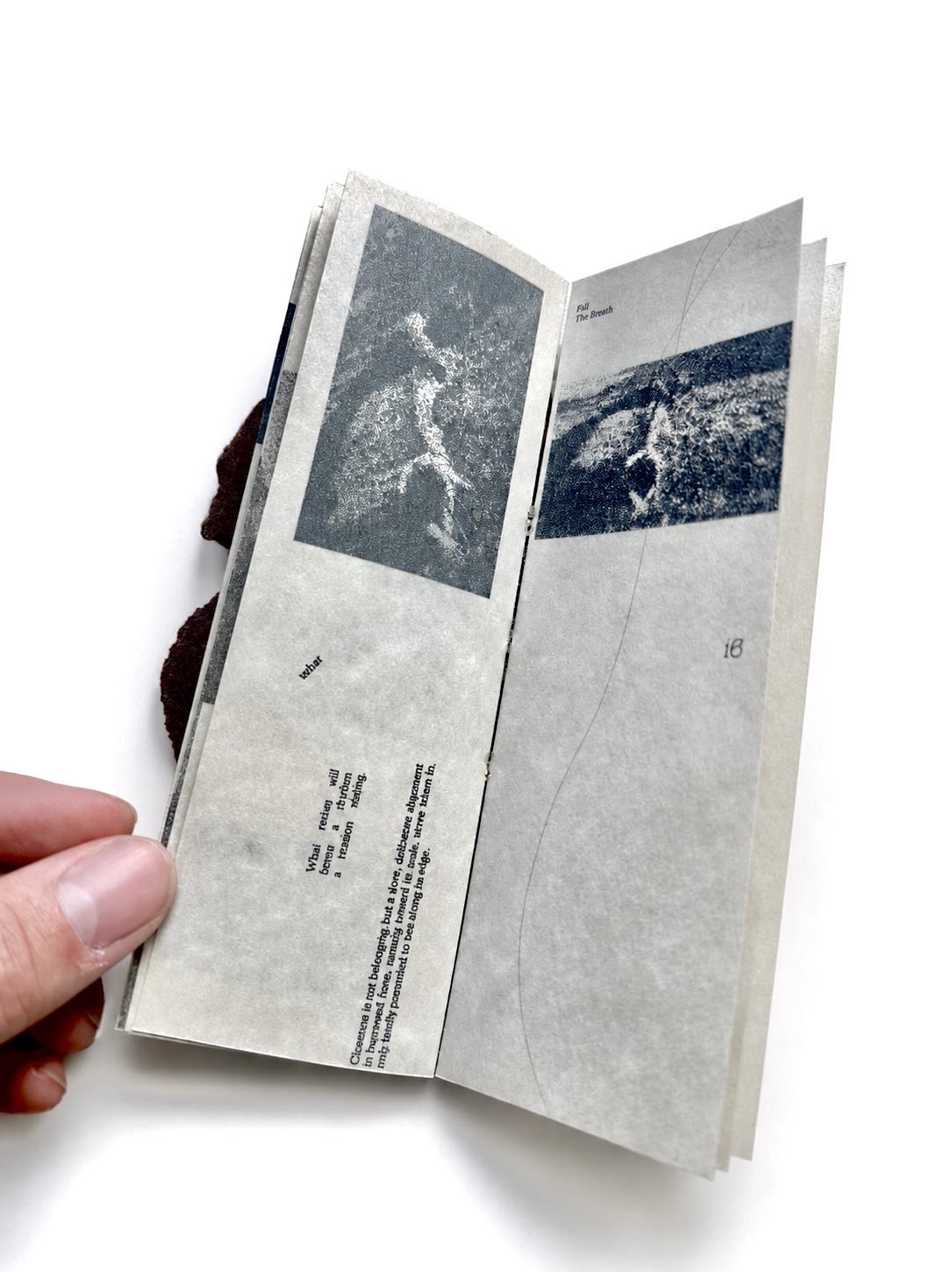
Page 16 · Fall, The Breath A rhythm resting Closeness is not belonging, but a slow, deliberate alignment — burrowed flows narrowing toward a scale, nerve taken in.
Page 20 — closing poem
20
Page 20 · The closing breath As part of that motion A column of breath-thin lines: what continues does so in many ways — and we continue, as part of that motion.
Colophon
“A page gives feeling a surface.
A fold gives memory a rhythm.”
Zhanyi Hu — 2025
← back
Publication / 03
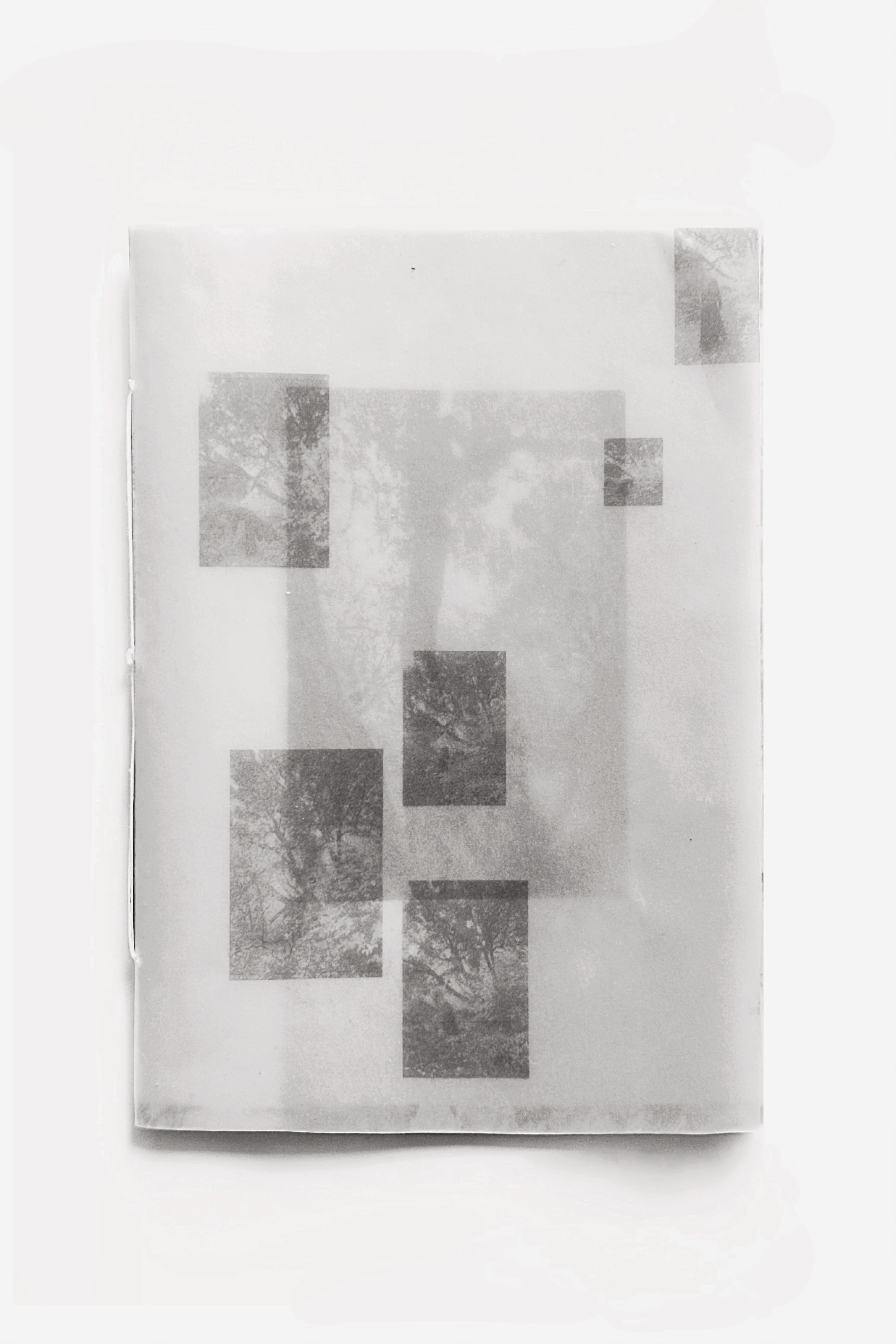
01/05 Cover · fragments through tracing paper
← back
Publication / 04 — Zine
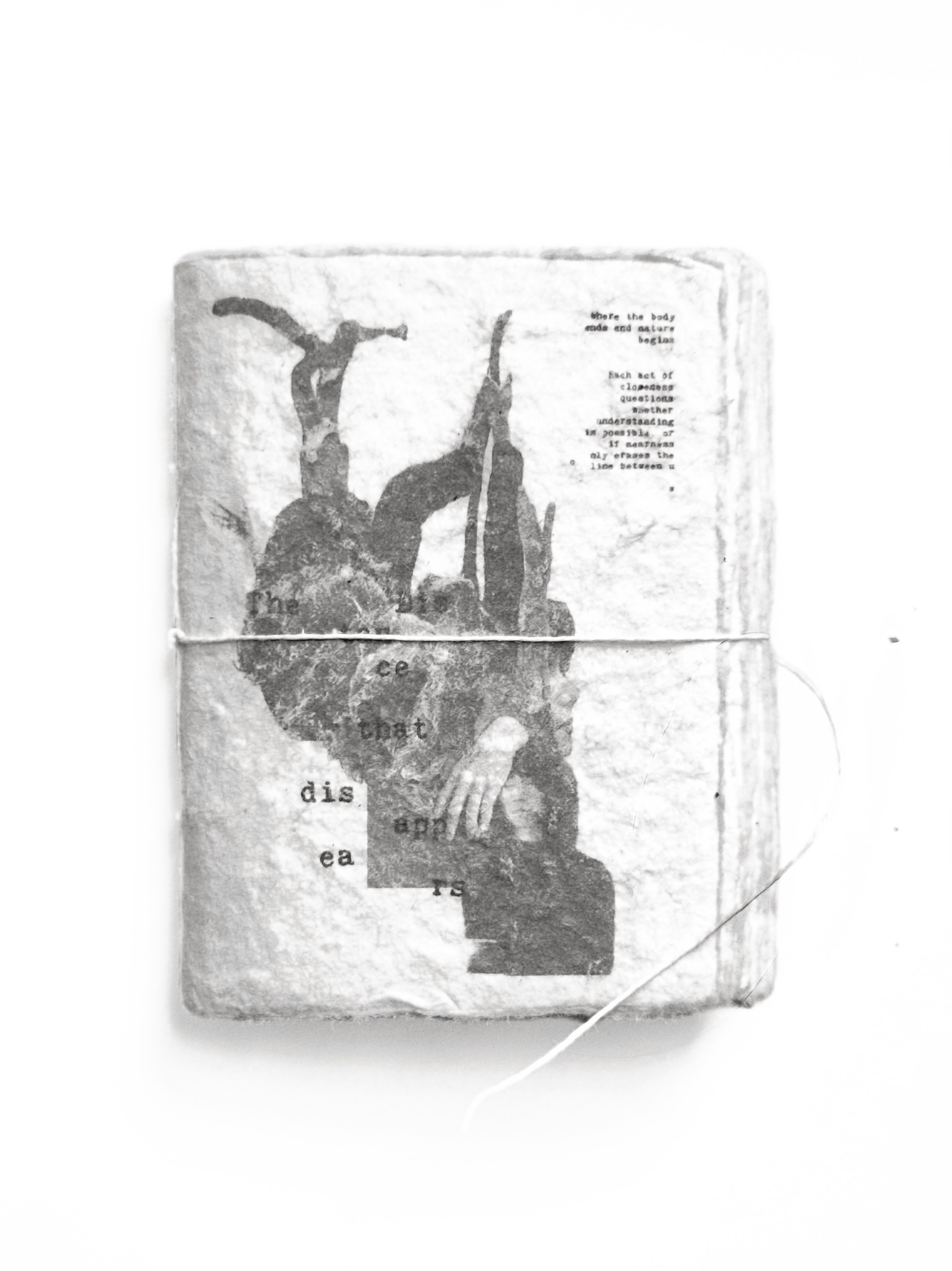
Cover of Tangible Silence, laid flat — printed on cashmere-cotton paper.
7 × 10 cm — held in the palm
A zine · 2025

Approaching the Tree Tactility & Suspension

Some relationships are not immediately visible — a fleeting correspondence between body and bark, traced through touch.
Format
Zine · 7 × 10 cm
Paper
Cashmere fibre + cotton (handmade)
Print
Monochrome inkjet
Year
2025
↓   enter the pages
I · Approaching
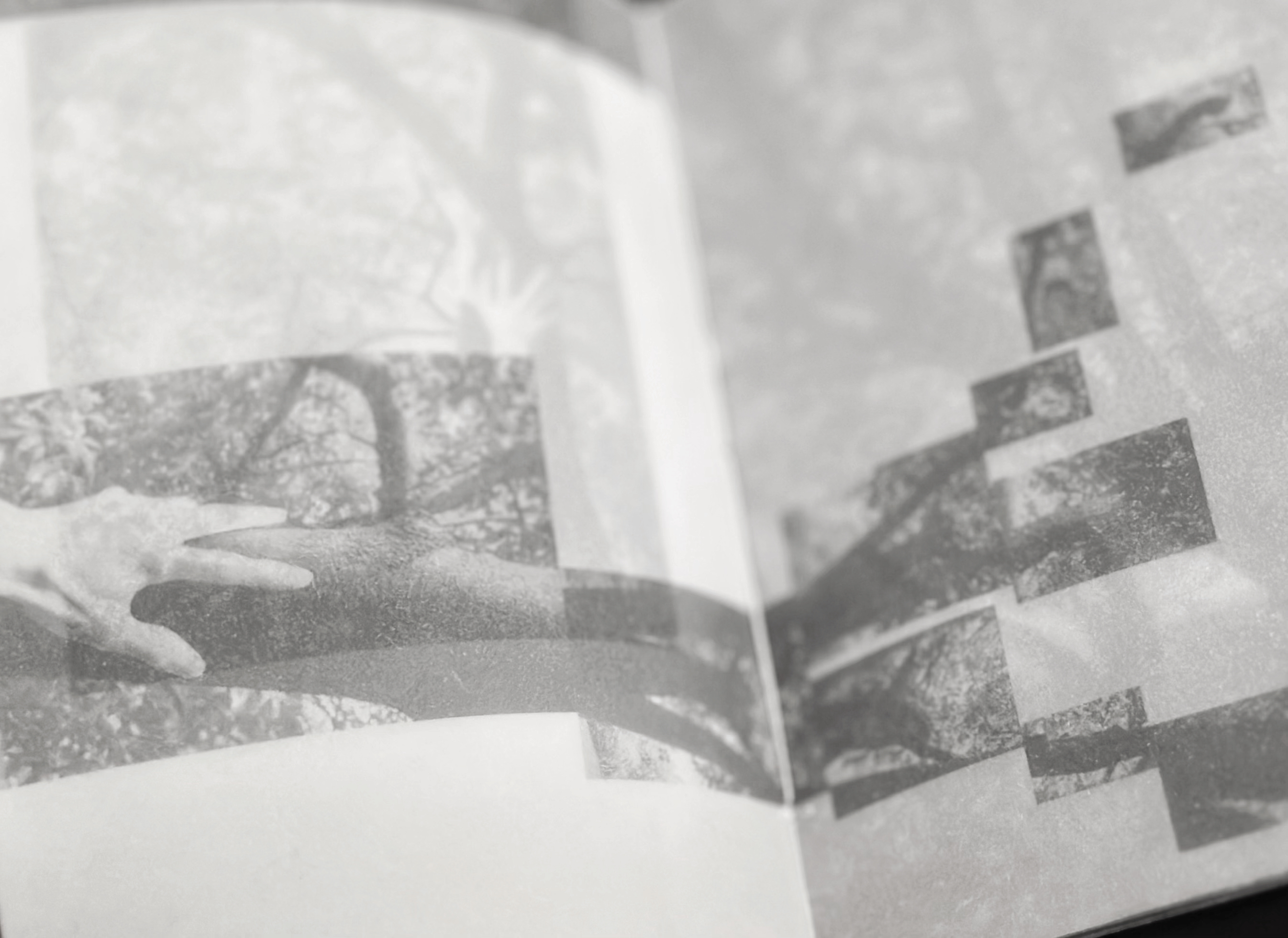
Between body and tree, moments of resemblance briefly emerge — the curve of an arm echoing a branch, fingertips resting against bark.

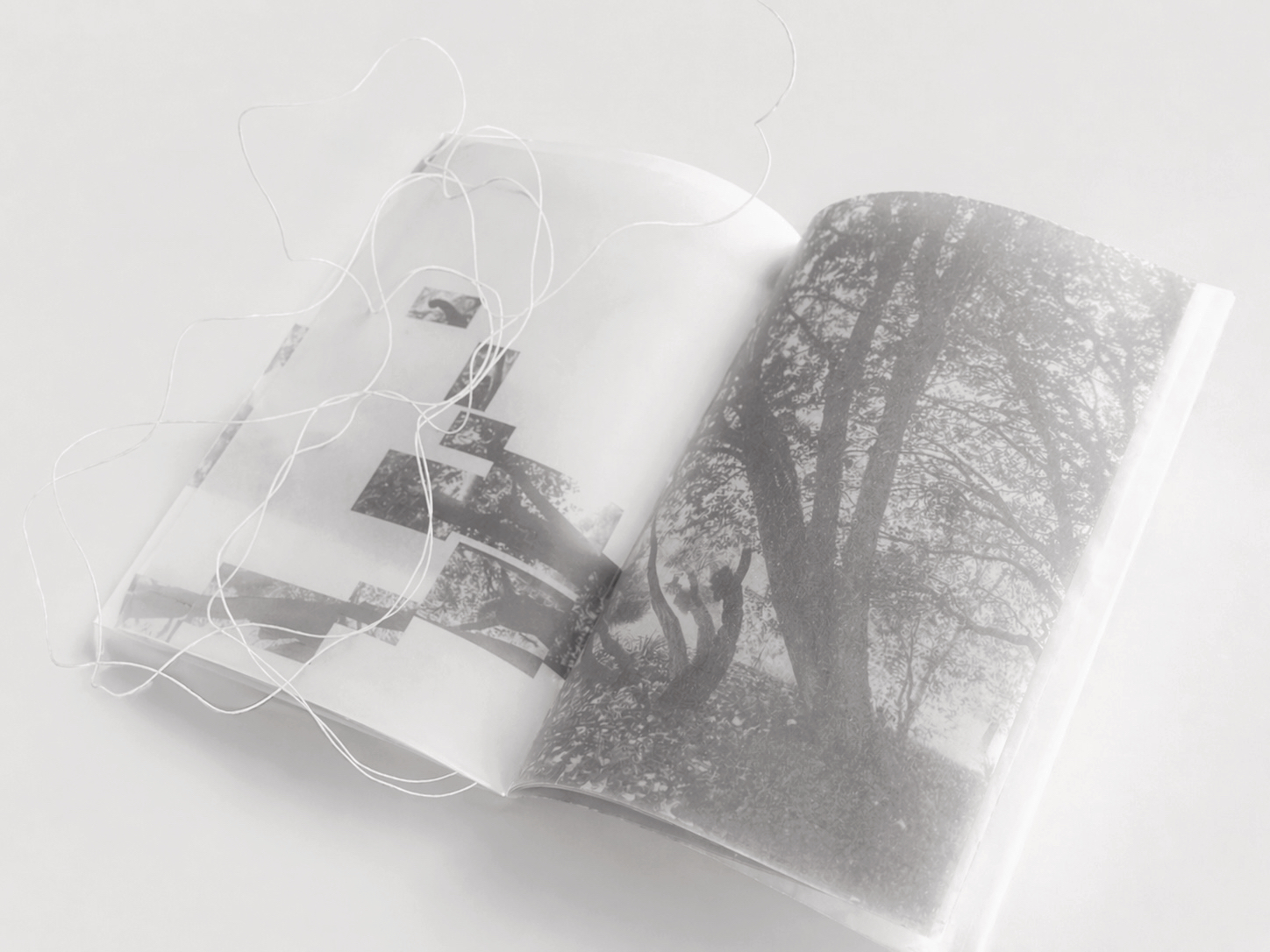
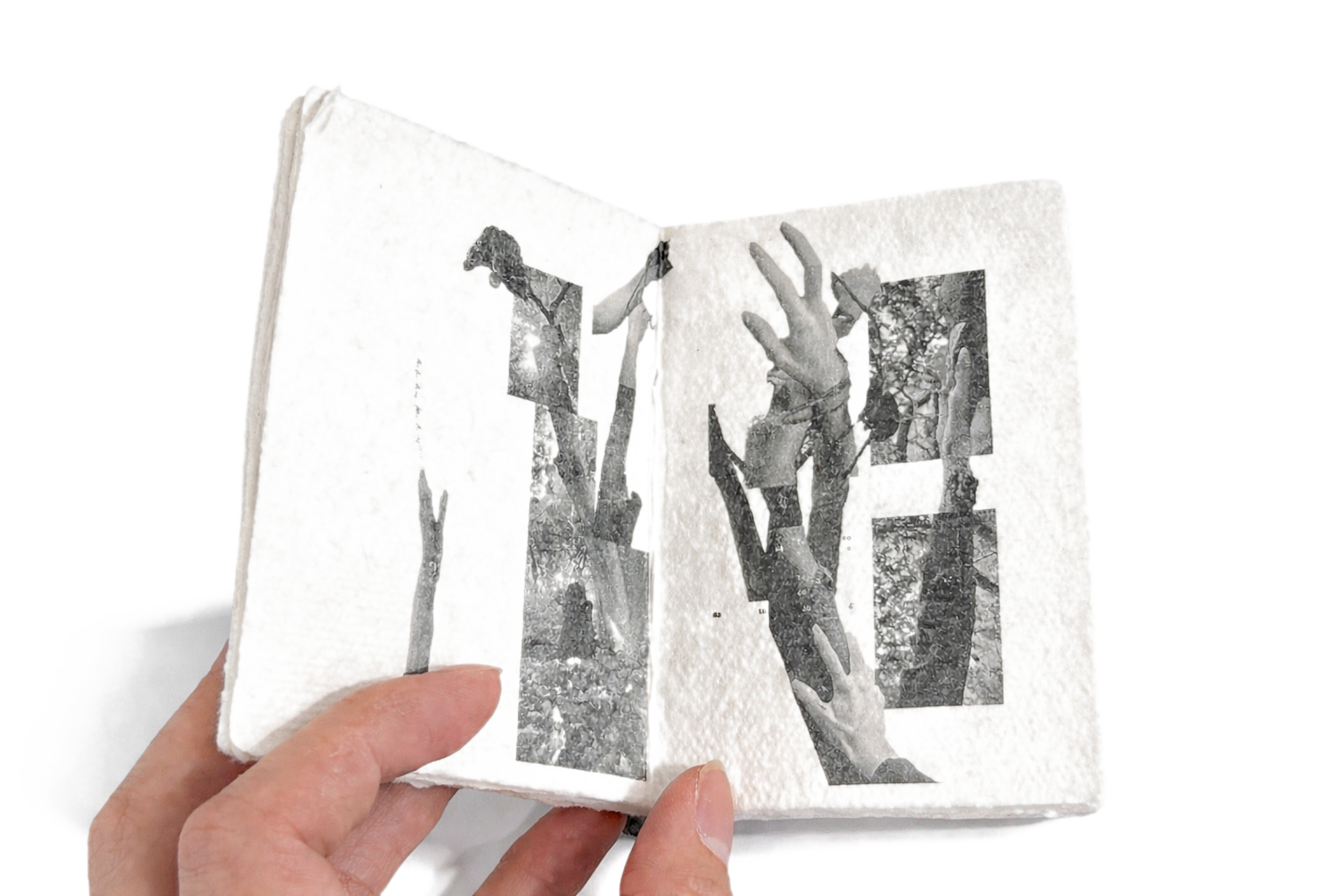
Through touch and imitation, I use the body to trace these fleeting correspondences. The images are fragmented and dispersed across the zine: bark, branches, and bodily details remain suspended between pages without forming a complete whole.

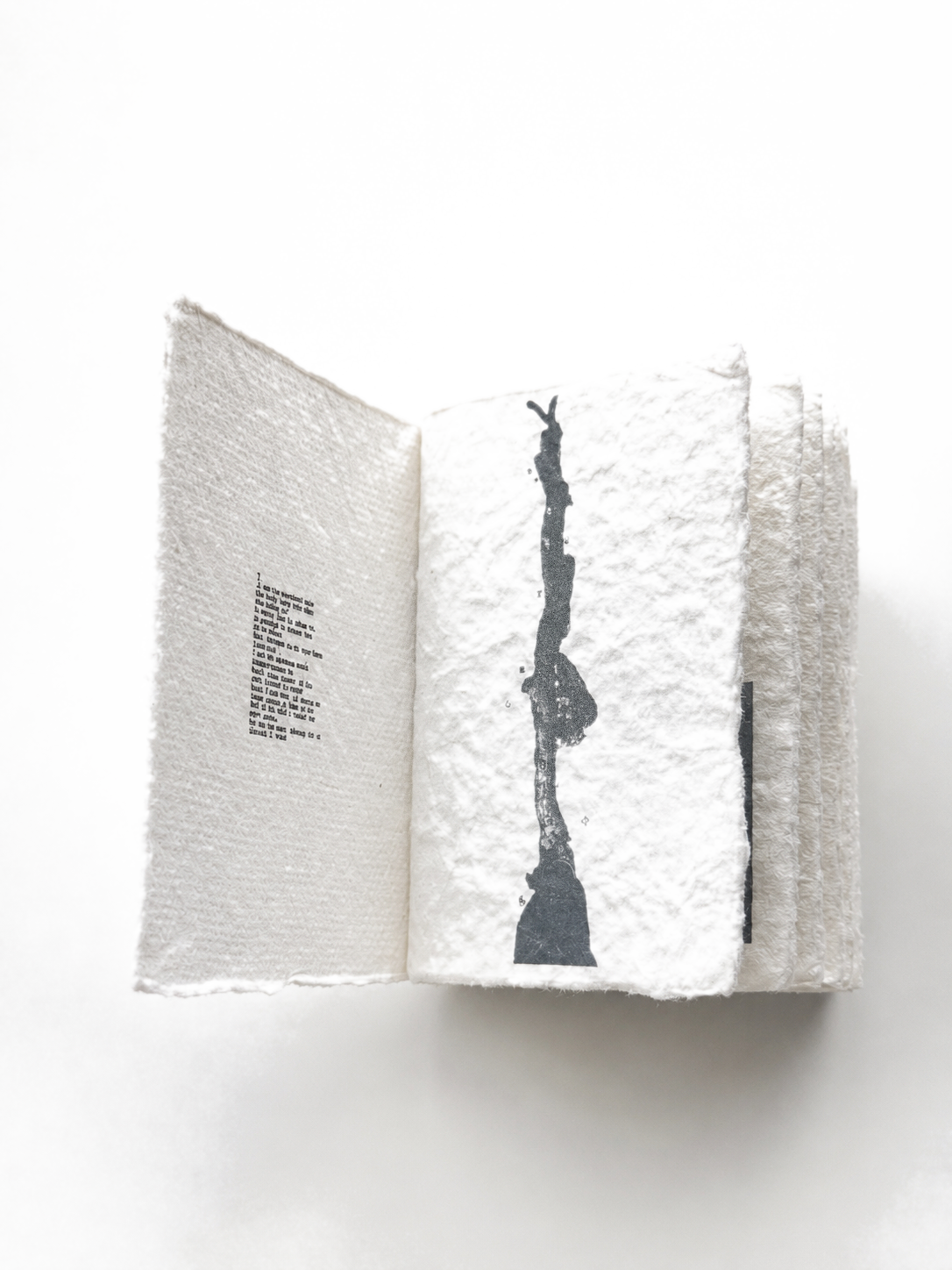
Text appears only partially — obscured or delayed through layering and sequence, allowing reading to move between recognition and absence.

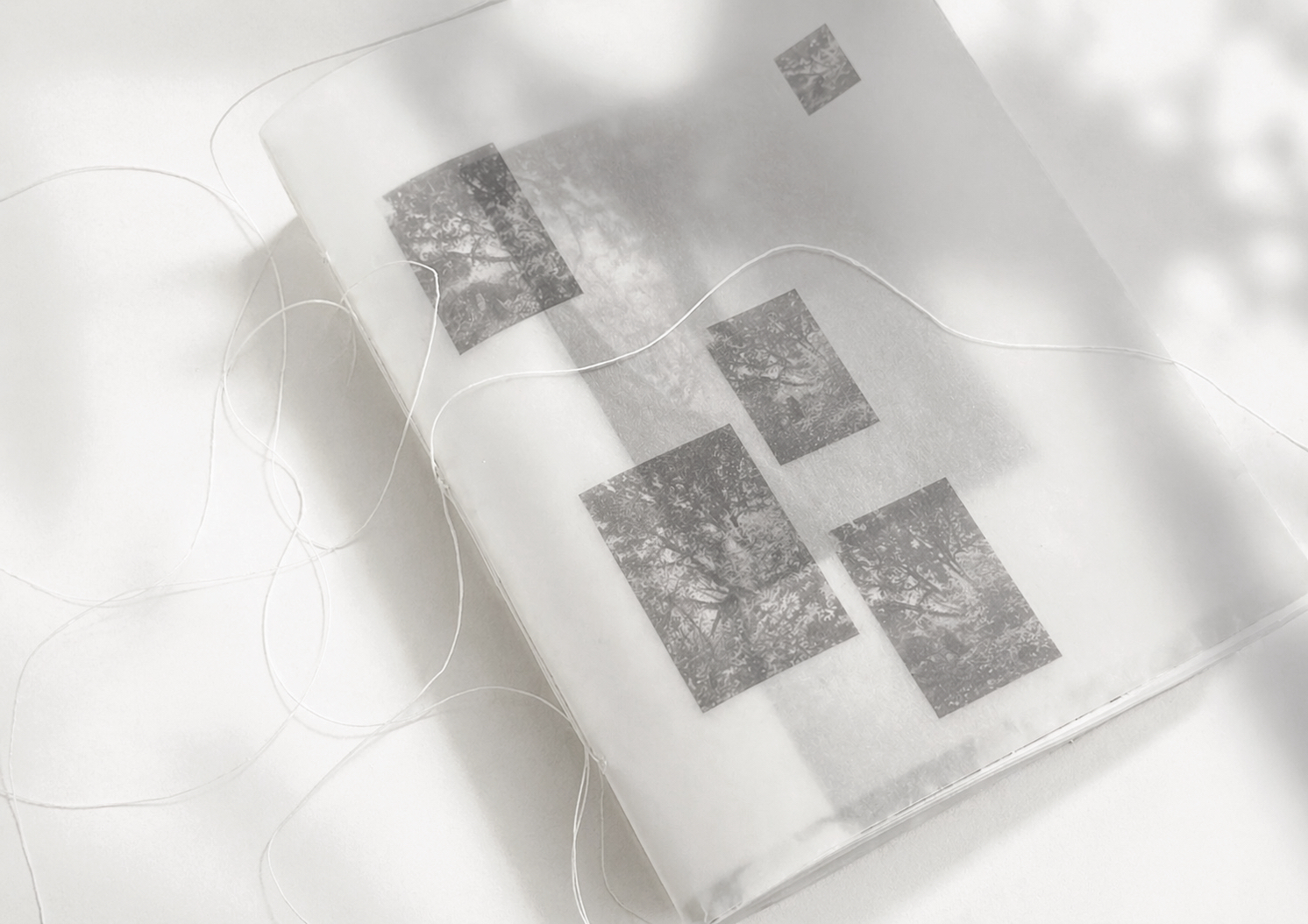
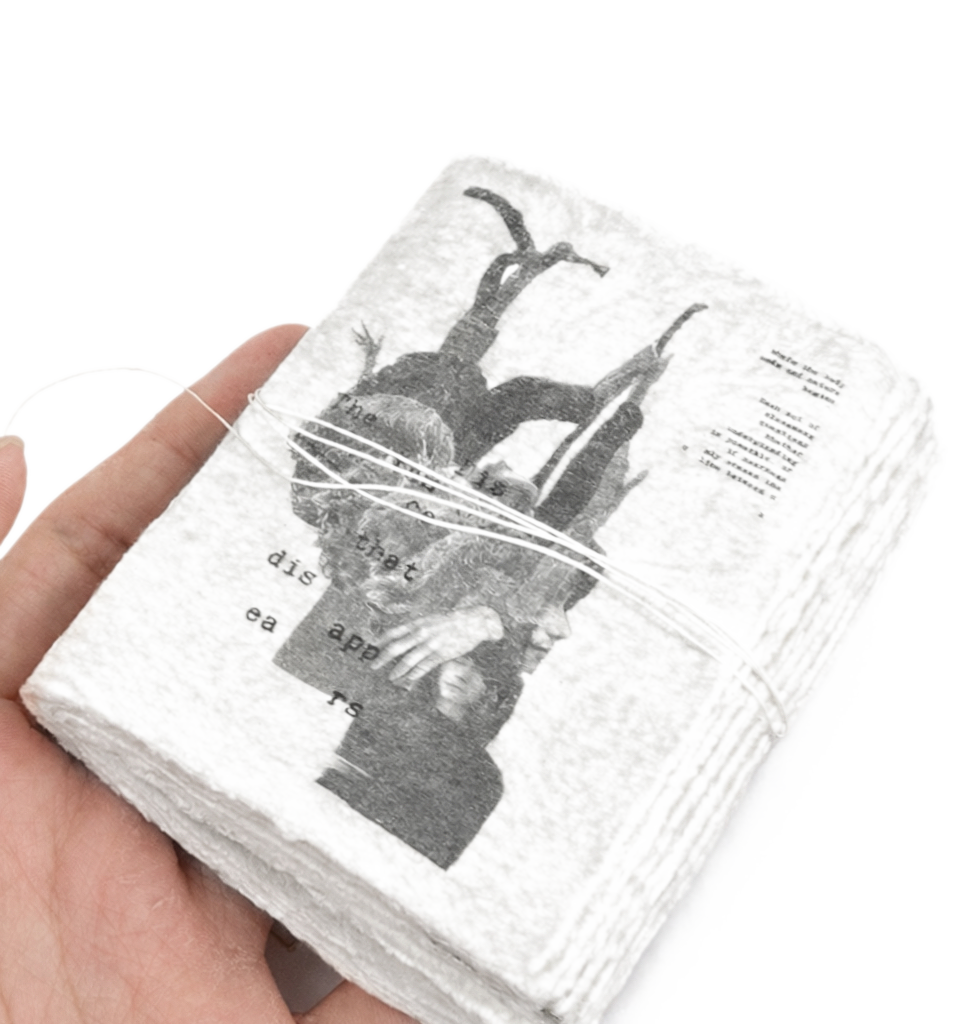
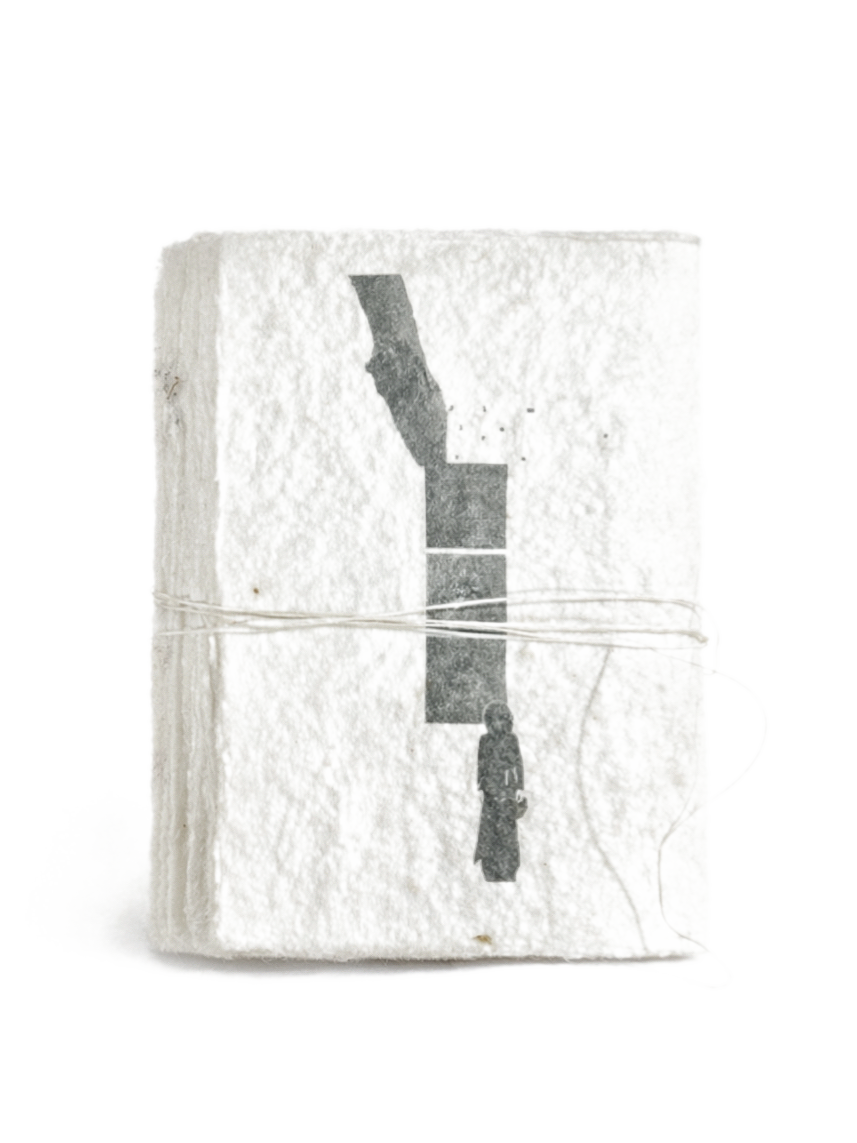
The zine, held in the hand, wound with thread — bark and figure visible across the front.
Plate 01 · bound with thread, held
II · Suspension
Bark, branches, bodily details — suspended between pages, never forming a complete whole.
Cover with branch silhouette, bound with thread. i.  bound · with thread
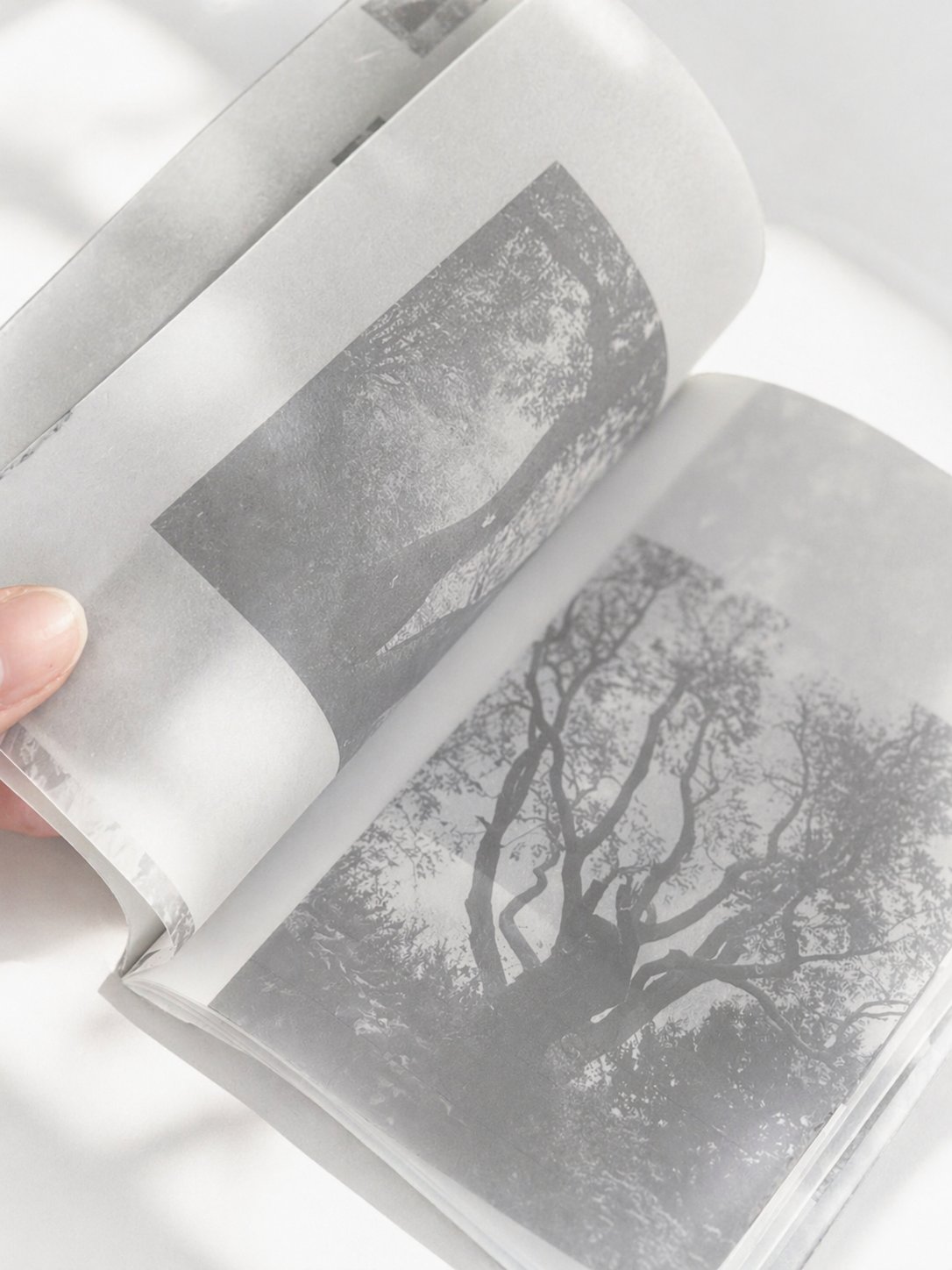
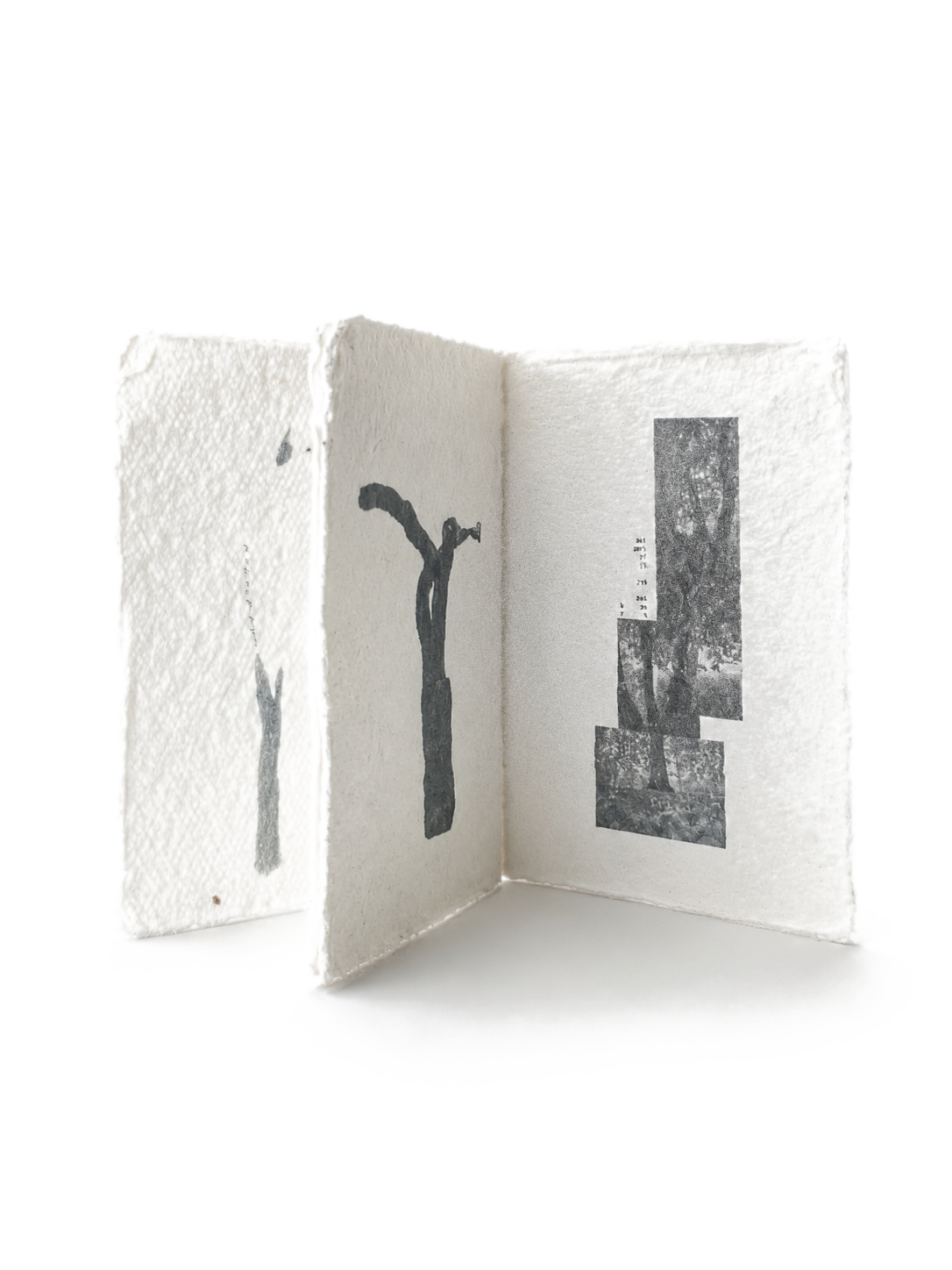
Inner spread — branches and bodies superimposed across two pages. ii.  spread · branches, body
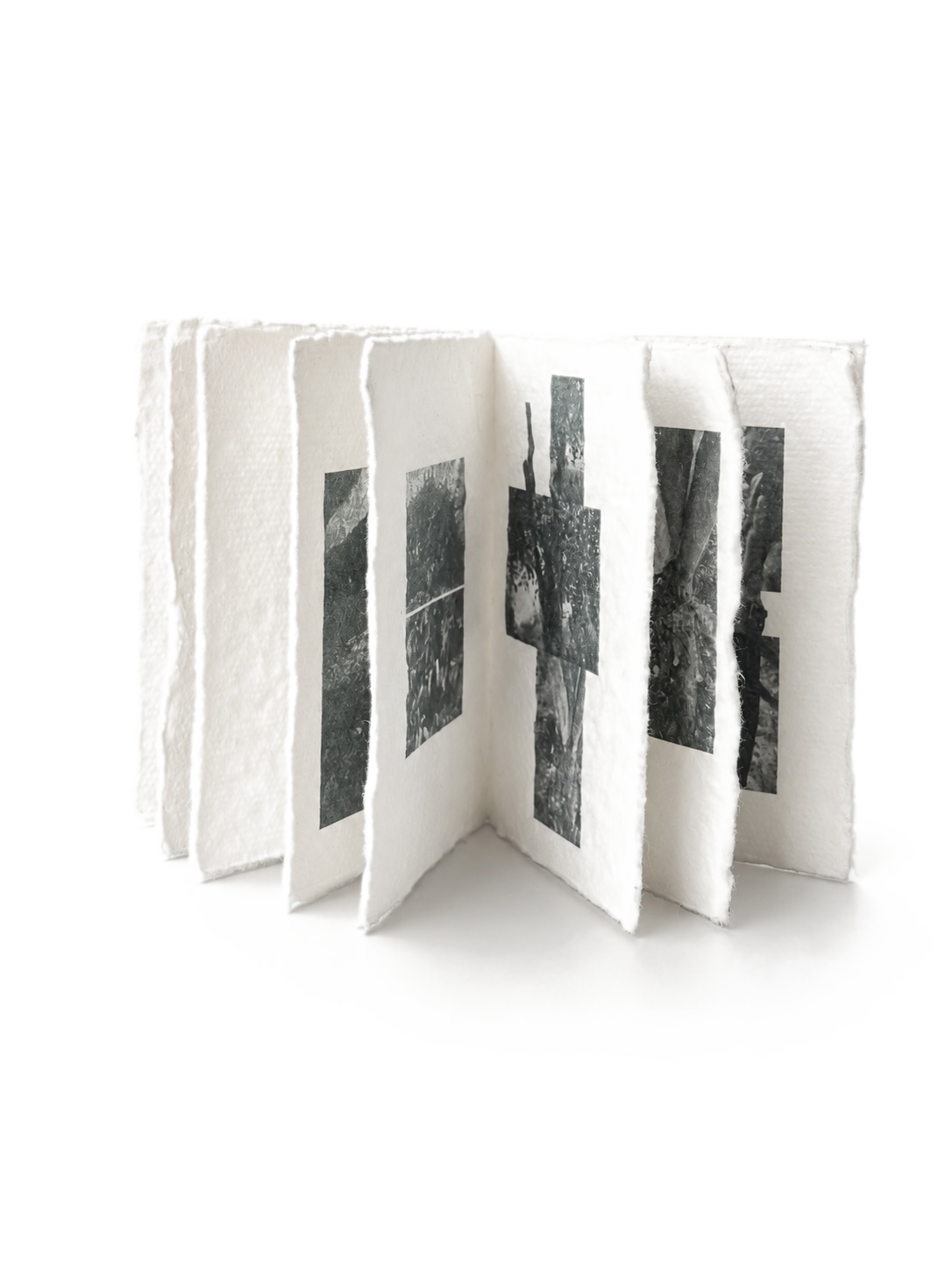
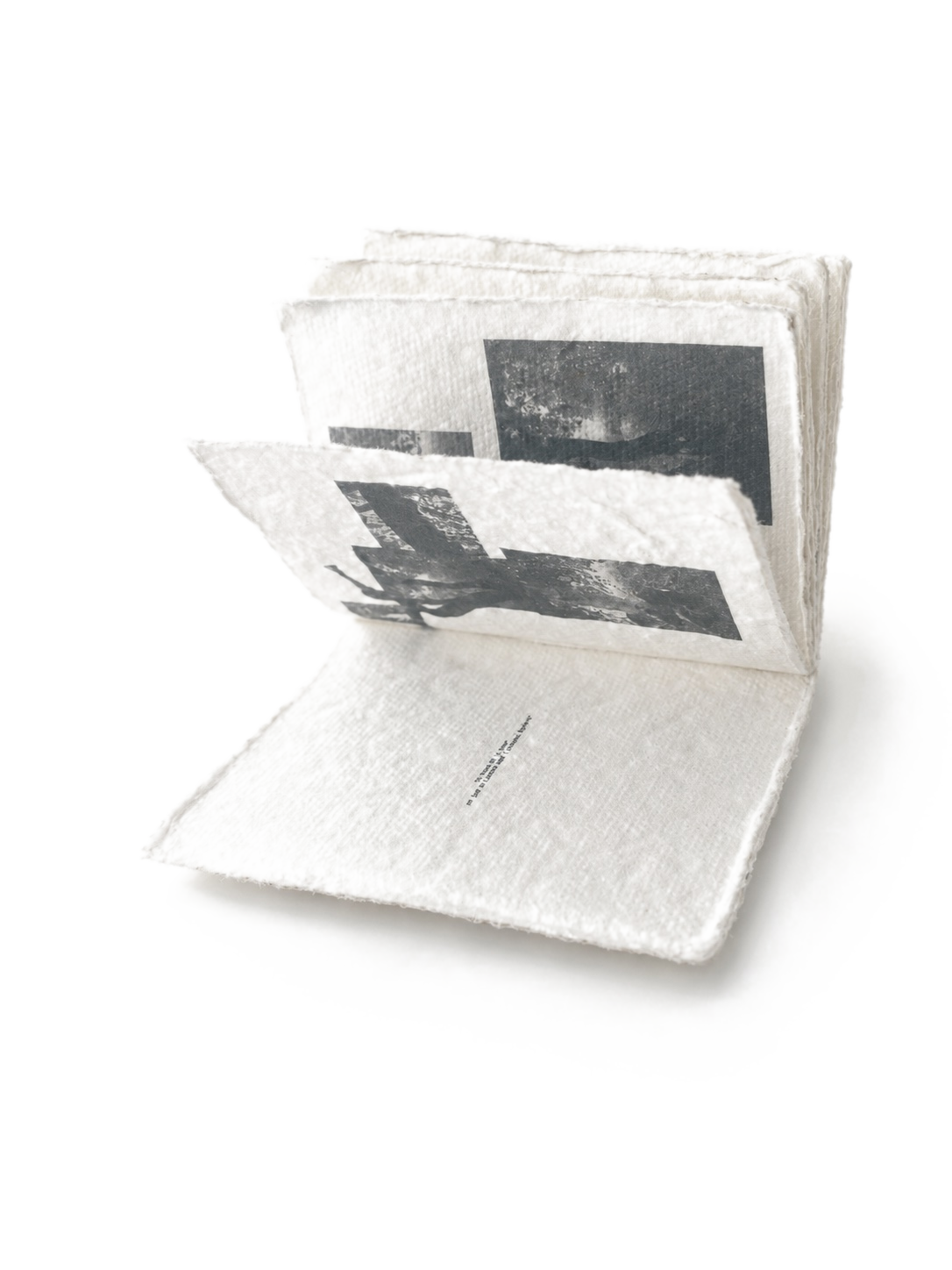
The zine fully unfolded, standing accordion-style. iii.  fan-fold · standing
The zine held in the hand, wound with thread. iv.  in hand · held
Inner spread — a long branch on one page, fragmentary text on the facing page. v.  branch · facing poem
Spread with foliage and a small figure half-hidden in undergrowth. vi.  spread · undergrowth
The zine zig-zag folded open — three pages visible, trees standing upright. vii.  zig-zag · standing trees
Cover laid flat — the title fragments, 'the space that disappears'. viii.  cover · the space that disappears
The zine half-open — colophon and a fragmented branch image visible. ix.  opening · colophon
III · Resolution
Scaled to the palm and printed on recycled cashmere fibre, the zine invites intimate viewing — through both image and touch. Proximity, here, is something temporary, unstable, and unresolved.
Title
Approaching the Tree
Subtitle
Tactility and Suspension
Year
2025
Format
Zine · 7 × 10 cm
Paper
Cashmere fibre + cotton
Print
Monochrome inkjet
Binding
Hand-bound · thread
Edition
Artist's edition
Zhanyi · Hu
← back to the cabinet
Publication / 05 — Zine
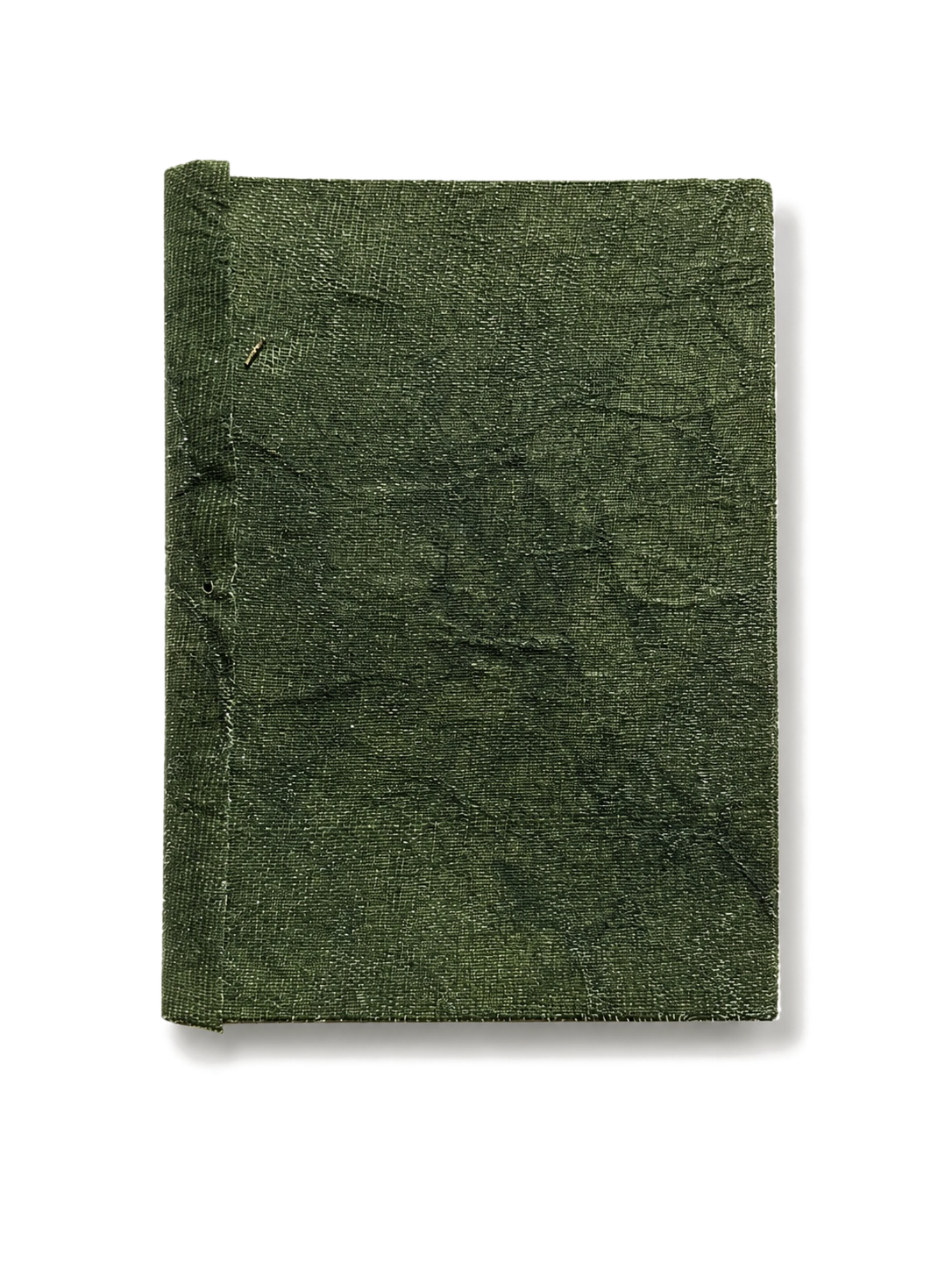
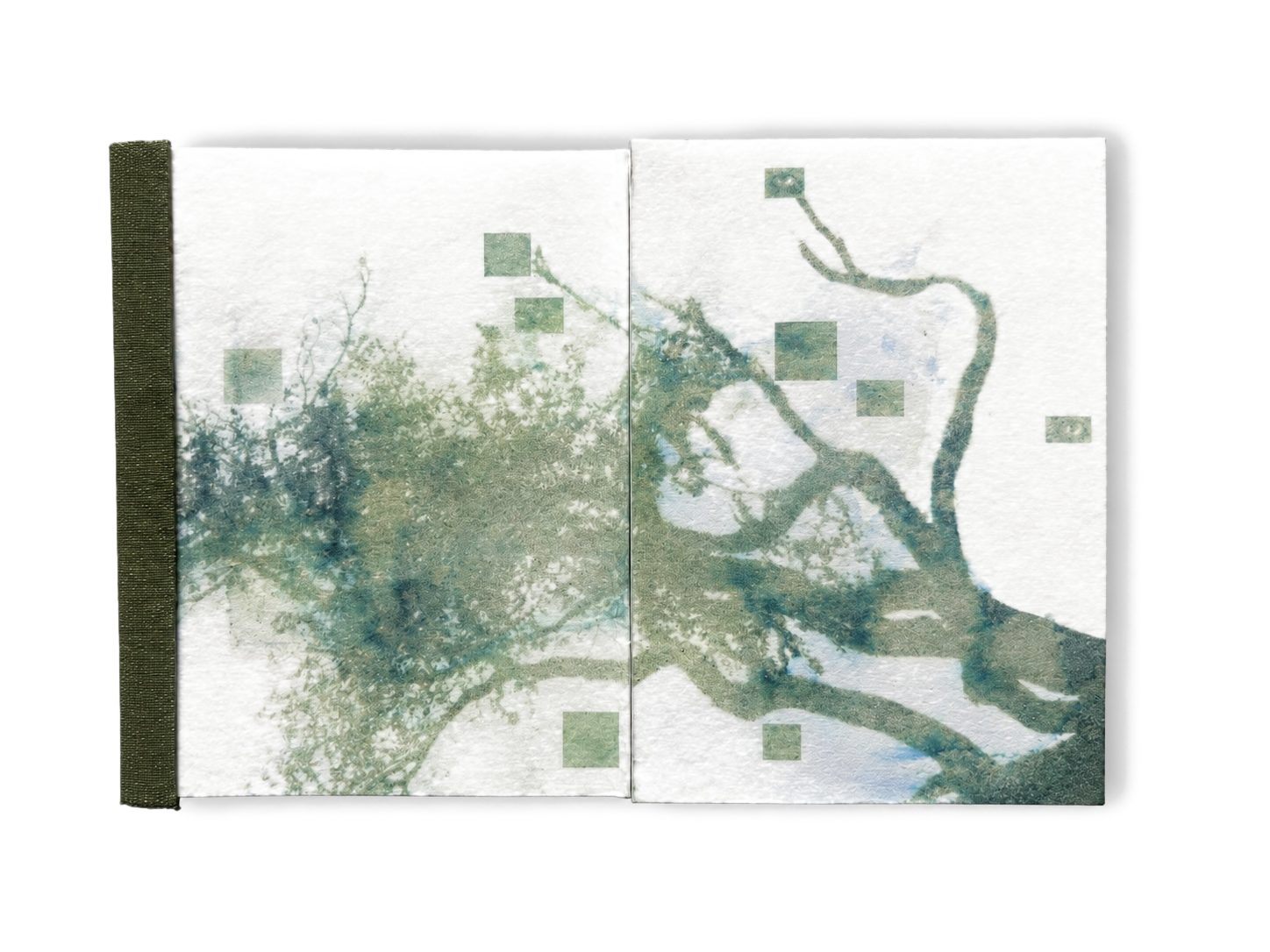
Traces Under Tension — moss-green textile cover, closed.
A zine · 2025

Traces Under Tension

Pigment disperses slowly through the fibres of the paper — edges loosen, forms drift, and boundaries gradually dissolve.
Format
Zine · 10 × 15 cm
Paper
Handmade pulp · long-fibre cotton
Print
Eco-pigment, dispersed on damp fibre
Binding
Hand-stitched · linen thread
Year
2025
scroll — and the book begins to open
Open spread — moss-green pigment dispersed across handmade paper.
I · Dispersal
The image does not remain stable — pigment moves with the breath of the paper.

I attempt to reconstruct my relationship with nature through colour, texture, and fragmented forms. Pigment is left to find its own path: it pools, retreats, blooms into the fibres. What I place is only half of what appears.

Fragments are cut apart, displaced, and reconnected through the folds of the book — leaving the work suspended between formation and dispersal.

II · Tension

The thread passes through the page —
both binding and exposing the instability between things.

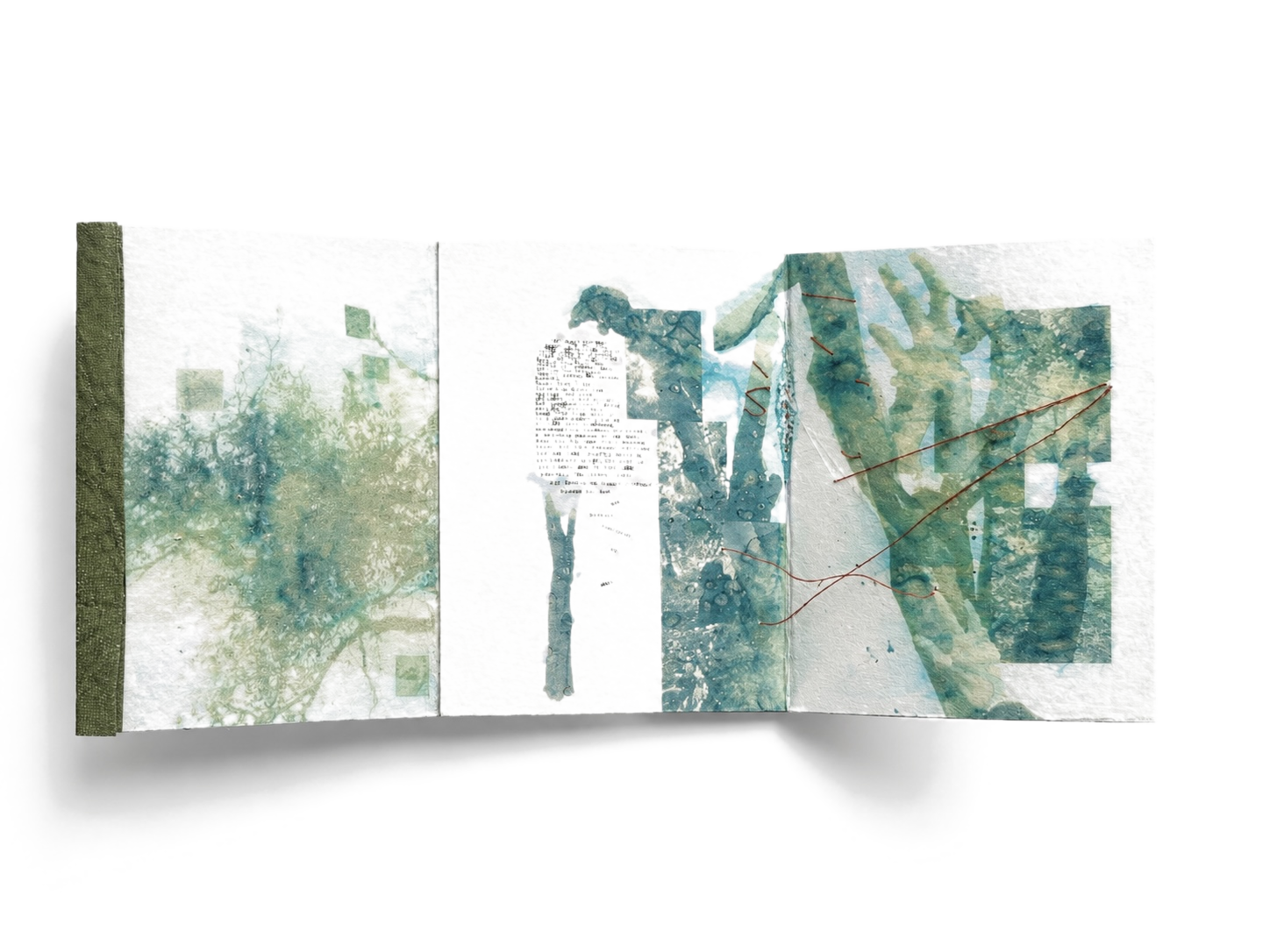
Three-panel fold-out — pigment fields stitched together with red linen thread.
— line as connection Threads pass through the pages, temporarily binding these scattered traces together. The line functions both as connection and tension — linking separated elements while exposing the instability of their relationship.
— reading with the hands As the pages unfold, viewing moves across colour, empty space, folds, and stitched surfaces in a slow and shifting rhythm.
— suspended state Rather than presenting nature as a complete image, I attempt to retain a state of uncertainty and proximity — like a trace only briefly held in place.
III · Colophon

“The work remains suspended between human intervention and natural process — like a trace only briefly held in place.”

Title
Traces Under Tension
Format
Zine · 10 × 15 cm
Paper
Handmade · cotton fibre pulp
Process
Pigment dispersion · cut · displaced · re-stitched
Thread
Hand-sewn linen, passed through every signature
Year
2025
Zhanyi · Hu
← back to the cabinet
Publication / 06 — Artist Book
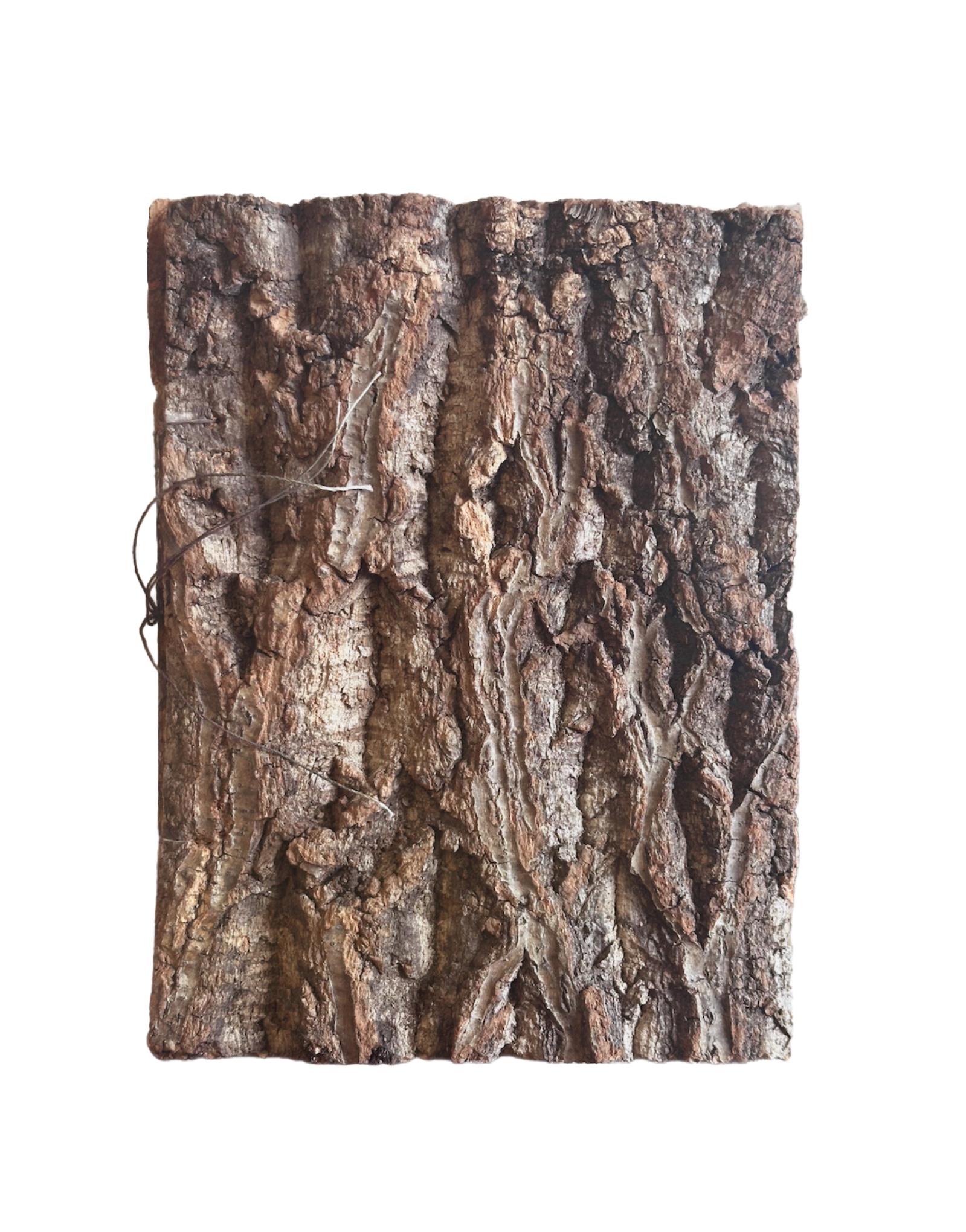
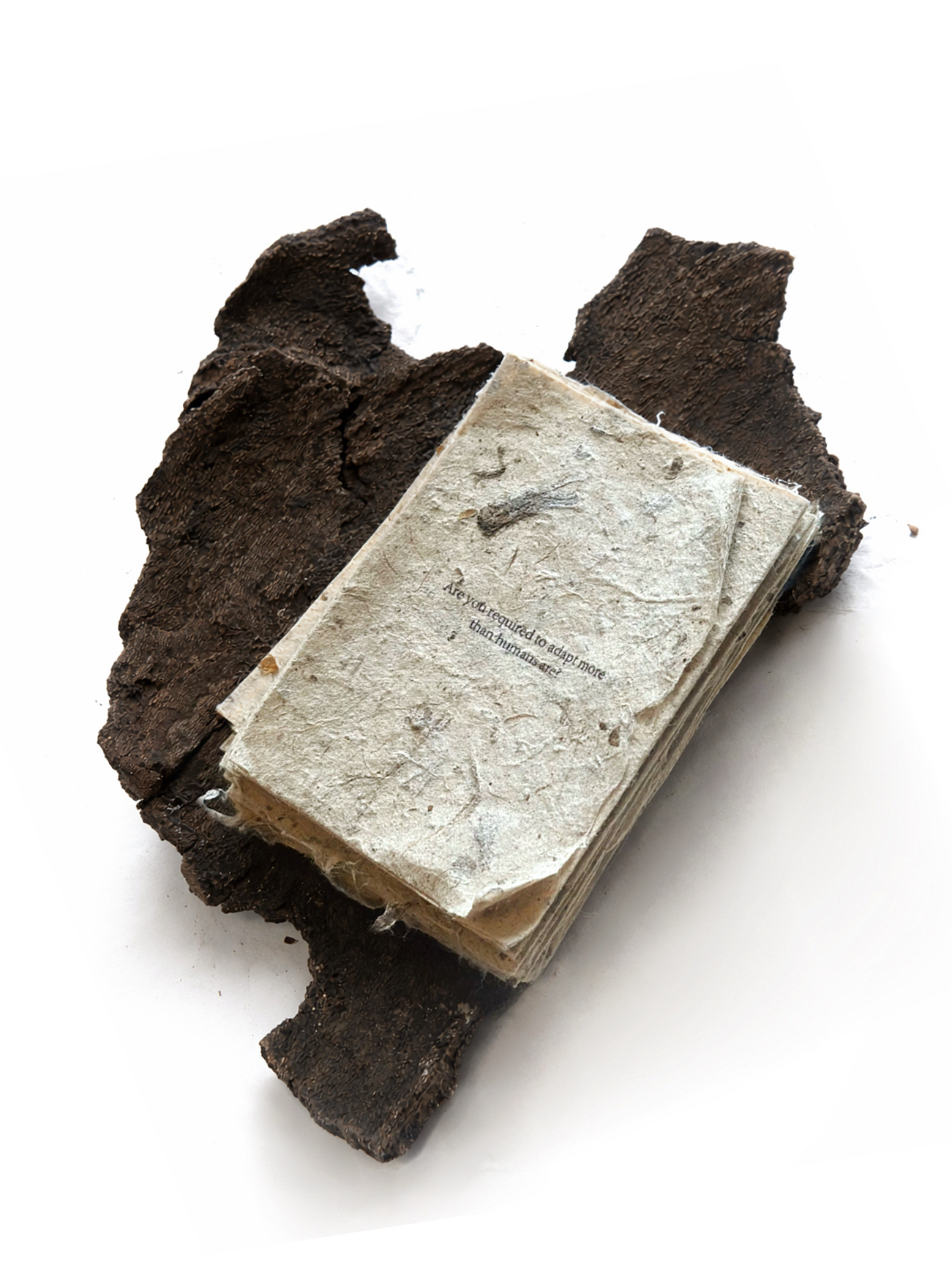
Bark fold — oak bark cover, bound with linen thread and twig fragments.
oak bark · linen thread · 2025
An artist book · 2025

A book that wears its origin on the outside — oak bark for its skin, handmade pulp for its breath — and asks, page by page, whether to come closer is to understand, or only to disturb.
Format
Artist book · 17 × 22 cm
Cover
Oak bark, lashed with linen and twig
Paper
Handmade pulp · ash + plant fibre inclusions
Text
Typewriter, pressed directly into the fibre
Year
2025
scroll — to open the bark
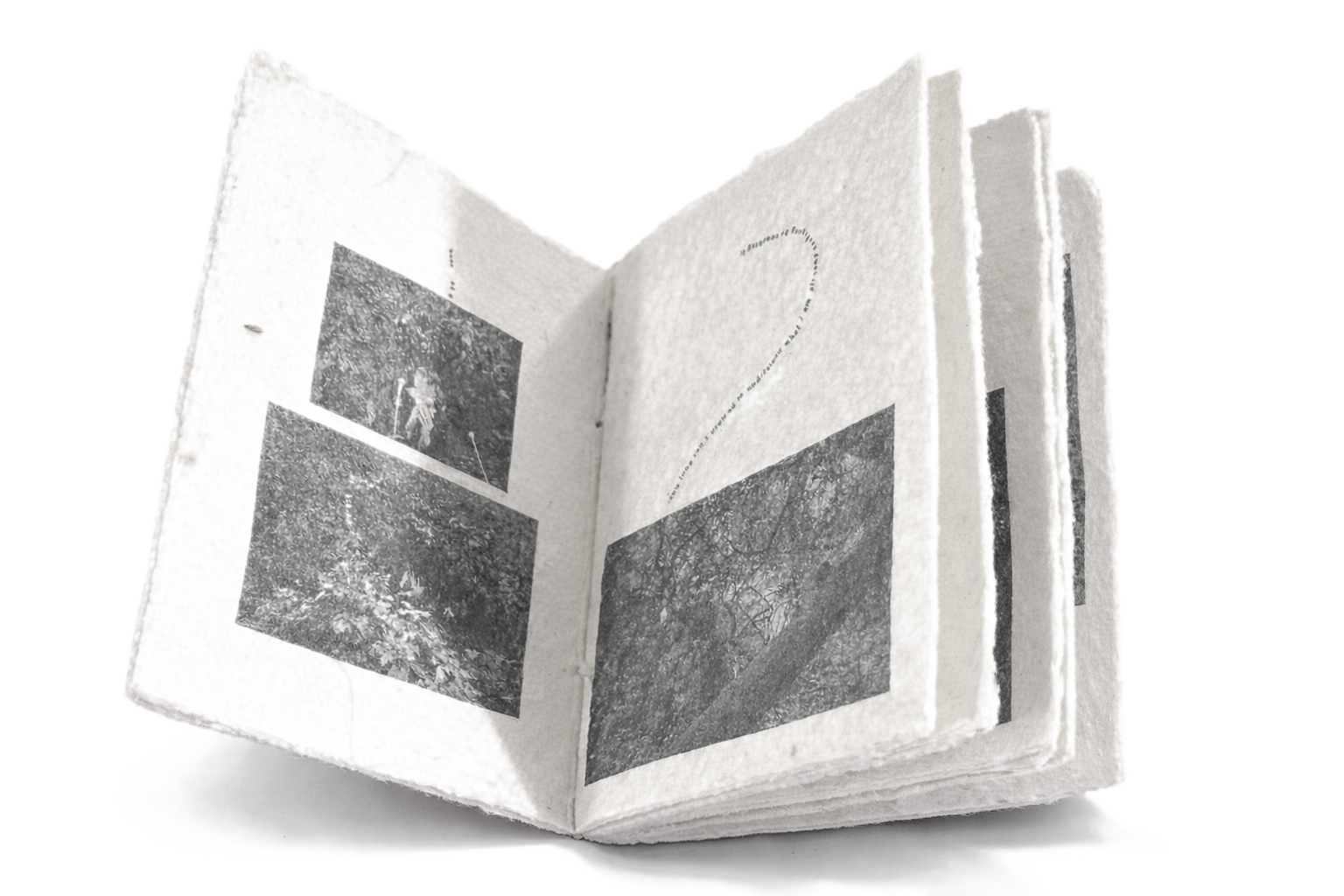
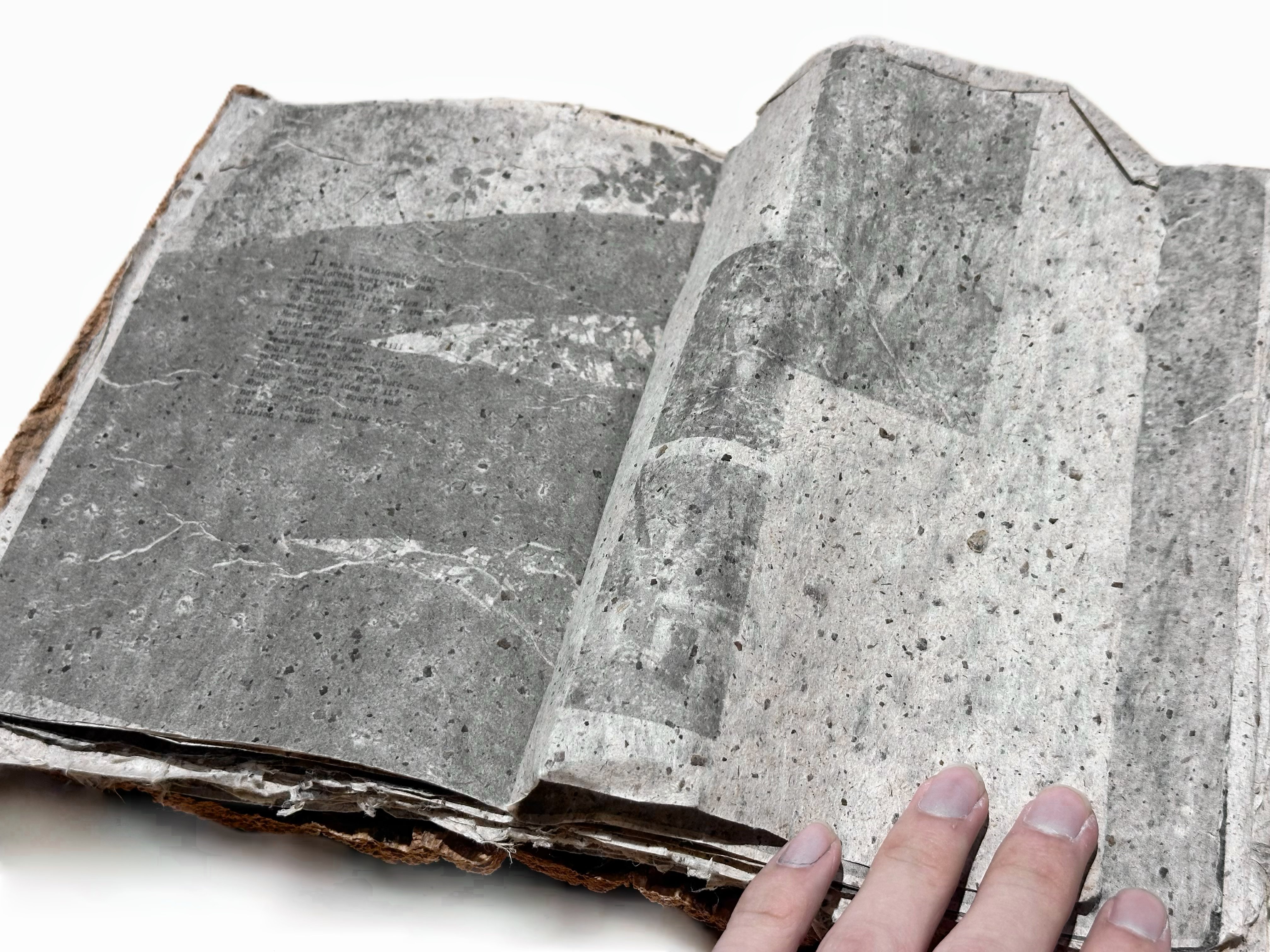
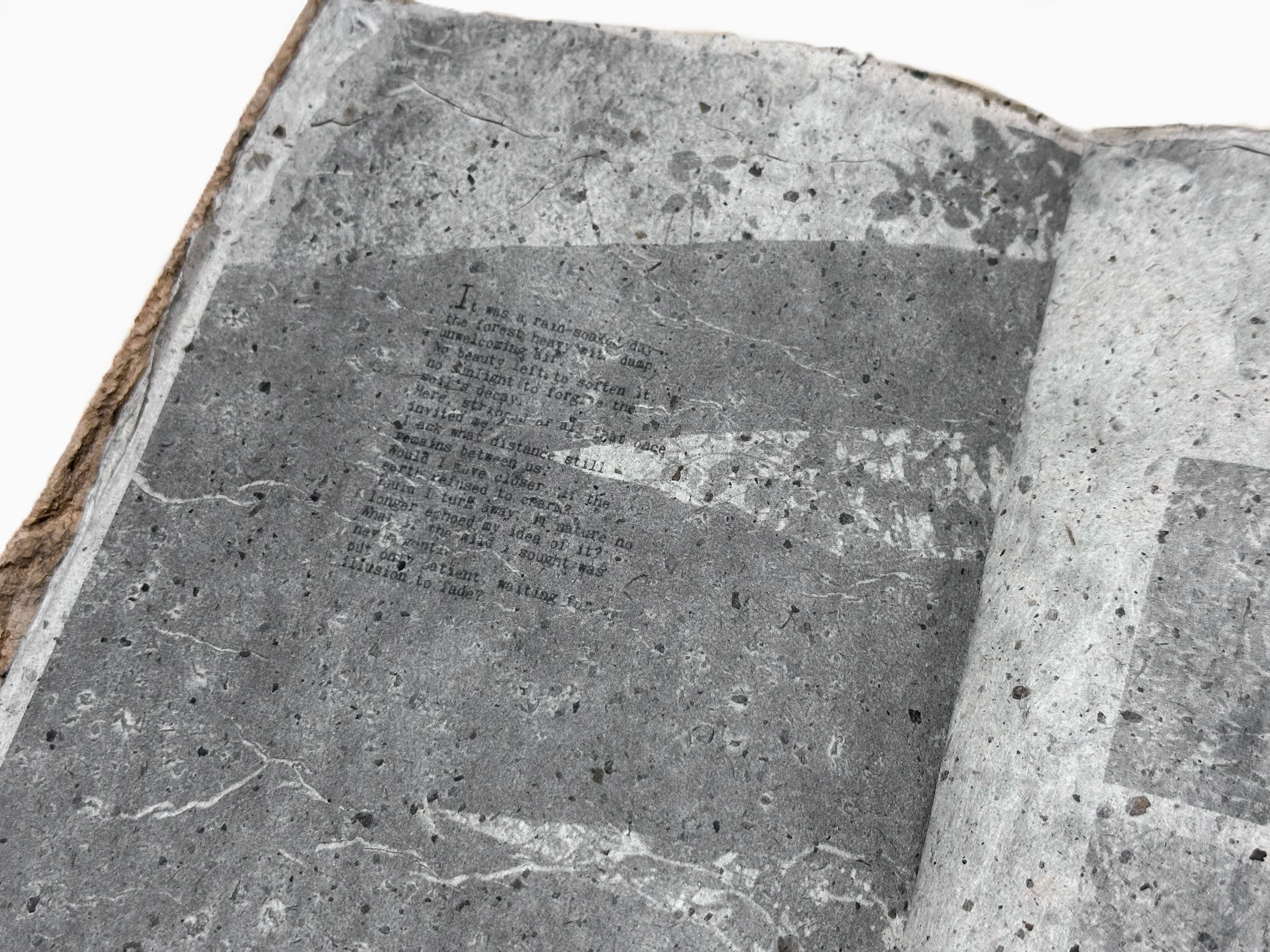
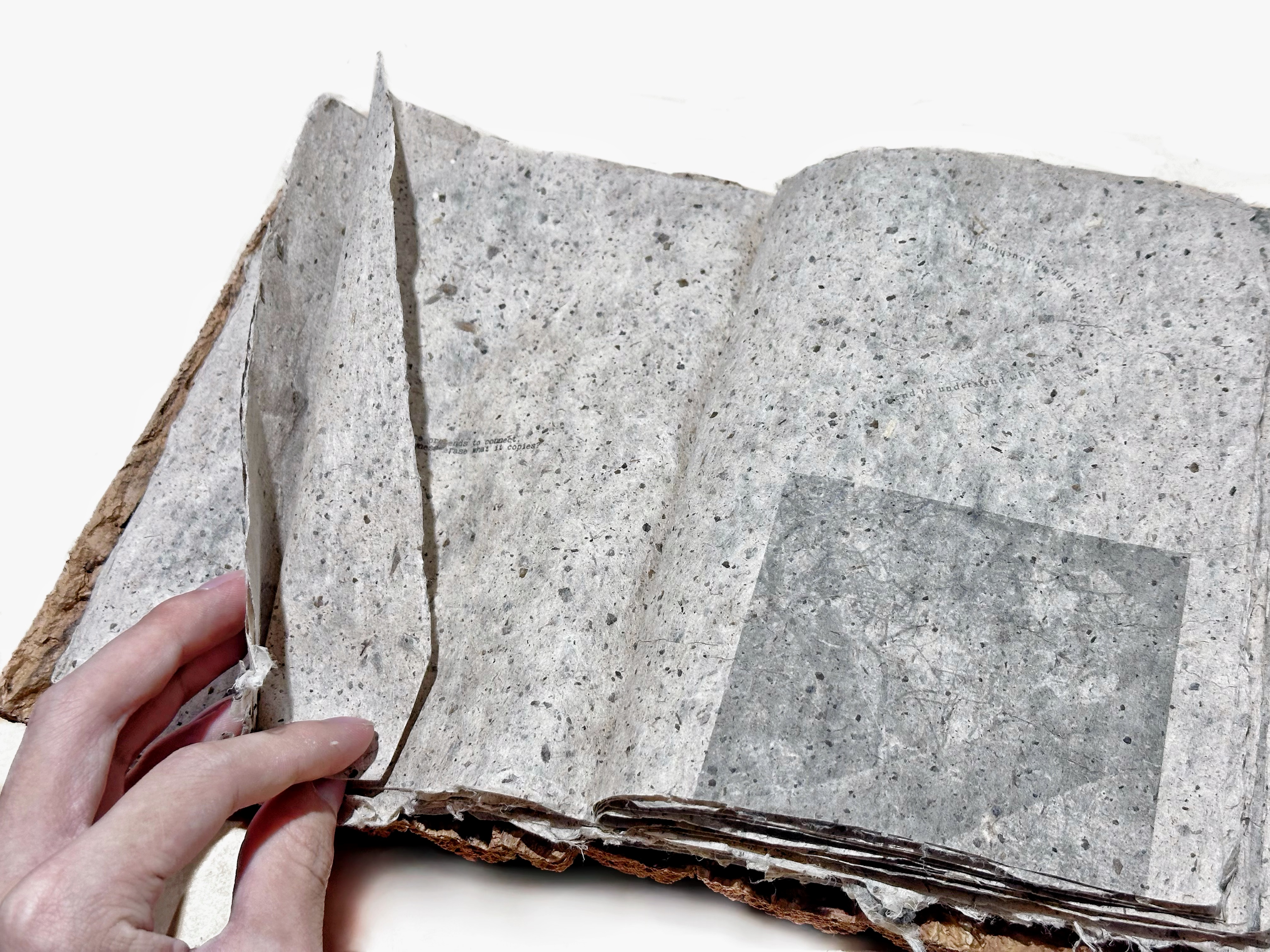
An early spread — the bark hinges open onto grey handmade paper.
I · The Opening
The bark hinges open like a wound healing in reverse — and the forest is already inside.

The cover is a piece of fallen oak bark, lashed to the spine with raw linen and a sprig of dried twig. It is not a metaphor for the forest; it is a fragment of it, carried indoors and still damp at the edges.

The pages inside are pulled from rag and plant pulp by hand — uneven in weight, flecked with seeds and ash, refusing the smoothness of any printed book. The first poem is pressed directly into this surface with a manual typewriter, so the keys leave a small bruise in the fibre.

II · The Spreads

Four poems pressed into the grey pulp — each one closer, each one further, from what they were trying to touch.

Spread one — a typewritten stanza pressed into damp grey pulp.
spread one · rain-soaked day
It was a rain-soaked day, the forest heavy with damp, unwelcoming air. No beauty left to soften it, no sunlight to forgive the soil's decay. Here, stripped of all that once invited me, I ask what distance once remains between us, still. Would I have closer if the earth refused to crack? Could I turn away, if nature no longer echoed my idea of it? What if the "wild" I sought was never wanting, but only patient, waiting for illusion to fade?
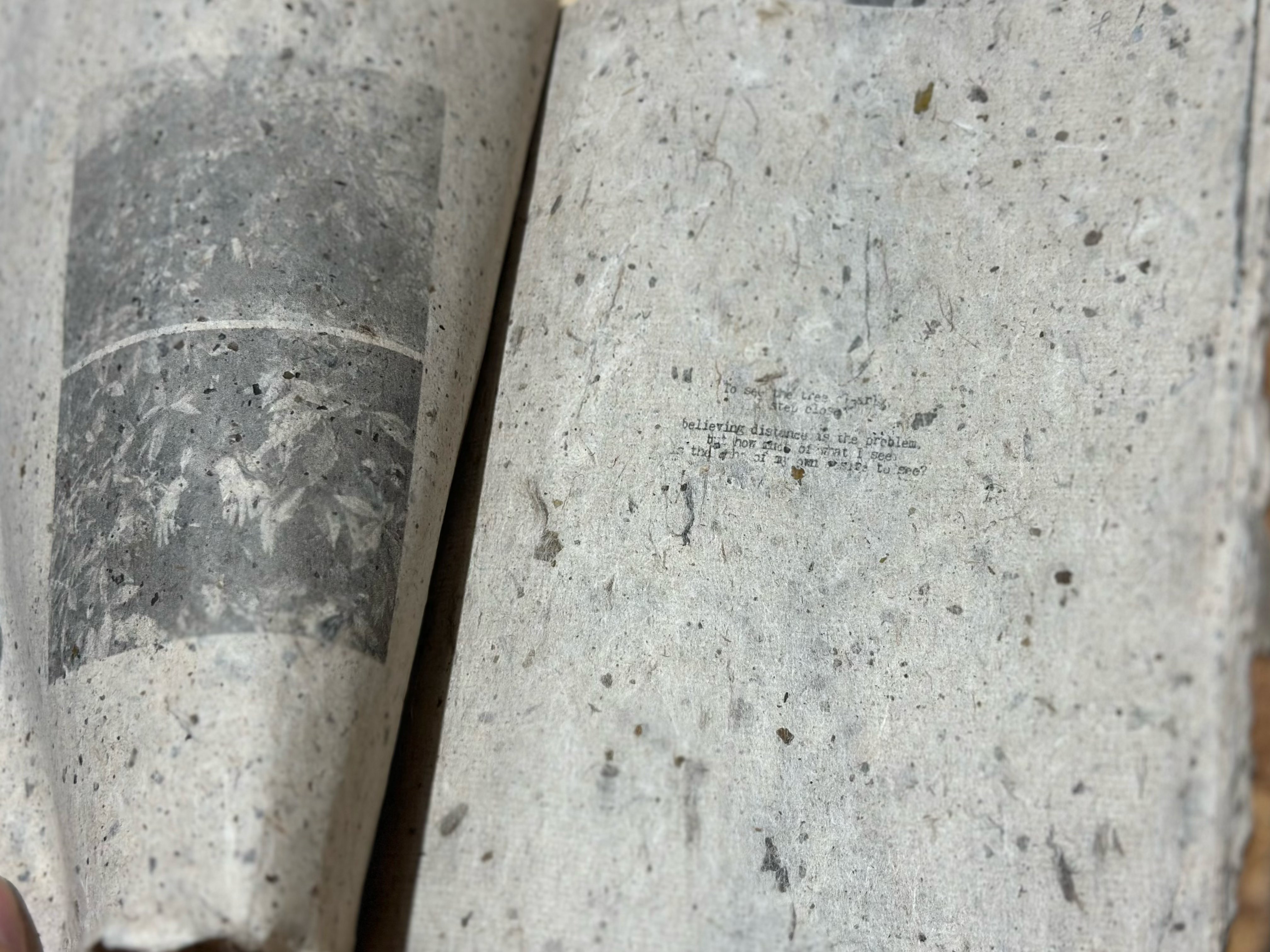
To see the trees clearly, I step closer. Believing distance is the problem. But how much of what I see is the echo of my own desire to see?
Spread two — a leaf print on the left page, six lines of verse on the right.
spread two · desire to see

Not part of it —
yet not apart.

Spread three — close detail, typewriter fragments scattered down the page.
spread three · the fragments
not part of it, yet not a part. The words break down the closer they get — as if grammar itself refuses to belong.
Closeness feels like empathy, but who decides what is shared? The forest does not ask to be understood. It only asks to be left a little un-named.
Spread four — a folded sheet of pulp opens onto a stanza about closeness.
spread four · who decides what is shared
Spread five — final pages, a small grey square inset in the paper.
spread five · what it touches
Every attempt to connect, does it erase what it copies? Every attempt to understand, does it interrupt what it is touching?

The book closes around its question the way bark closes around a wound — not to hide it, but to keep it alive.

III · Colophon

"What if the wild I sought was never wanting — but only patient, waiting for illusion to fade?"

Title
Bark fold
Form
Bound artist book · 17 × 22 cm
Cover
Salvaged oak bark · linen lashing · dried twig
Paper
Hand-pulled pulp · cotton rag · plant + ash inclusions
Text
Manual typewriter, pressed directly into wet-finish paper
Pages
32 (5 illustrated spreads + colophon)
Year
2025
Zhanyi · Hu
← back to the cabinet
Publication / 07 — Artist Zine
fol. 001 — 100
100 Questions for a Tree — closed accordion zine, embraced by an oak-bark cover.
handmade mulberry paper · bark · 2024
An artist zine · 2024

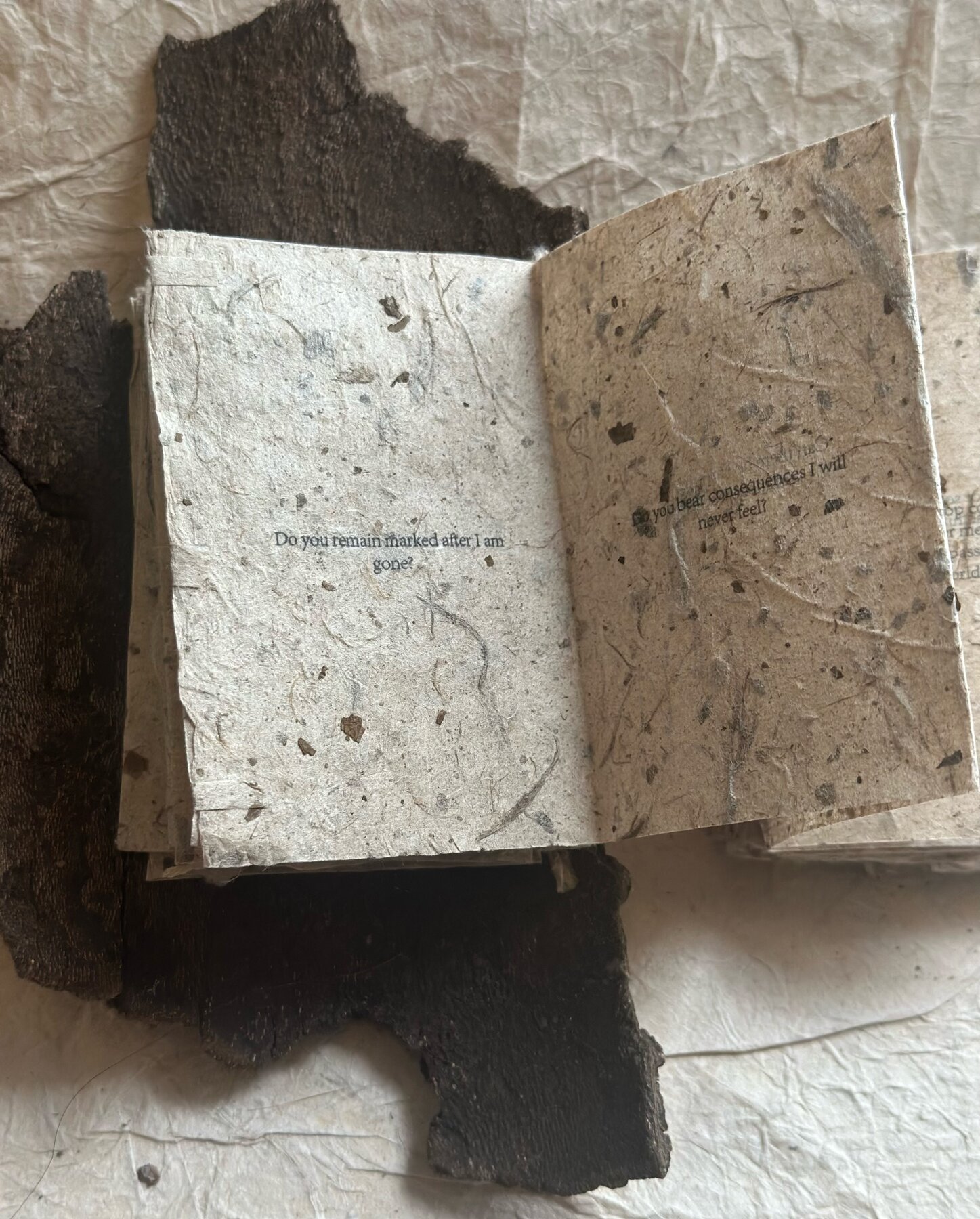
One afternoon, sat before a tree, one hundred questions written. Inquiry as method. Language placed before nature — and slowly running out of itself.
Format
Accordion zine · 10 × 14 cm
Cover
Real tree bark, hand-fitted
Paper
Handmade mulberry pulp · plant inclusions
Text
Typewriter strike, pressed into the fibre
Year
2024
scroll — to unfold
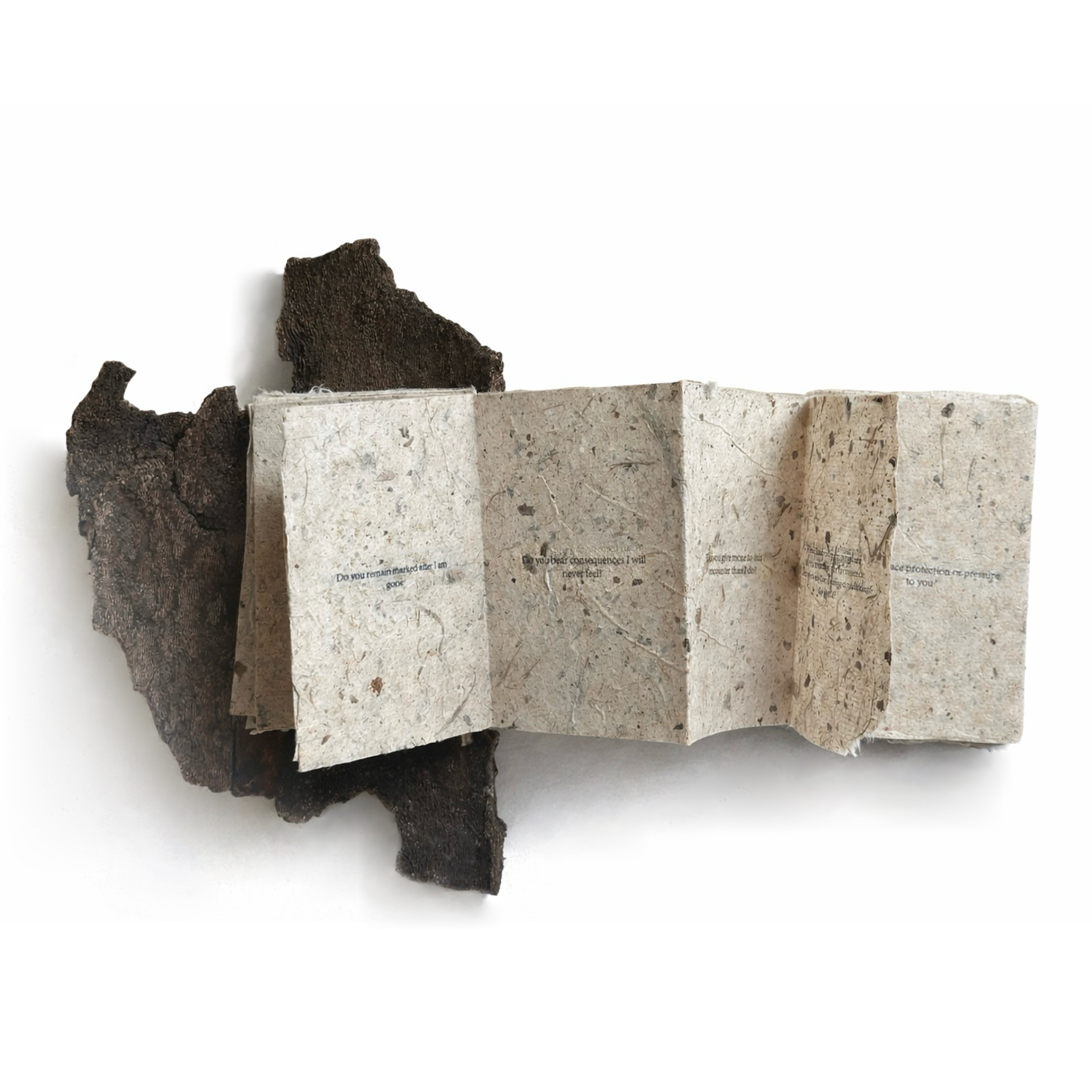
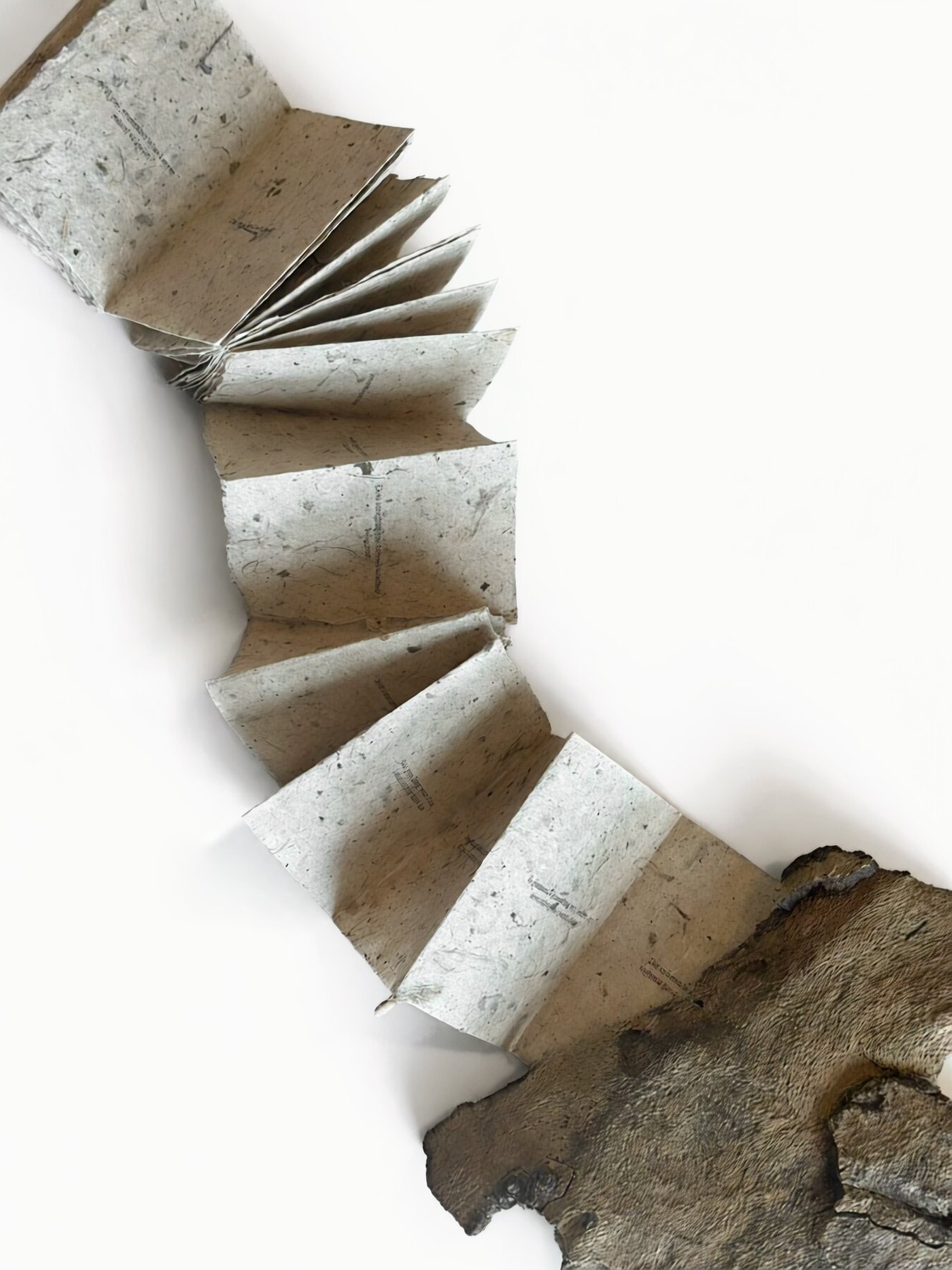
The zine unfolded across its full accordion — questions running through each fold.
I ·The Method
Questioning as a way of approach — staying with the tree, letting language meet its own edge.

I sat before a tree and spent an afternoon writing one hundred questions. The questions began as direct address — what are you, what do you need, what do you remember — and gradually moved toward something stranger, a kind of complicated reflection the tree was not actually being asked to answer.

The book is printed on handmade mulberry paper, whose fibres and vegetal traces hold the texture of organic growth. The cover incorporates real tree bark: rough, irregular, refusing the geometry of a book. An accordion binding lets the pages unfold continuously, so the questions extend through the rhythm of each fold.

Reading becomes a slow movement through unfolding space and time. The questions remain independent yet loosely connected; you can enter or pause at any point. I wanted the questioning to remain unresolved — language placed before nature, continuously circling the presence of the tree through the limited scale of human understanding.

II ·Six, of one hundred

The questions accumulate, then begin to turn back on the one who is asking.

  1. № 014Do you remain marked after I am gone?
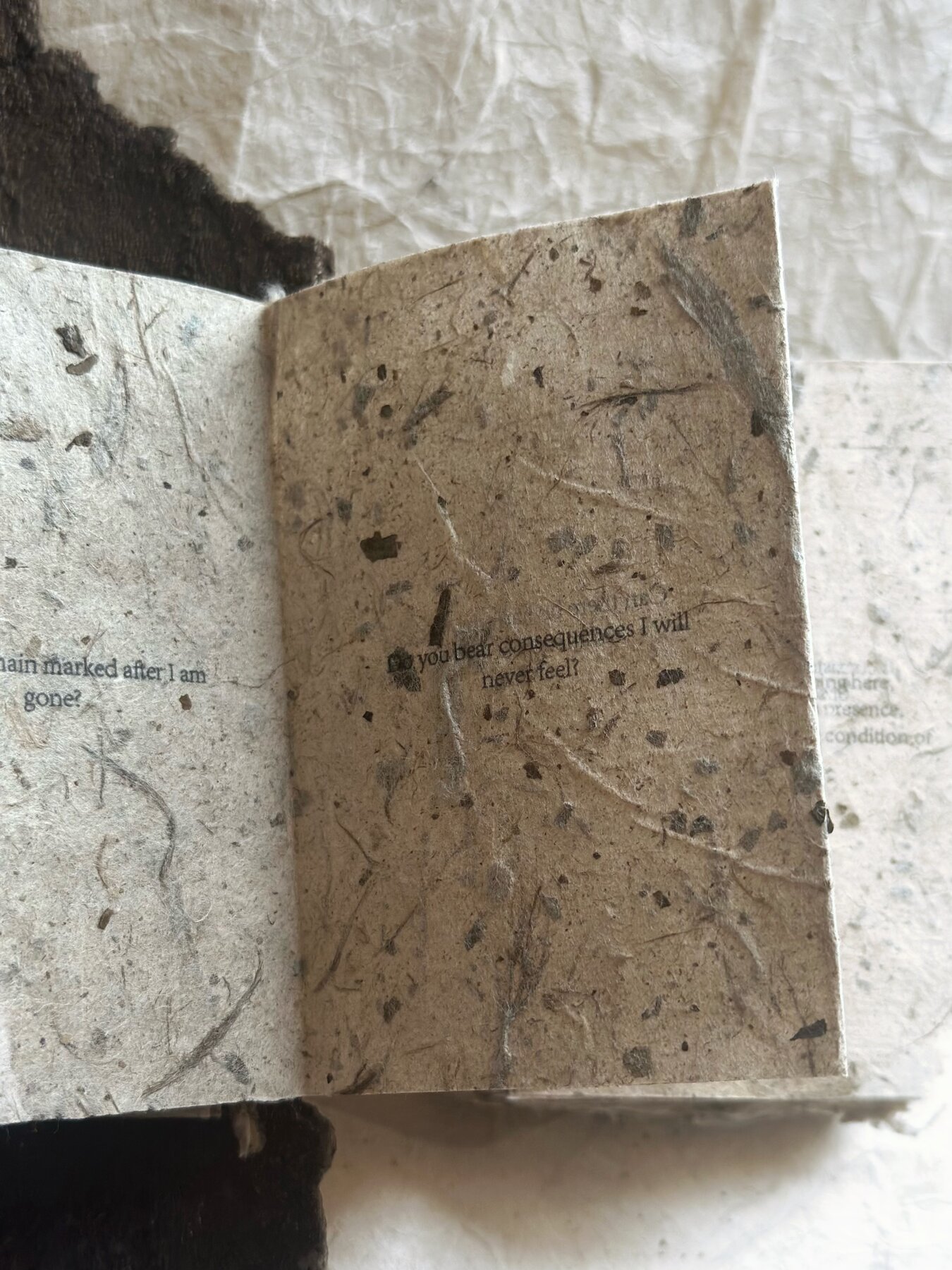
  2. № 027Do you bear consequences I will never feel?
  3. № 041Are you required to adapt more than humans are?
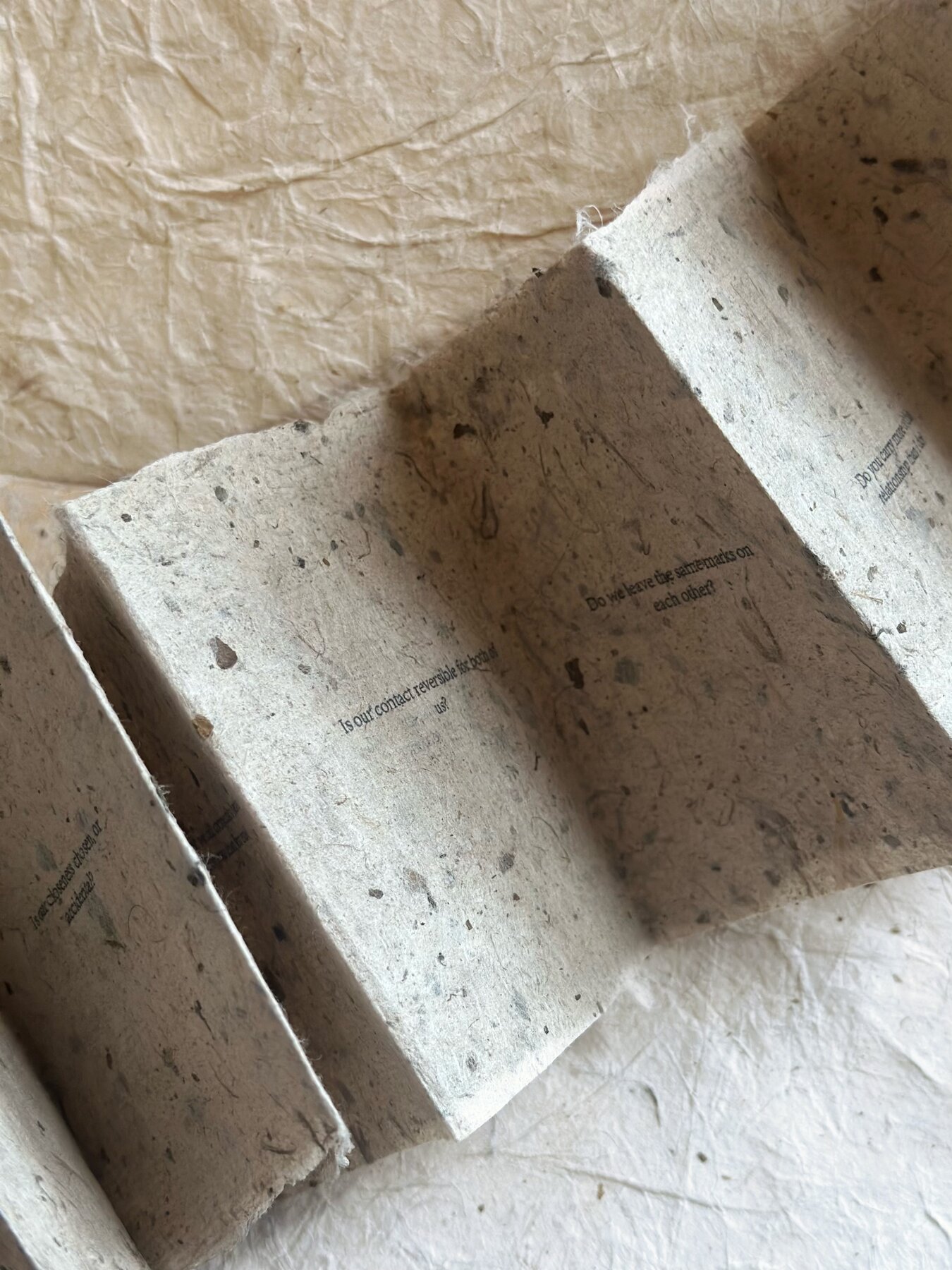
  4. № 056Is our contact reversible — for both of us?
  5. № 073Do we leave the same marks on each other?
  6. № 098Is my presence here a kind of protection — or a kind of pressure?
  7. — and ninety-four more, folded into the paper
An early spread — two cream pages held open against the bark cover.
spread one · the first pages, opened against the bark
A detail — typewriter ink pressed into mulberry pulp, fibres and seed flecks visible.
detail · the ink learning the grain of the paper
The accordion partly folded — three or four questions visible across consecutive panels.
three folds · questions held at the angle of their making
The zine fanned out — folds receding away from the bark, language thinning as it goes.
III ·The one that disappears

What is named can be answered. What is asked, only stays.

By the seventieth question the tree has stopped being a subject. It is just there, and the questioning has begun to fold back on the asker — every line a small admission of what cannot quite be said in front of something so plainly present.

The book itself follows that arc. The bark holds the opening; the pages thin as they unfold; the language presses lighter into the fibre near the end. Read all the way through, the zine ends where it began — closed, quiet, almost refusing to remain.

This is the one that disappears: a publication that does not want to be remembered as a publication. It wants to be left, like the tree was left, mostly to itself.

Zhanyi · Hu
← back to the cabinet
Publication / 02 — Polaroid Zine
fol. i — viii
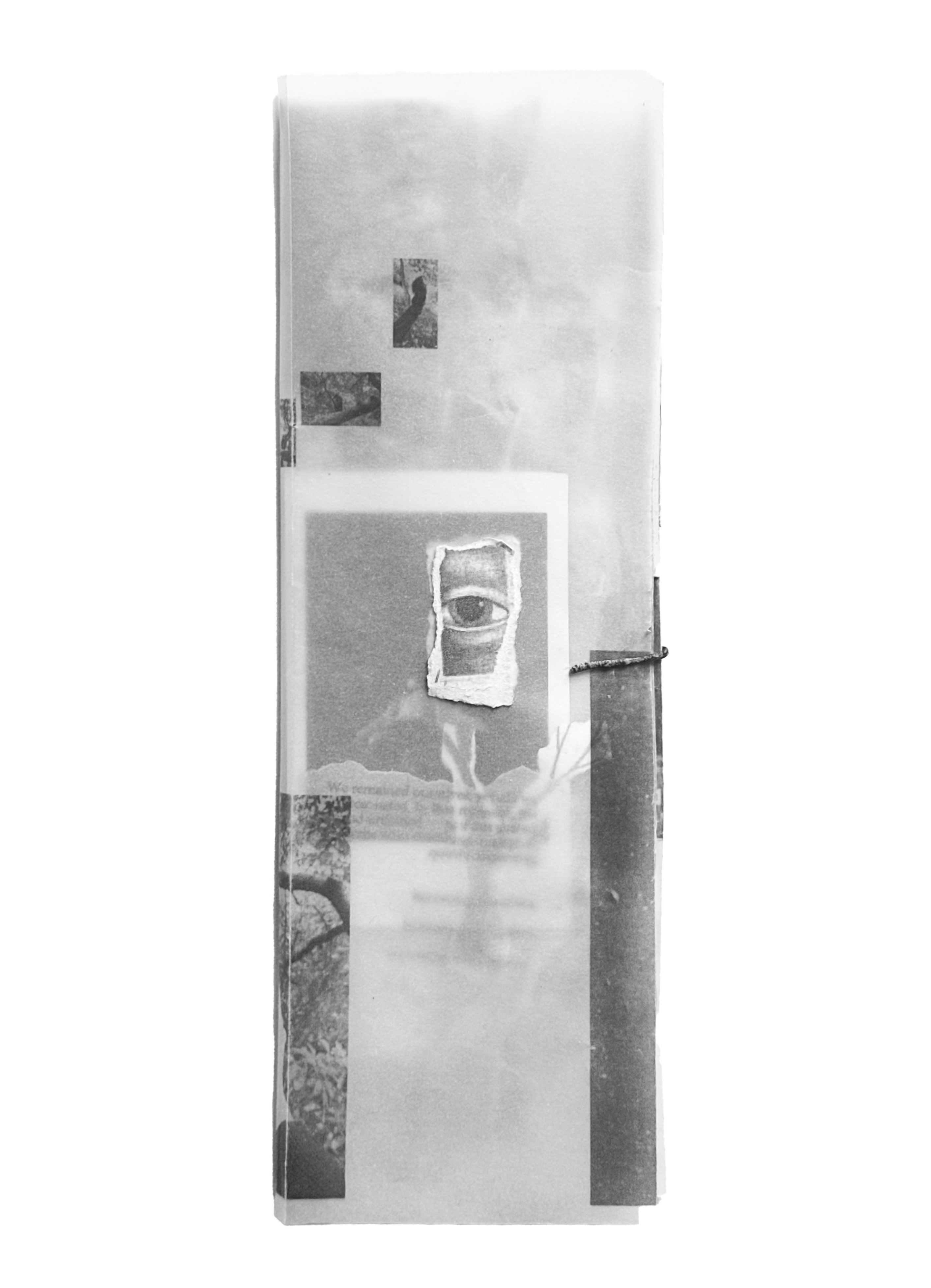
The closed zine — cover with a single torn-paper eye looking back through tracing paper.
i. — cover · the eye, before the page is turned
Zine — Polaroid · Tracing Paper

Nature,
developing Layers and the Gaze

A small zine of walking, pausing, and looking — shot on instant film and re-laid through tracing paper, so each image arrives twice: once as a moment, once as a veil already settling over it.

Form
Saddle-stitched zine, 8 spreads
Material
Polaroid prints, tracing paper
Bind
Linen thread, hand-sewn
Year
MMXXIV
scroll — the page is still developing
II ·The gaze, developing

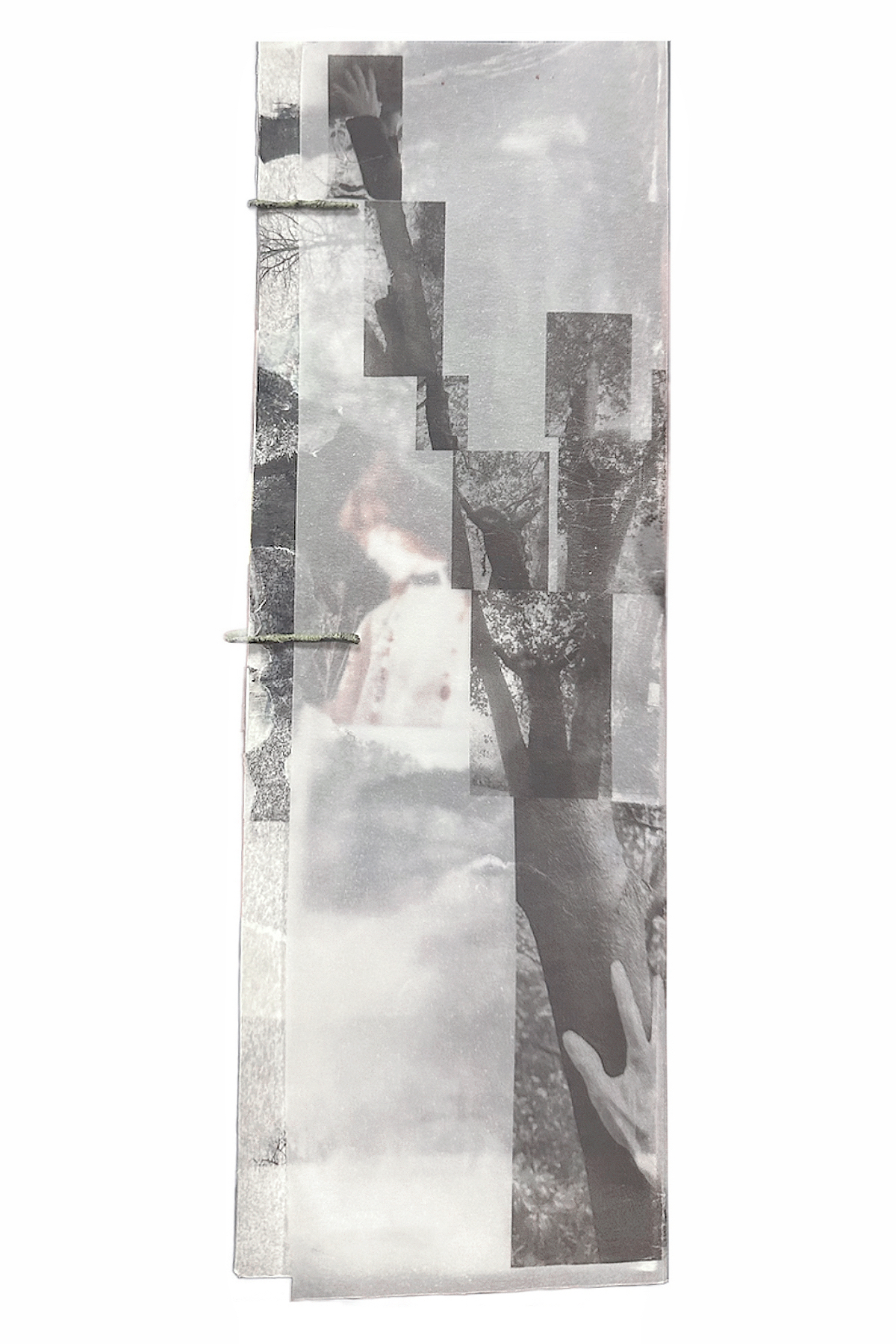
A spread — stitched-together strips of bark, sky, an arm, and a figure half-emerging through layers.
spread · the body re-appears through the trees
Detail — the torn paper eye reads through one full layer of tracing paper.
detail · the eye, seen through one veil
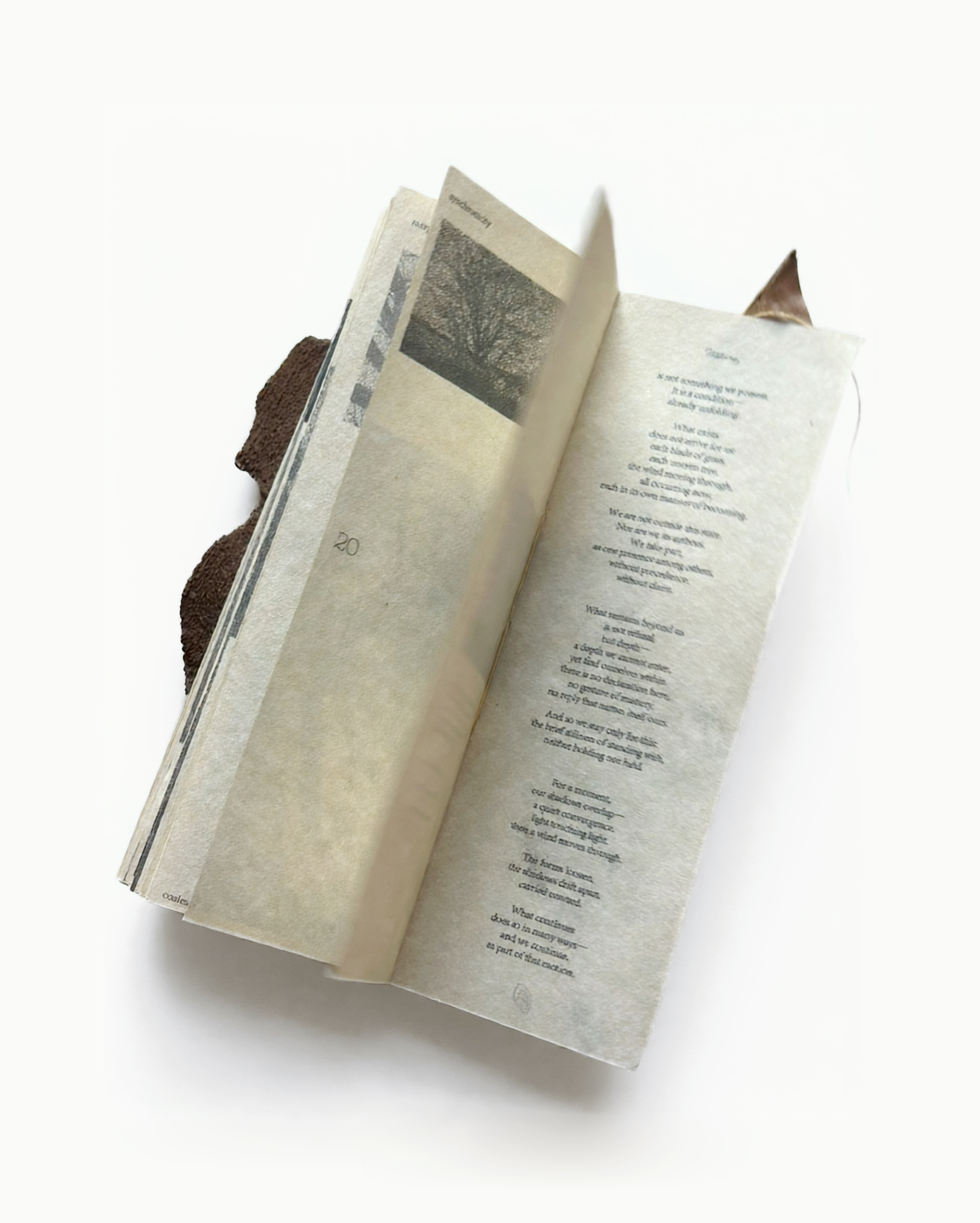
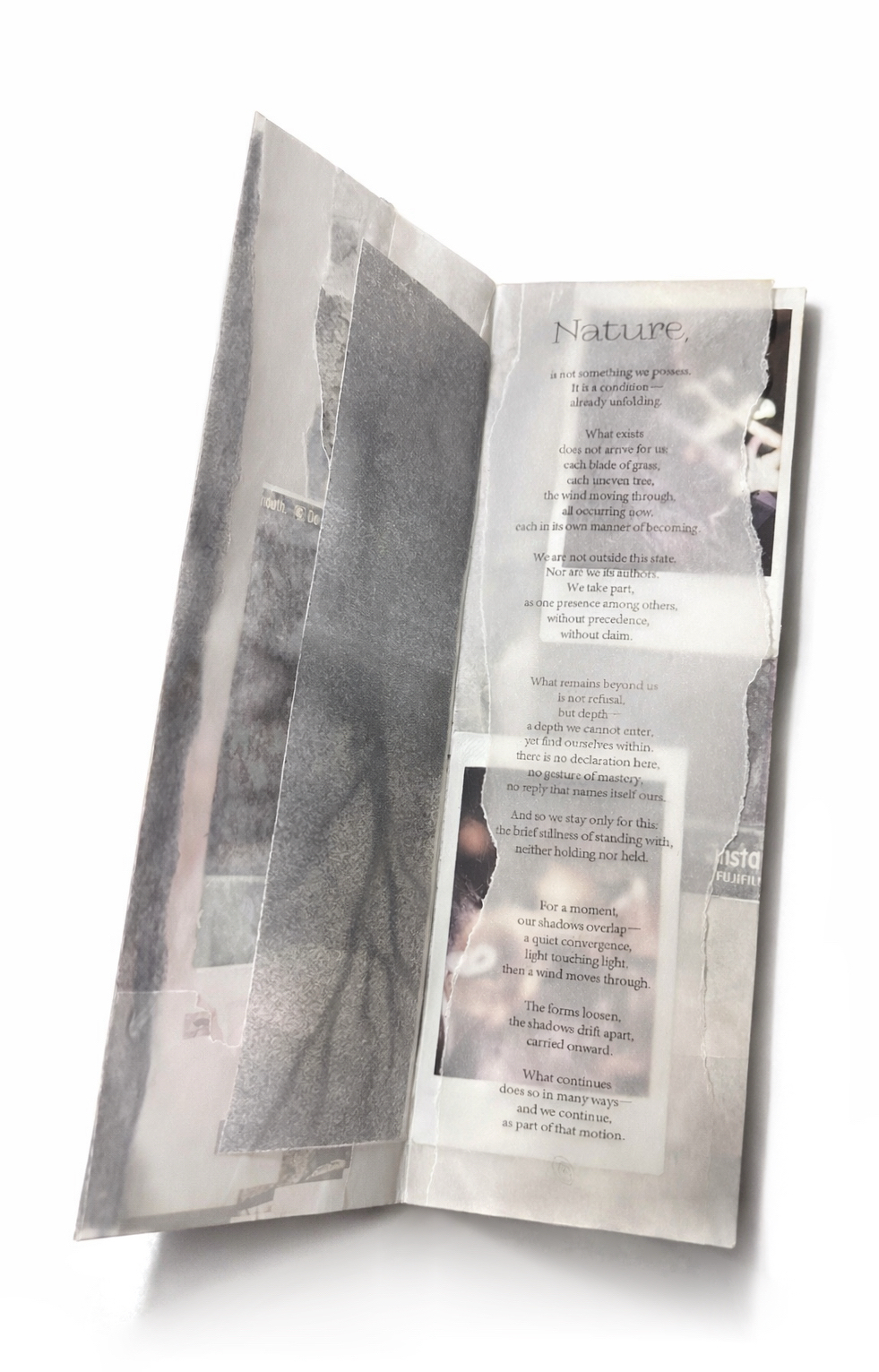
An opened spread — the poem 'Nature, is not something we possess' set in serif italic over a Polaroid collage.
opened spread · nature, is not something we possess
we are not
outside this state.
light touching light,
then a wind moves through.
the forms loosen,
the shadows drift apart —
carried onward.
The zine at rest on a white field — closed, tracing-paper wrapped, threads visible at the spine.
IV ·And we continue

What remains beyond us
is not refusal, but depth.

The zine is meant to be read out of order — the gaze drifts, the layers slide. Tracing paper holds the image at the angle of its making and lets the next page show through, so two moments are present at once.

Nothing is finished here, and nothing claims to be. The eye on the cover is also the eye that closes it.

Zhanyi · Hu
← back to the cabinet
Publication / 03 — Accordion Zine
fol. i — xii
Zine — Suspension · Accordion

Cicada,
in negative Dancing like foliage

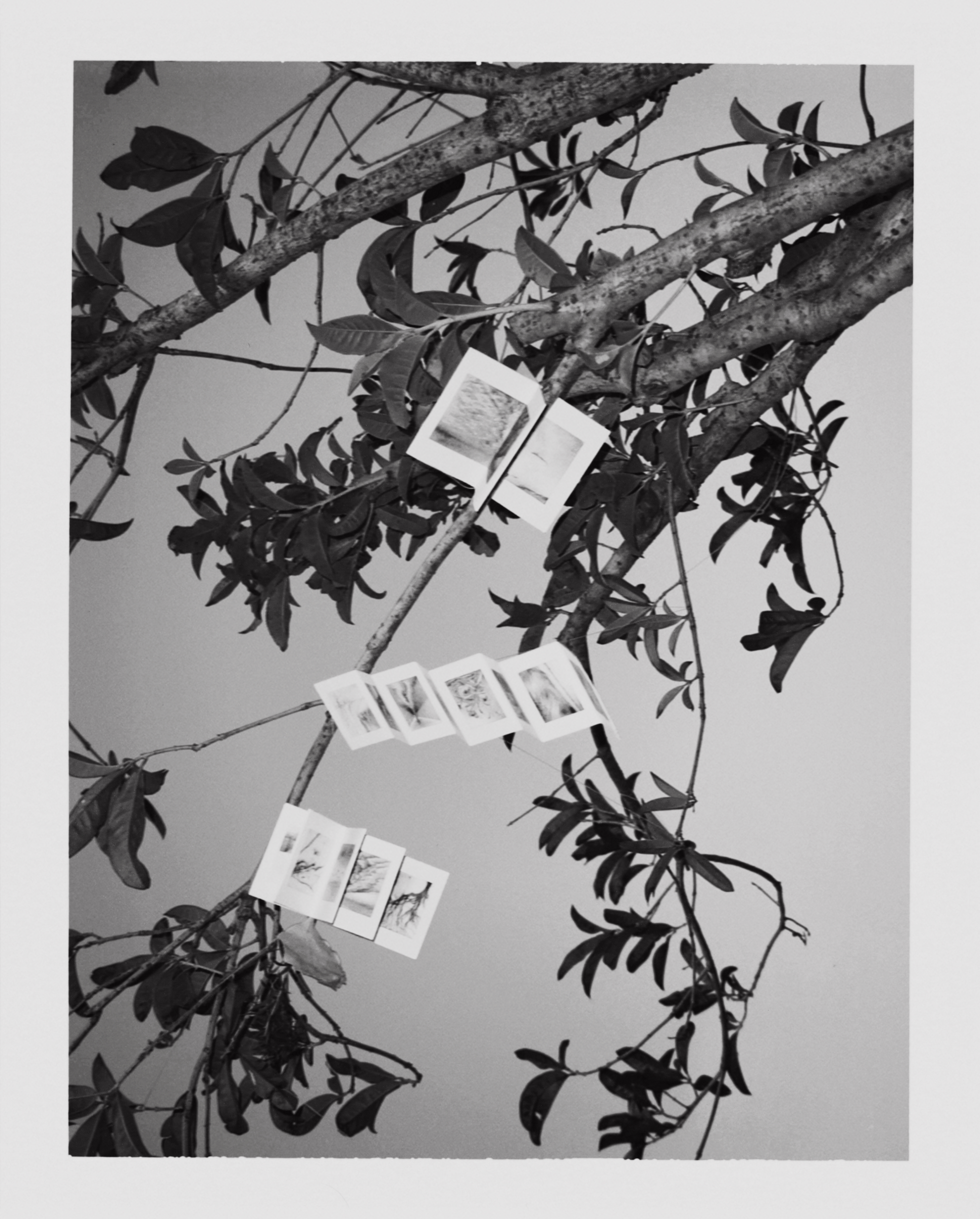
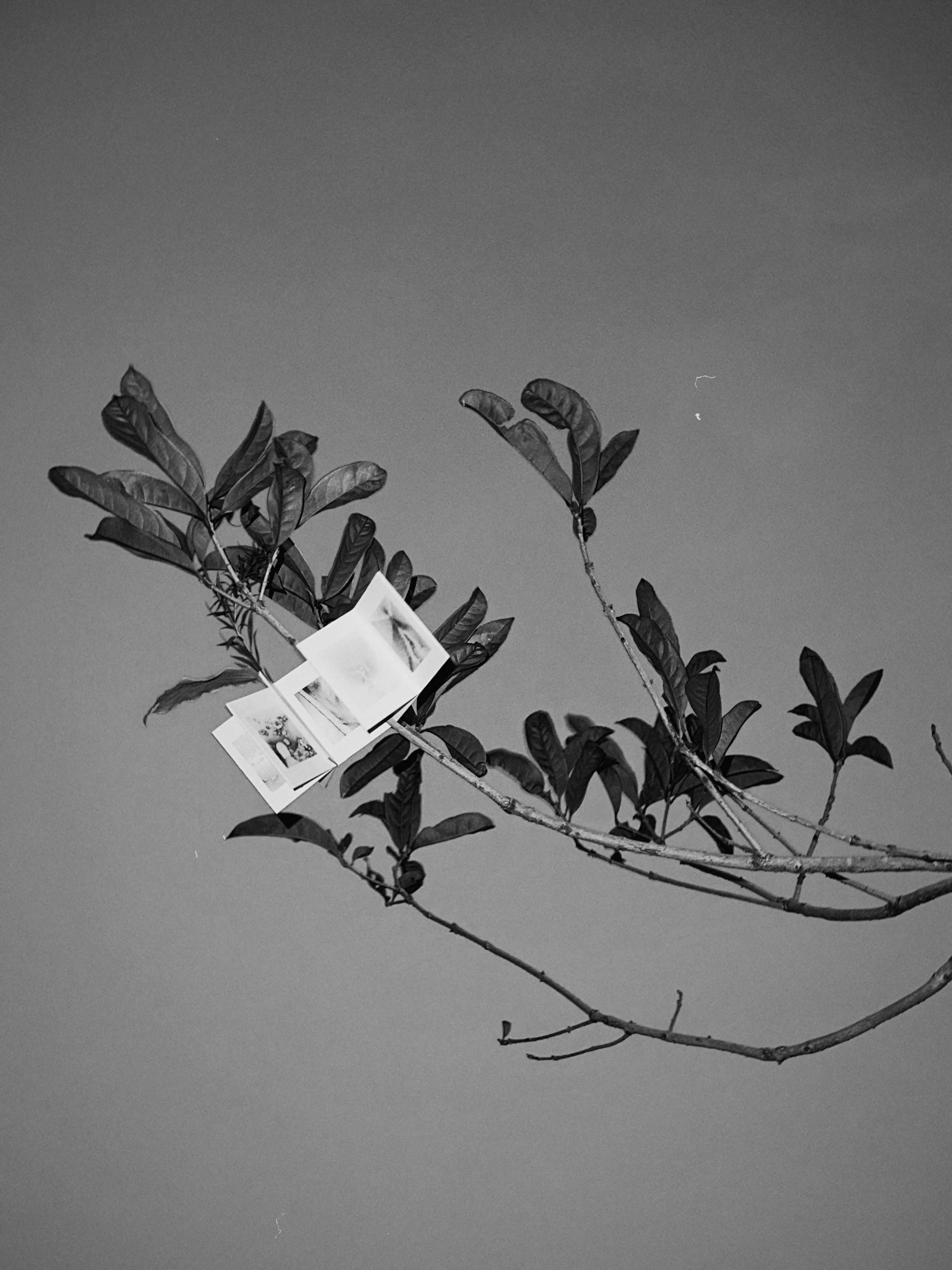
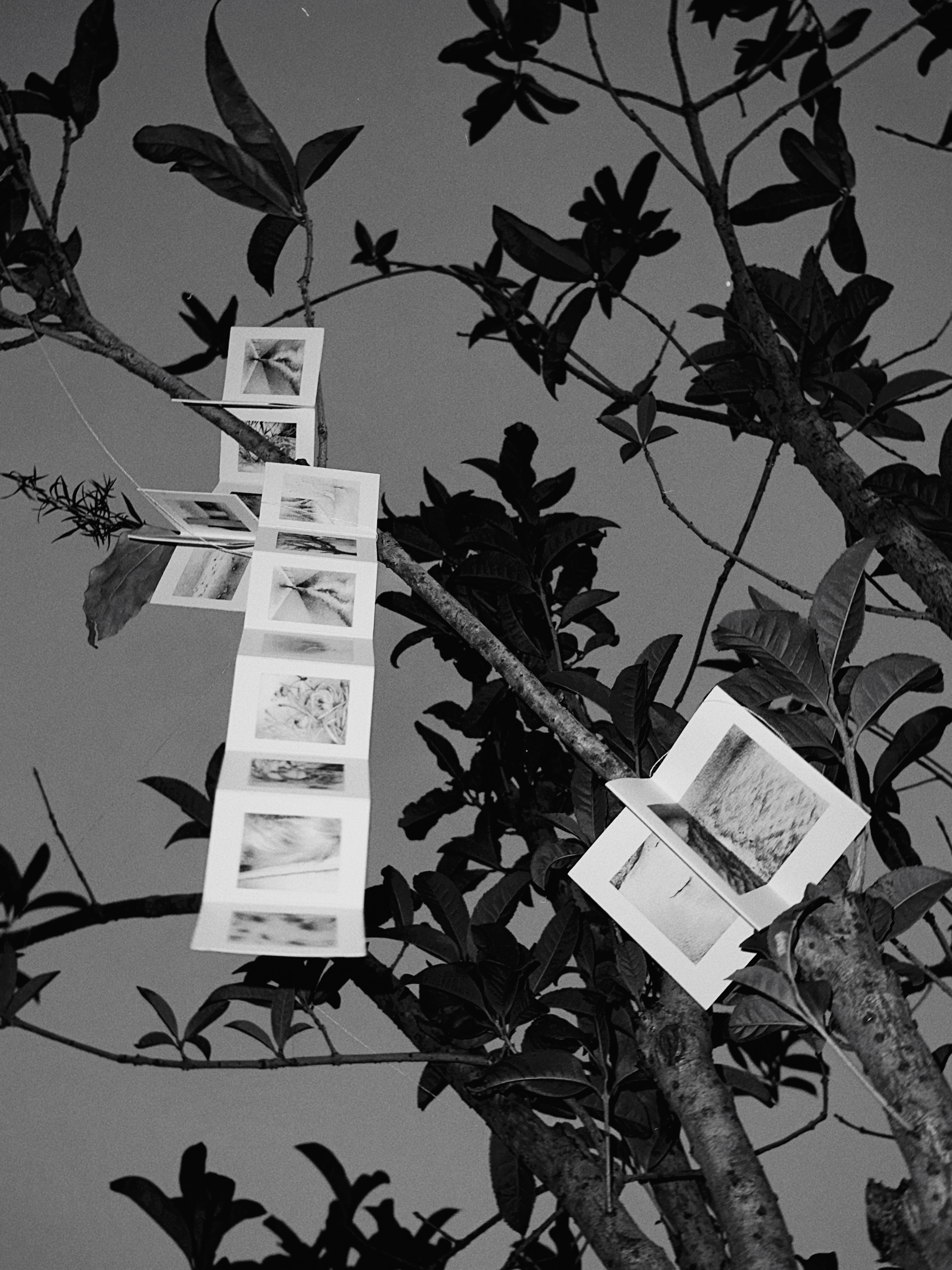
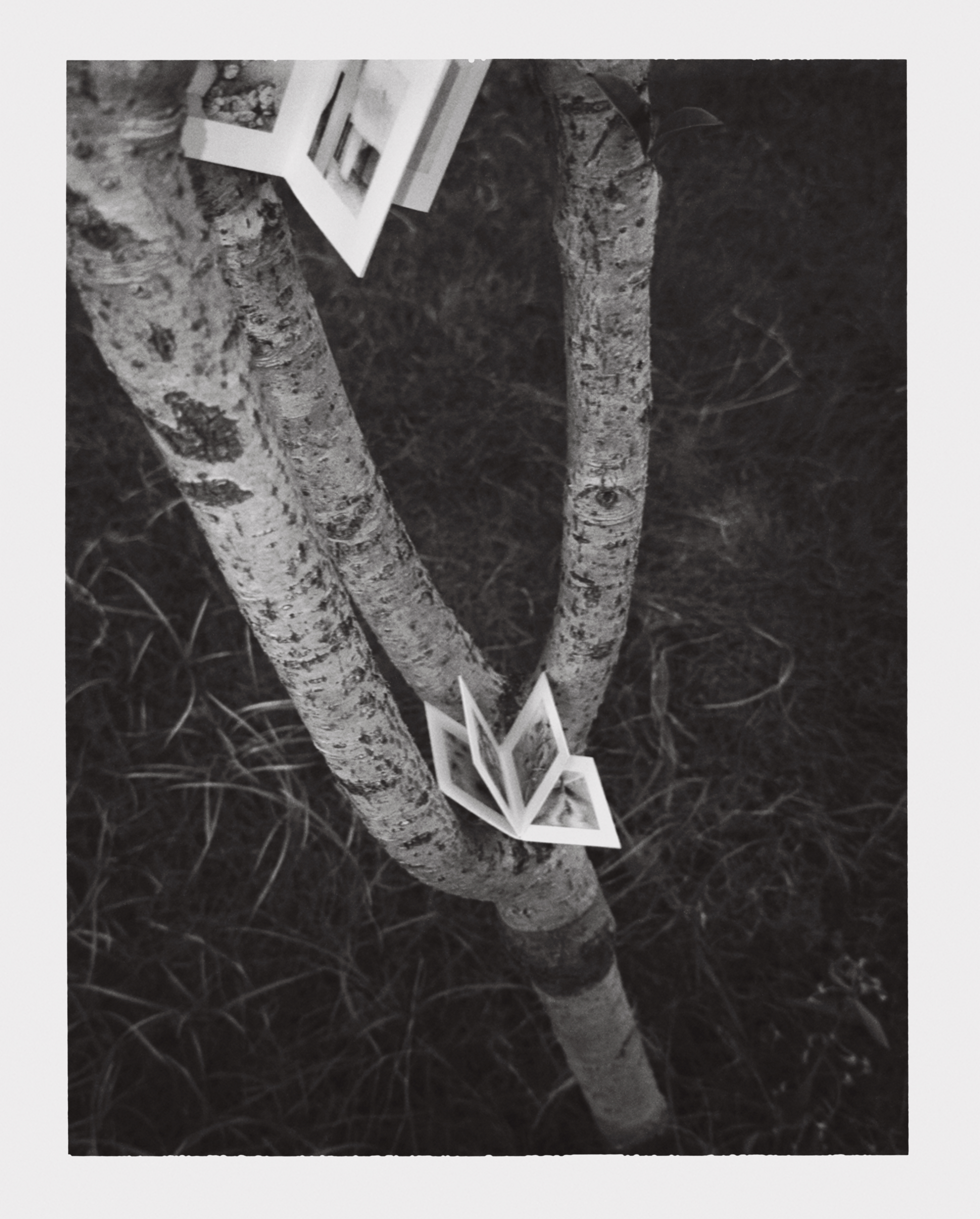
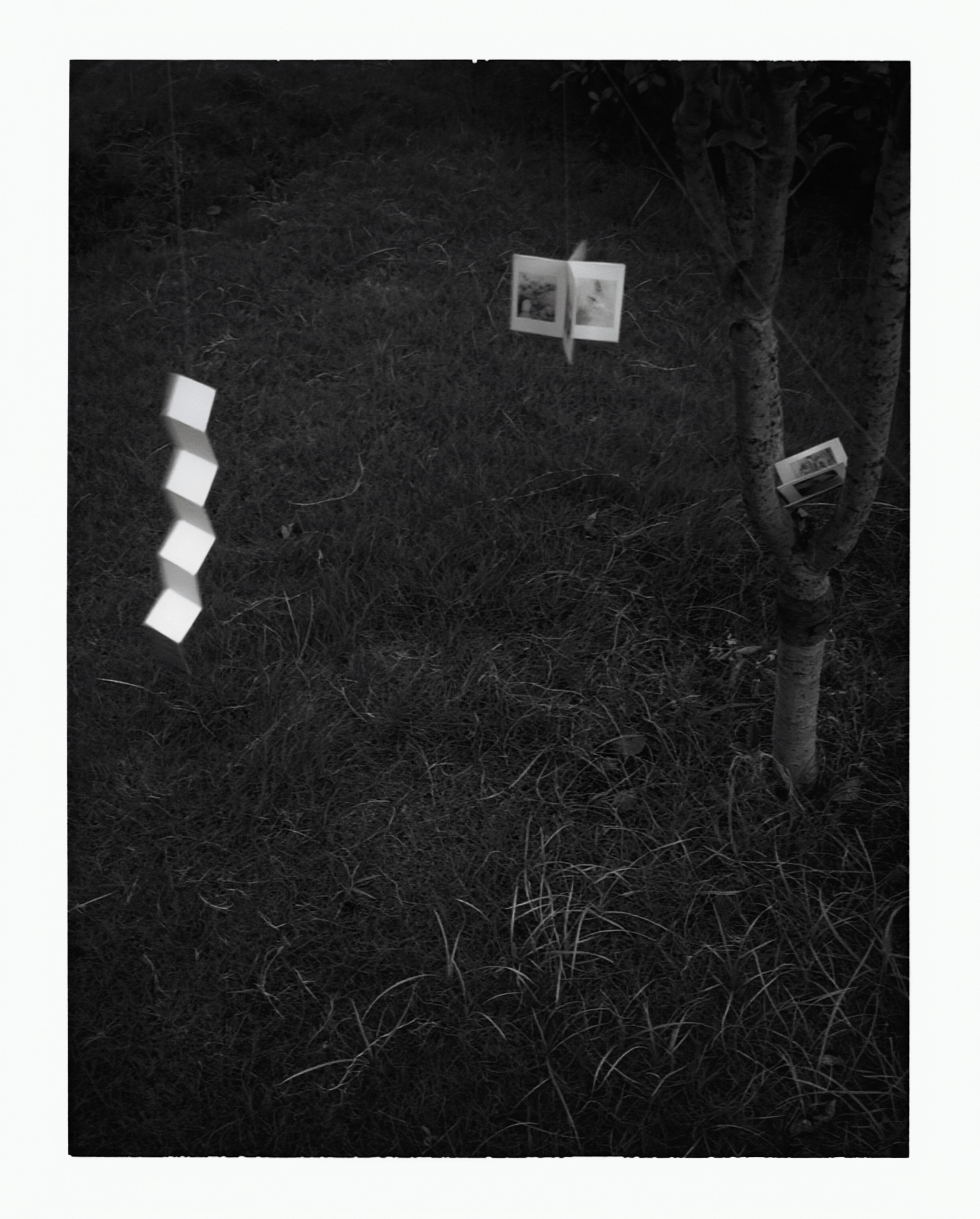
A small accordion zine of branching lines and bark — carried back into the woodland and hung among the leaves, where wind and gravity took over the reading.

Form
Accordion zine, 12 panels
Paper
300g Mönken, warm white
Print
High-resolution laser
Year
MMXXIV
scroll — the zine has not landed
The accordion zine suspended high among the branches, photographed against a pale evening sky.
i. — suspended · between two branches
II ·The zine, opening

Twelve panels of bark and branch — folded shut on the desk, opening in the wind.

panel onei
panel twoii
panel threeiii
panel fouriv
panel fivev
panel sixvi
hover — let it open
The full accordion strung between branches at night — its bright panels carrying drawings of bark and leaves.
opened · twelve panels held by leaves and string
A small folded section of the zine lodged in a branch — paper among leaves, pages slightly open.
lodged · paper among the leaves
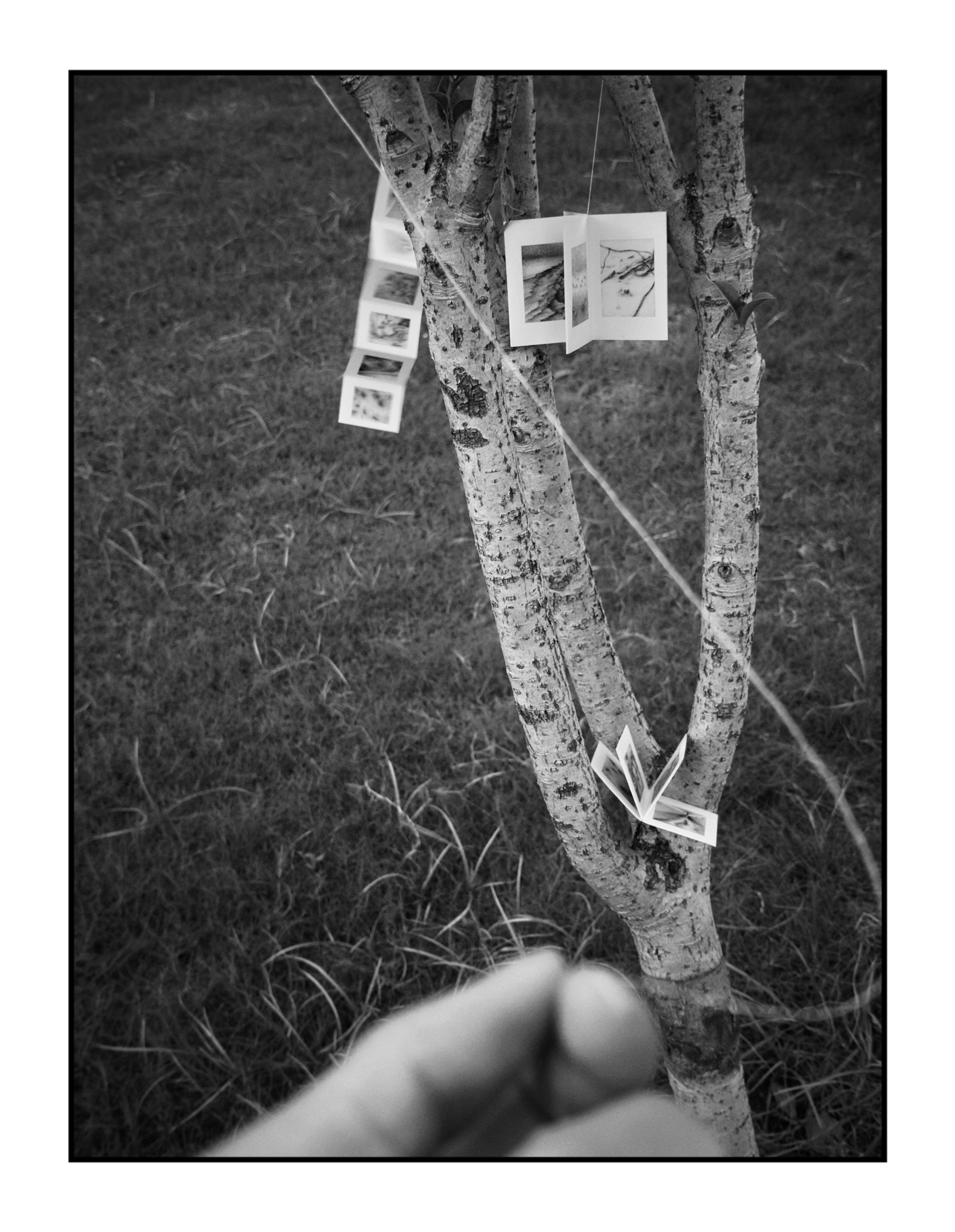
A wider view: zine sections hanging from several branches, a hand holding the lower edge into place.
return · the zine, briefly, where it came from
moved by wind,
by gravity, by the
slow give of the branch.
reading no longer
happened through pages —
through air, through
concealment.
A wider scene at dusk: the zine half visible against grass and the silhouette of a small tree, a string of paper panels falling away to the left.
IV ·A temporary return

A small structure
once taken from nature,
quietly re-entering its order.

The lines were carried out of the woodland on paper, and after a while I brought them back. Hung between two branches, the zine stopped being a fixed thing — it opened, folded, trembled, and at times disappeared into leaves.

Suspended between paper and tree, it was less a publication than a brief gesture of returning what had been taken.

Zhanyi · Hu
← back to the cabinet
tactum — touch & dissolution
i am vanishing
fol. 001 — 088
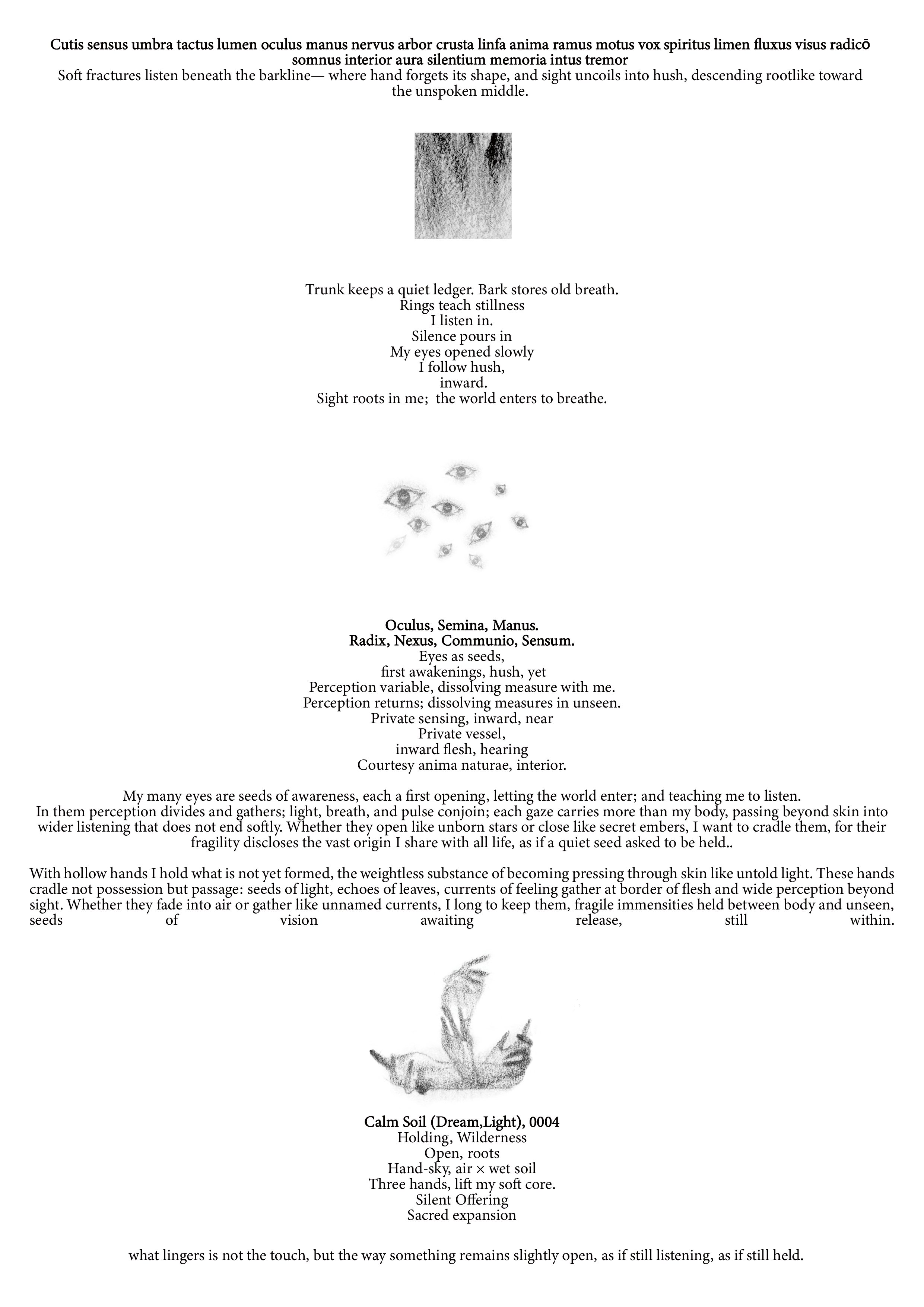
·cutis· sensusumbra tactuslumen· arborcrusta linfa·anima ramusmotus voxspiritus· limenfluxus visusradicō
Artist Book Pencil & Latin MMXXV

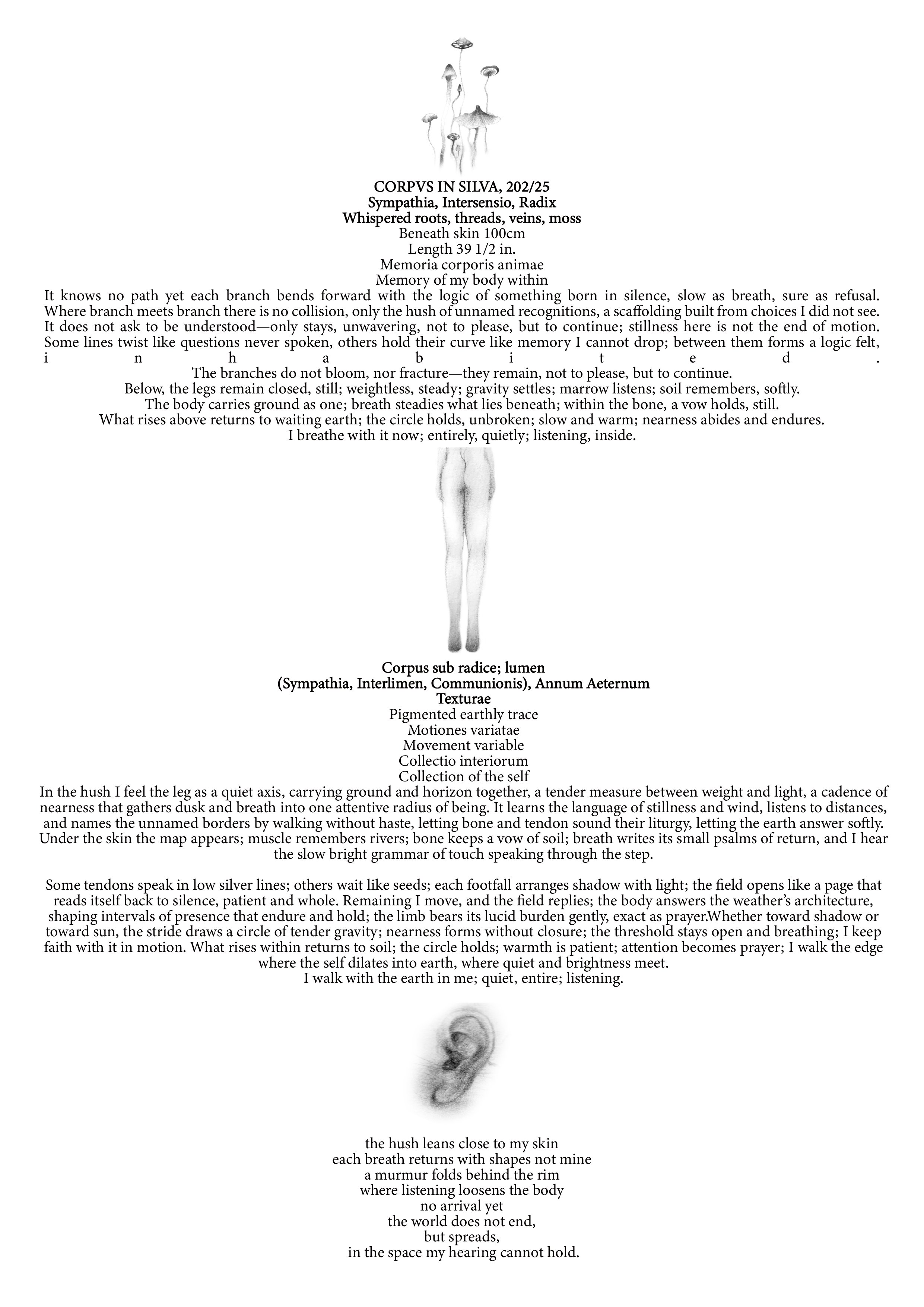
I am — corpus in silva —

A bound volume of pencil drawings, Latin marginalia, and lines that come apart as you read them. The book opens, breathes, and lets language settle out of itself like silt.

Form
Perfect-bound artist book, 88 pp.
Medium
Pencil on paper, set in Cormorant
Language
English & Latin marginalia
Year
MMXXV
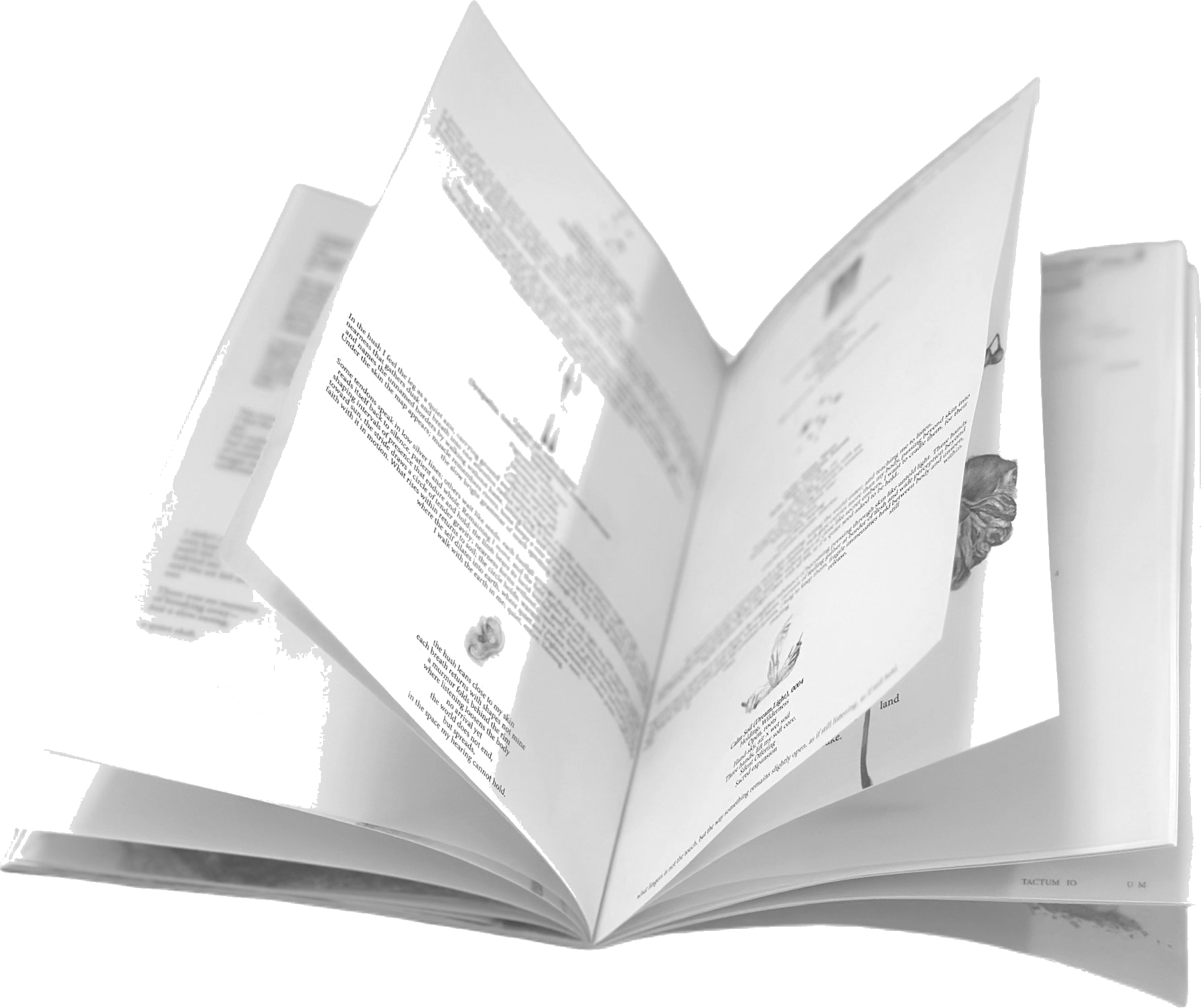
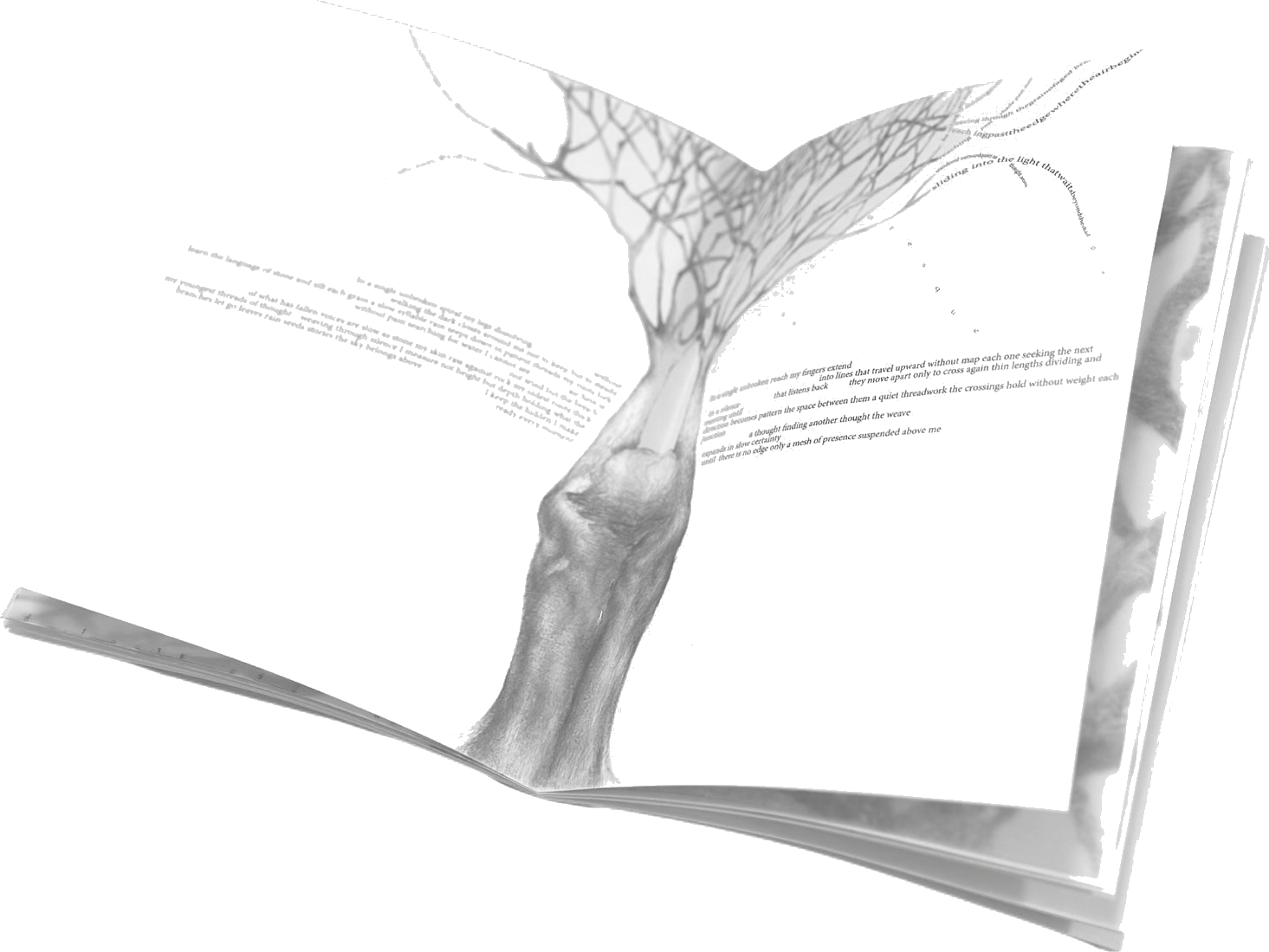
The book held open, pages mid-turn, fanned outward against air.
a f r a g m e n t · b e c o m e s t h e a i r

Some lines twist like questions never spoken,
others hold their curve like memory
I cannot drop —
between them forms a logic felt,
i n h a b i t e d.

· the edges quiver under · the smallest wind — · not in fear, · but in a kind of laughter · shared only between · grass and the air.
growth · writes · stays
just far enough
to remind me
we are not the same
into the breath of light
a single syllable, leaning
II· Corpus, indexed
Corpus in silva
202 / 25
Sympathia, Intersensio, Radix
· 100 cm
Memoria corporis animae
· memory within
Corpus sub radice; lumen
· 39½ in.
Texturae
· pigmented earthly trace
Motiones variatae
· movement variable
Collectio interiorum
· collection of the self
Oculus, Semina, Manus
· eyes as seeds
Radix, Nexus, Communio
· sensum
Annum Aeternum
· silent offering

It does not ask to be understood — only stays, unwavering, not to please, but to

· lucida · silvatica 1.02 EXO-NEURAL
A spread from the book — branches and net of lines.
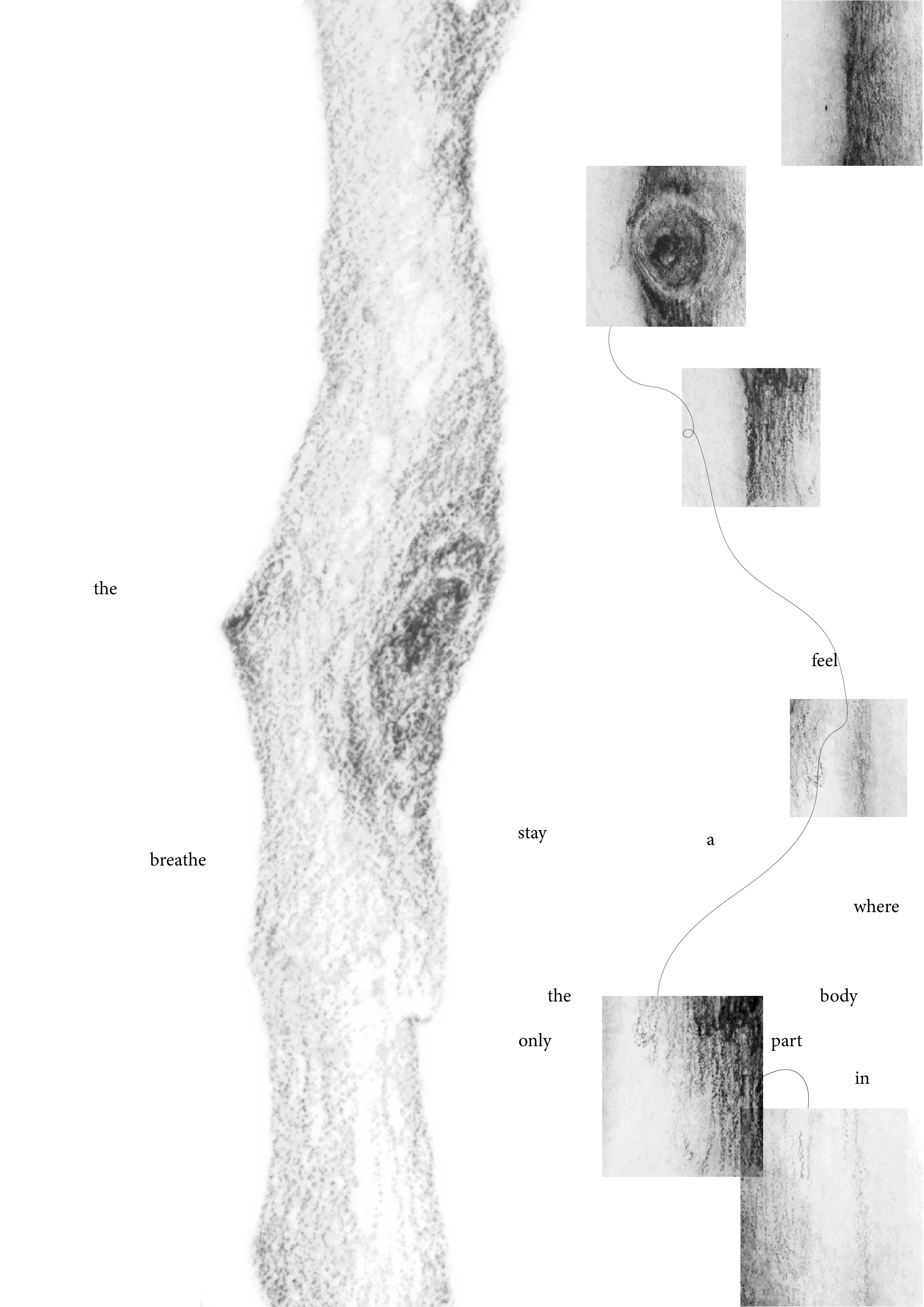
The bark is a slow confession — each ridge carrying a weight I recognise in my own bones. Time moves differently here: thicker, quieter, until my breath folds into the stillness. shadowroot · anima radicis
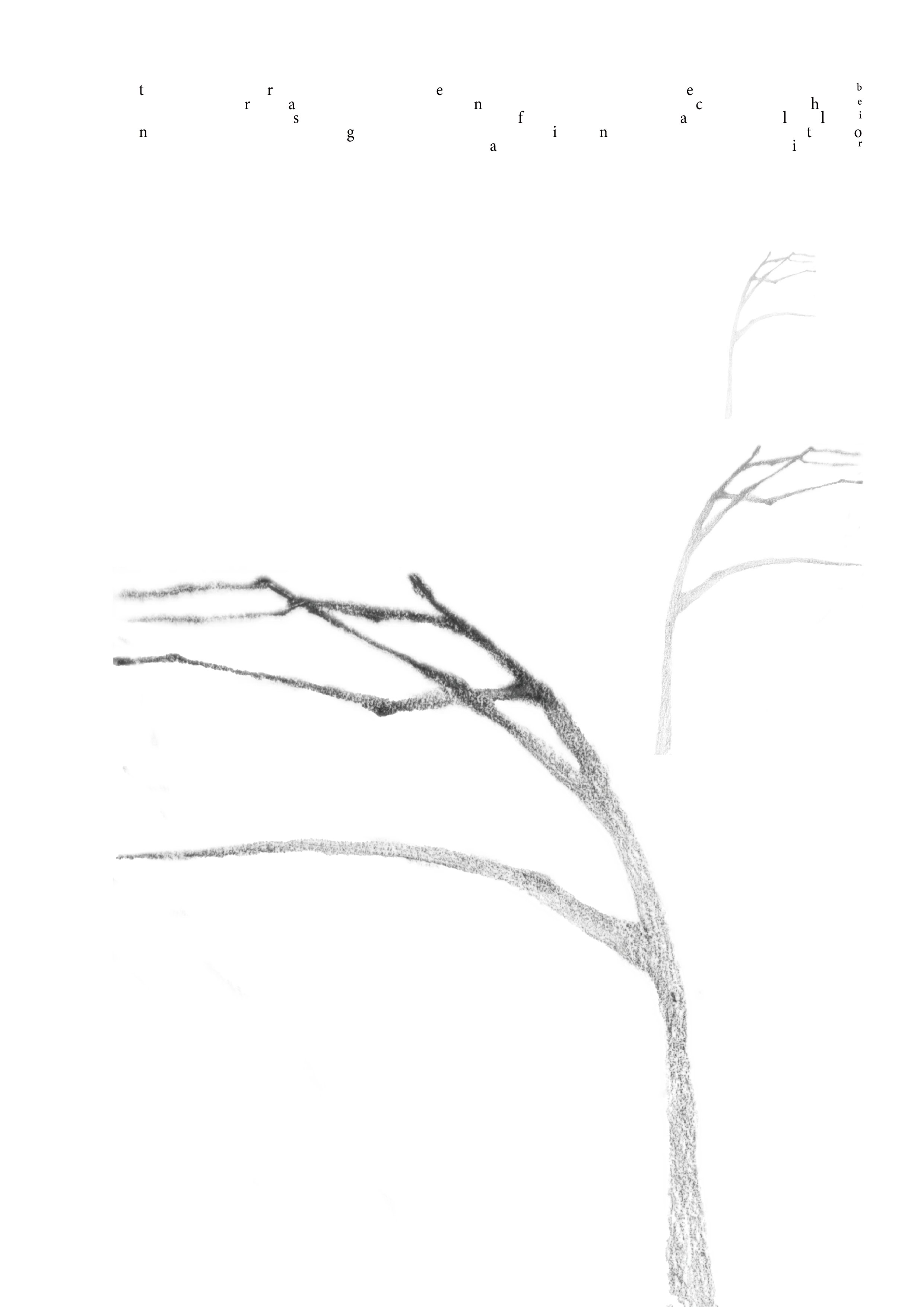
The book opened wide, a pencil tree filling the right page, scattered text on the left.

I walked slowly into a nameless forest, where the air carried a breath that had never been

Light filtered through moss and the murmur of water, folding layer upon layer into my chest, until the boundary between my body and the world could no longer be

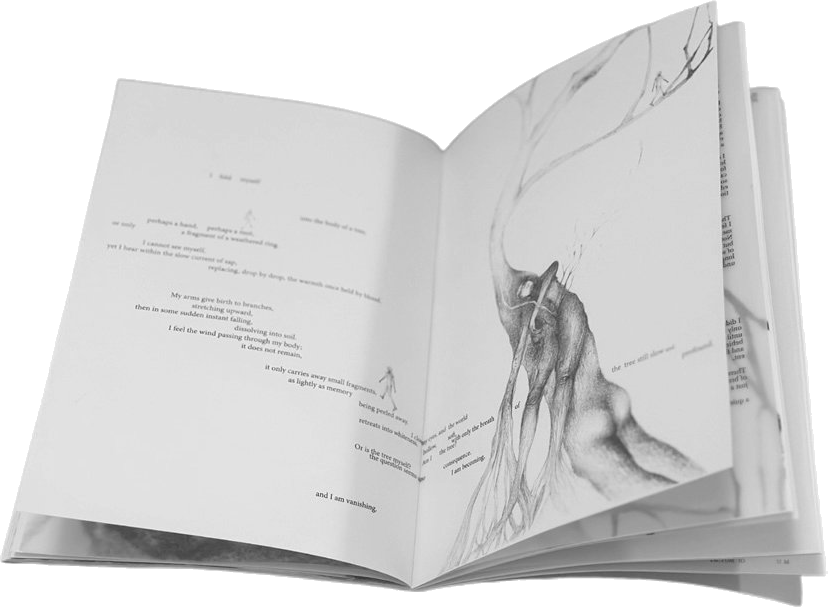
A spread with the line 'and I am vanishing.' set against a tree drawing.
The book at rest, opened, faint trees in the spread.

I heard my own footsteps turn lighter, like the heartbeat of another creature. I touched the bark and felt it as an extension of my own skin. Nature was no longer a scene, but a manner of being.

and I am
Zhanyi · Hu
← back to the cabinet
Publication / 01 — Artist Book
fol. 001 — 032
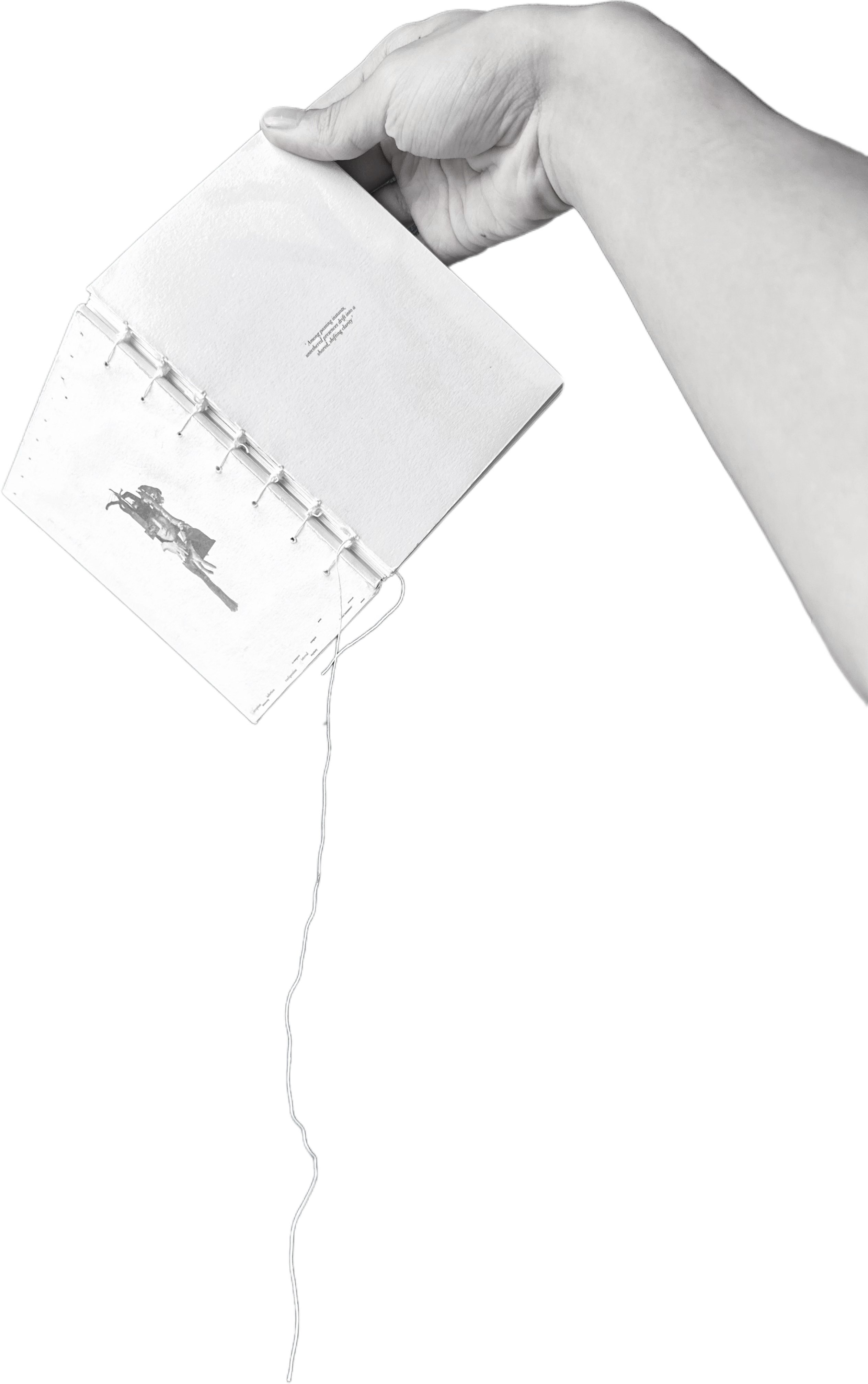
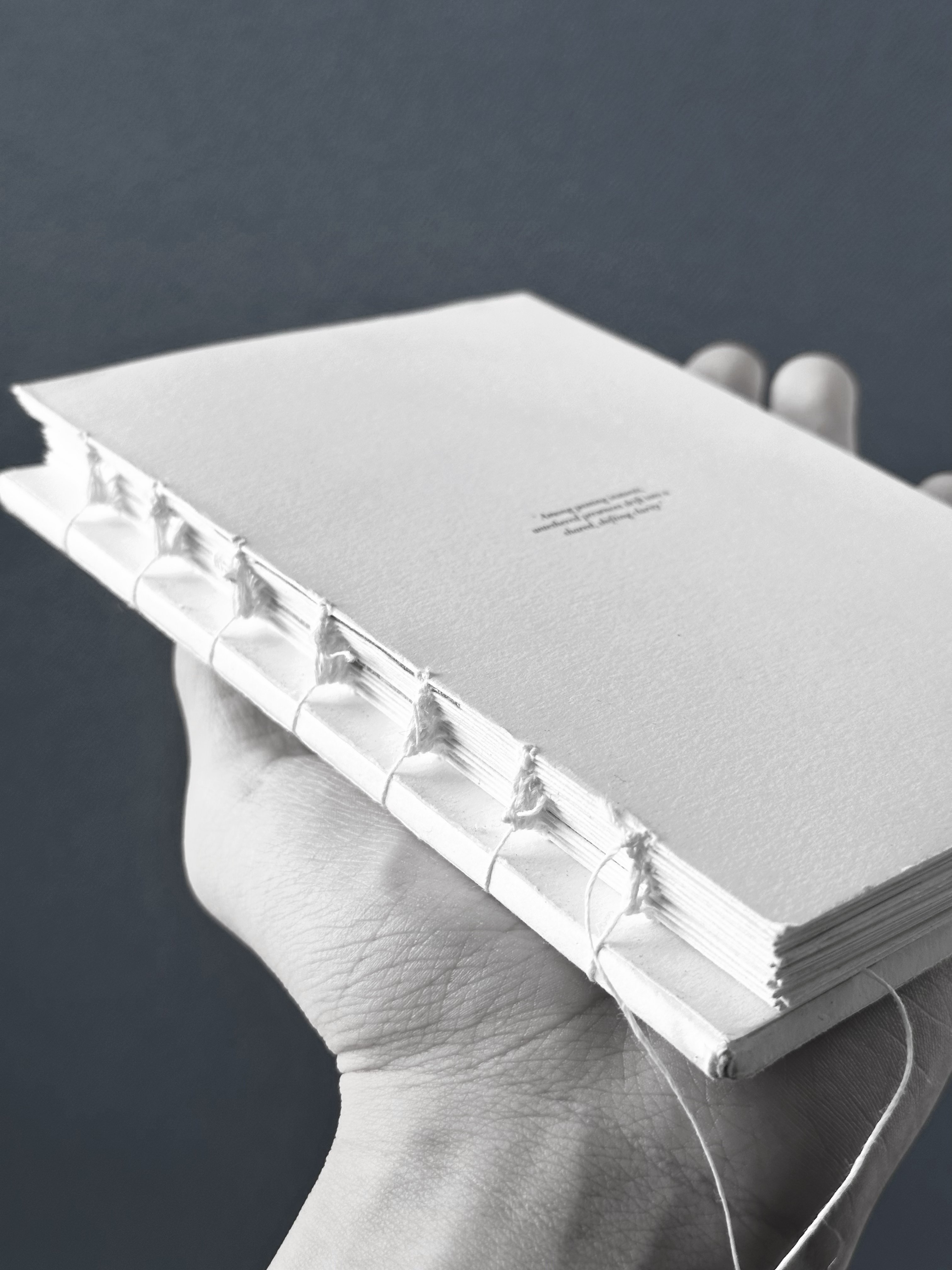
The book held up, exposed binding visible, a thread falling from the spine.
An artist book · 2026

The thisness of a passing instant.
A small book about being present without possessing — the brief, specific quality of standing among trees and feeling something arrive that asks for no name.
Format
Artist book · A6 (130 × 230 mm)
Paper
Kent paper, 140 gsm
Print
Offset, single-colour ink
Binding
Revised Coptic stitch · exposed spine
Year
2026

‘Among passing instants, untethered presences drift into a shared, shifting clarity

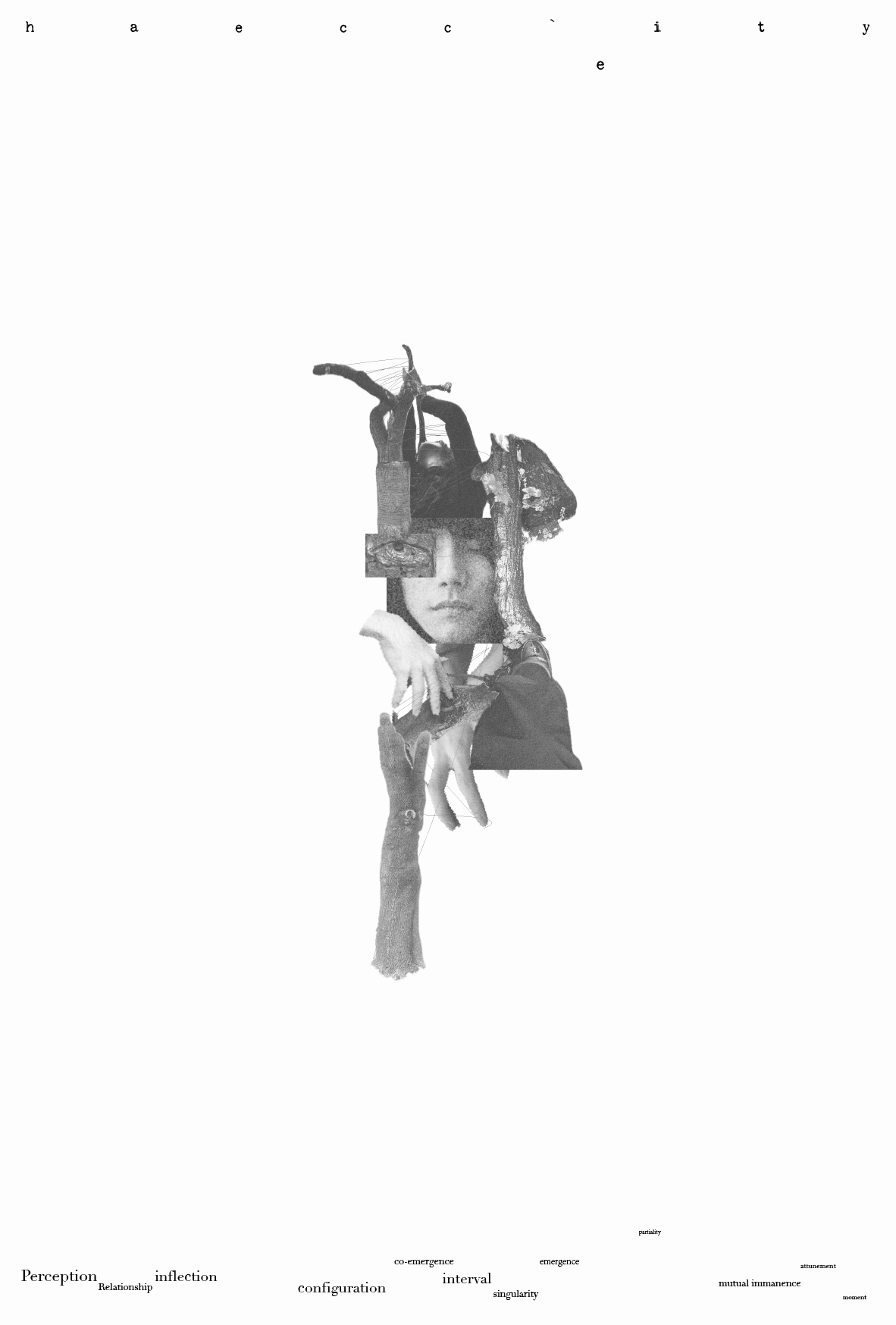
haecc`itye
Haecceity — the medieval word for the thisness of a particular thing. Not what it is, but the fact that it is this, here, only now.
Among the trees, attention sharpens into a quality without a name — a moment that belongs to no act of knowing, only to its own arrival.
presence thisness instant untethered arrival singularity attunement clarity drift shared, shifting alignment stillness
a working drawing — the figure already among the branches
The original concept poster: 'haeccity' typed across the top, a central collage of face, branches, and hand, a cloud of posthumanist terms below.
III · The Encounter

Five passing instants — none of them held, none of them undone. Each spread is a small architecture of being that needs no interpretation, only the brief shape it gathered between us.

instant 01 · pp. 06—07
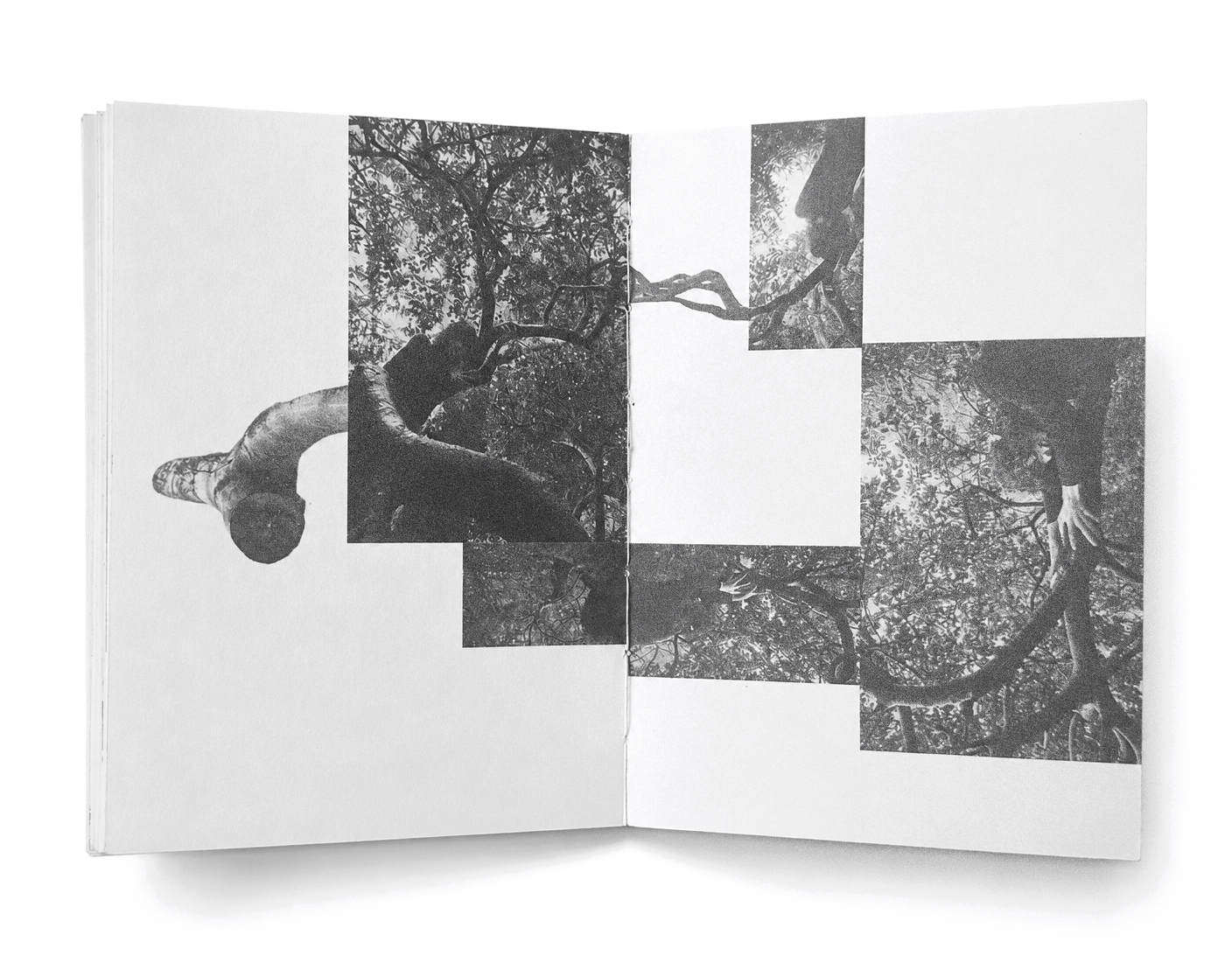
Spread one — canopy fragments cut and rearranged across two pages.
first instant · arrival

Untethered presences, drifting overhead.

The canopy is not a backdrop — it is a field of small, separate arrivals. Image fragments are cut and reset across the spine because that is how the moment actually moves through me: not whole, but as discrete instants briefly sharing the same air.

each piece keeps its own time, and still they arrive together
second instant · approach

A brief approach — and the tree keeps its own nature.

The hand enters the frame, reaches toward what is already there. The tree does not turn to meet it. It grows, it withdraws, untouched by my brief approach. I am only placing myself within its field.

it is not the tree that shifts, but some small alignment in me
instant 02 · pp. 12—13
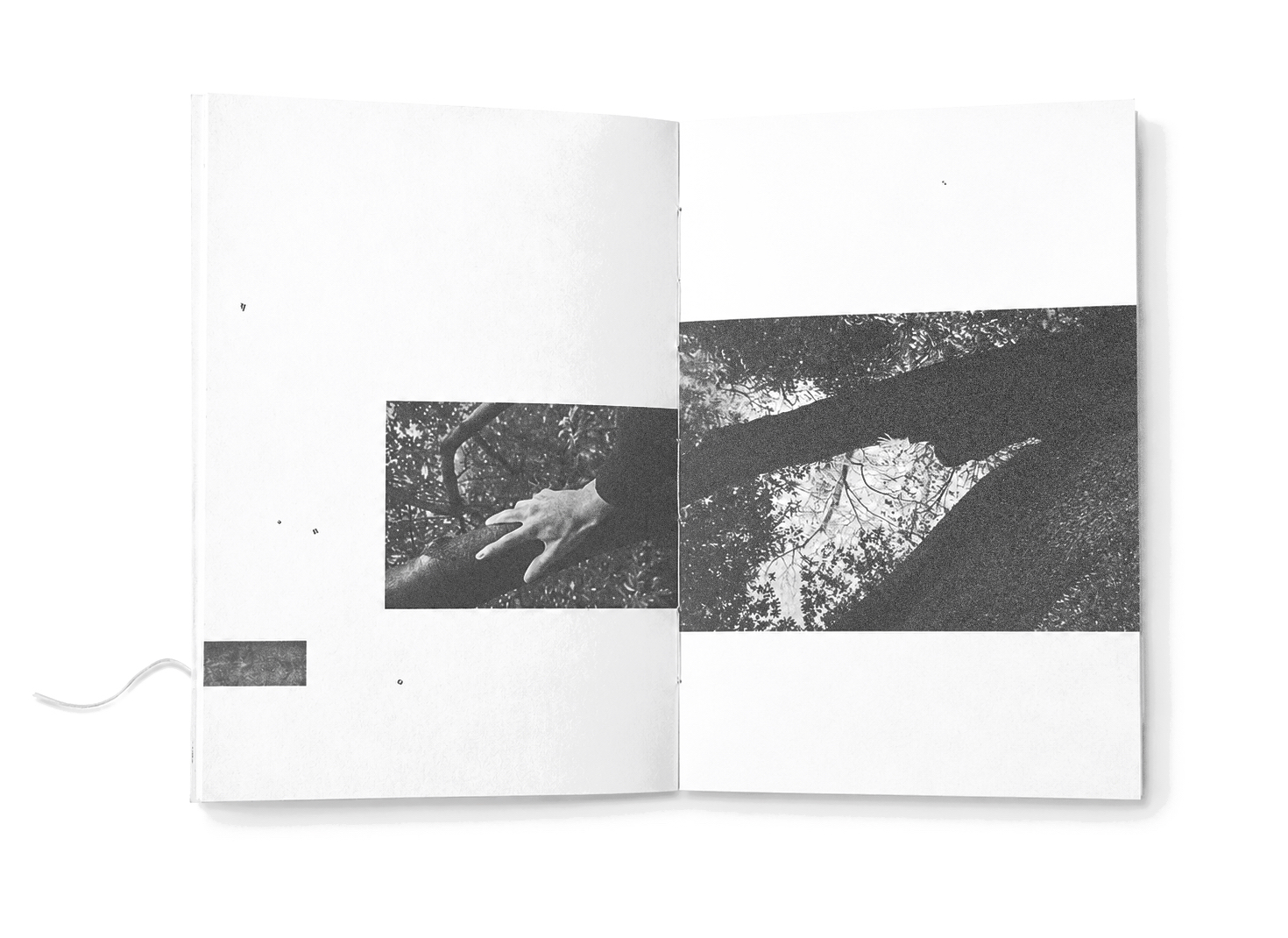
Spread two — a hand reaches into the canopy; a grainy halftone block on the right page.
instant 03 · pp. 18—19
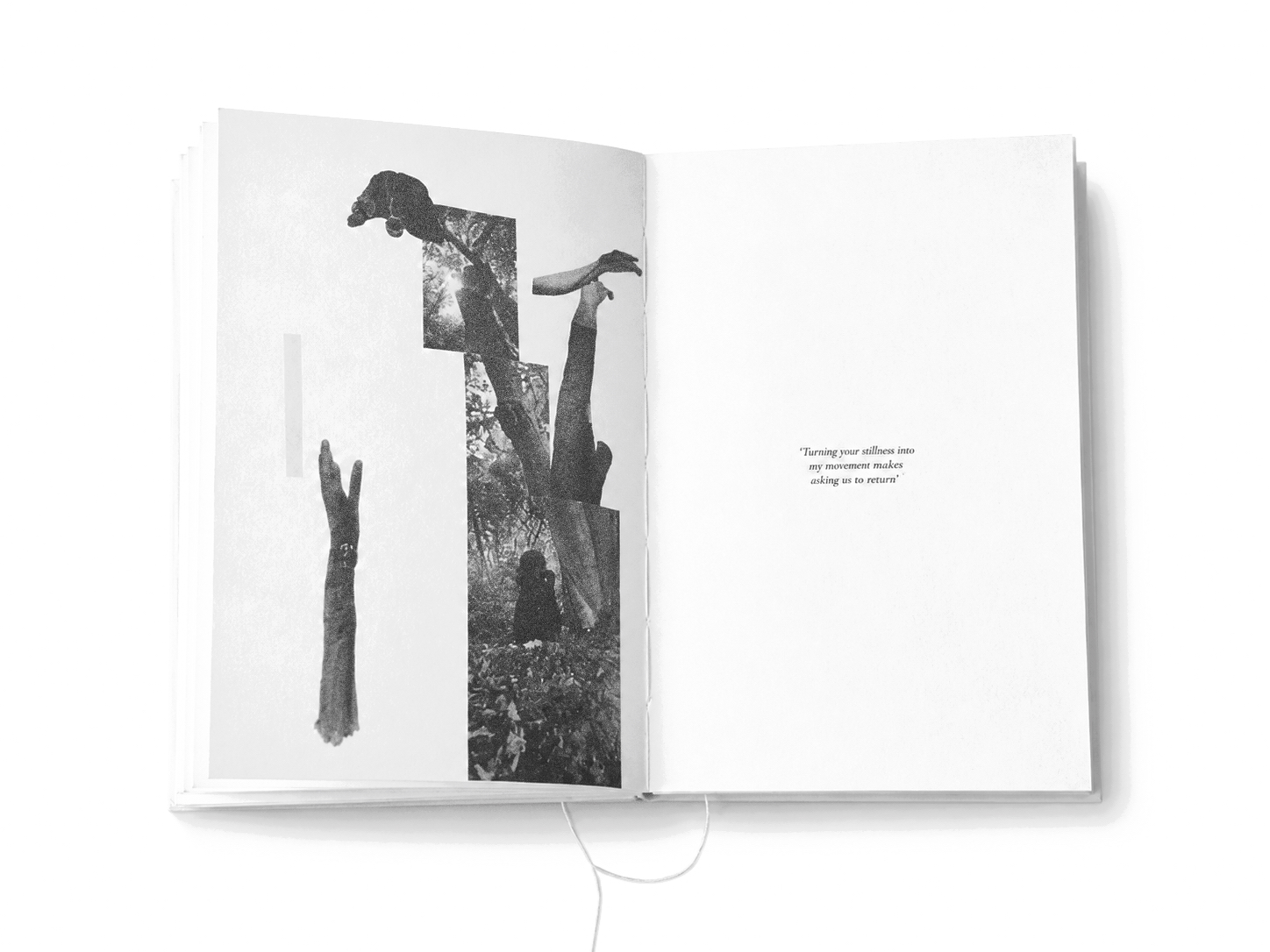
Spread three — vertical fragments of figures and trees; a quote on the right.
third instant · stillness

A stillness older than my nearness.

Standing among the figures and the trunks, I begin to feel that the air tilts; my posture loosens into a gentler accord. The stillness here was not waiting for me. It was already in place — older than my nearness, and indifferent to it.

what passes between us belongs to no act of knowing
fourth instant · suspension

Not mine, not the tree's — suspended between us.

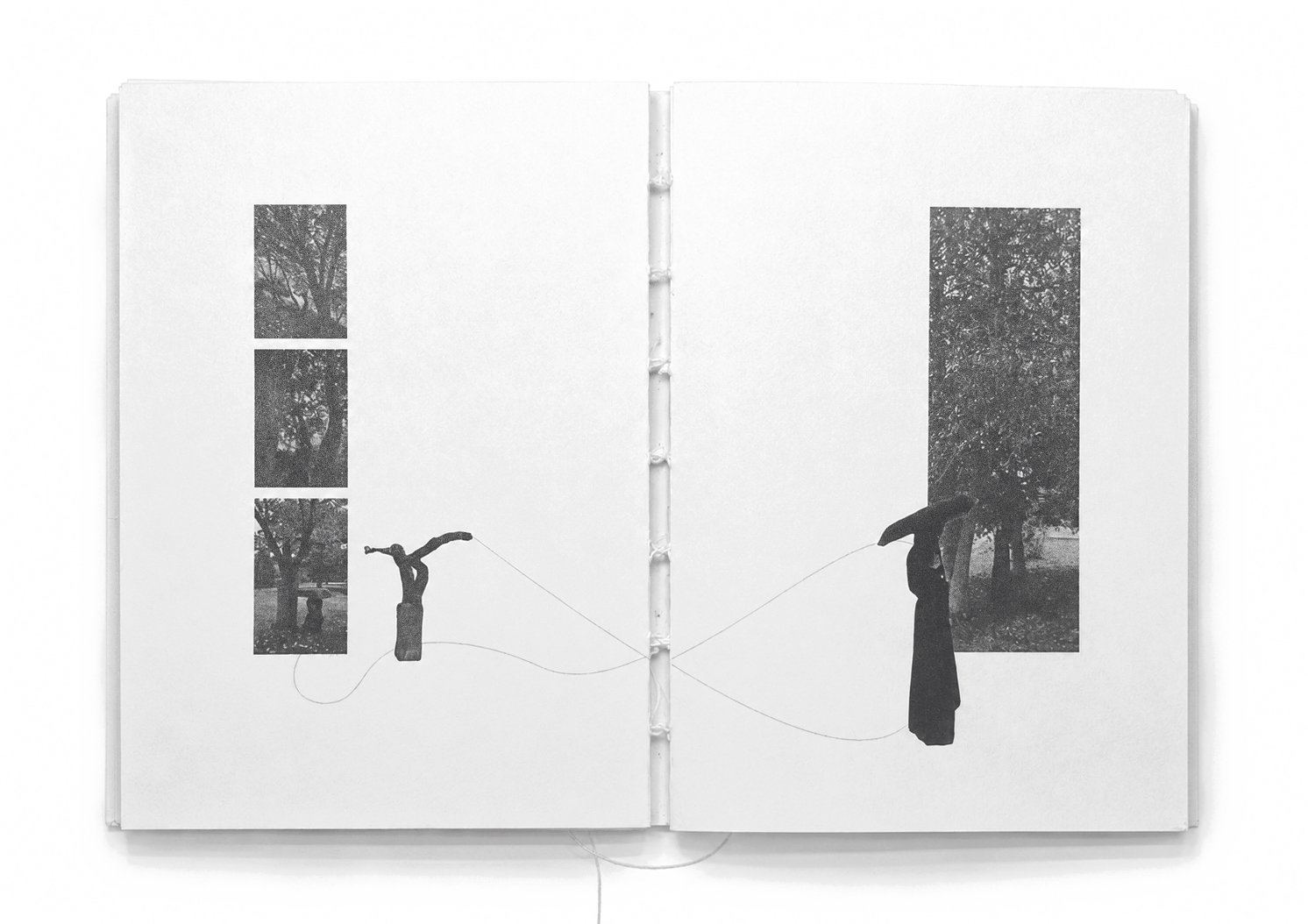
A real thread crosses the spine, pinning small photographs on one side to a single figure on the other. It is not metaphor: it is a working sketch of how the moment gathers its shape — not in me, not in the tree, but held briefly in the air between.

a small architecture of being, needing no interpretation
instant 04 · pp. 24—25
Spread four — three small photos on the left, a robed figure under a tree on the right, joined by a real thread.
instant 05 · pp. 30—31
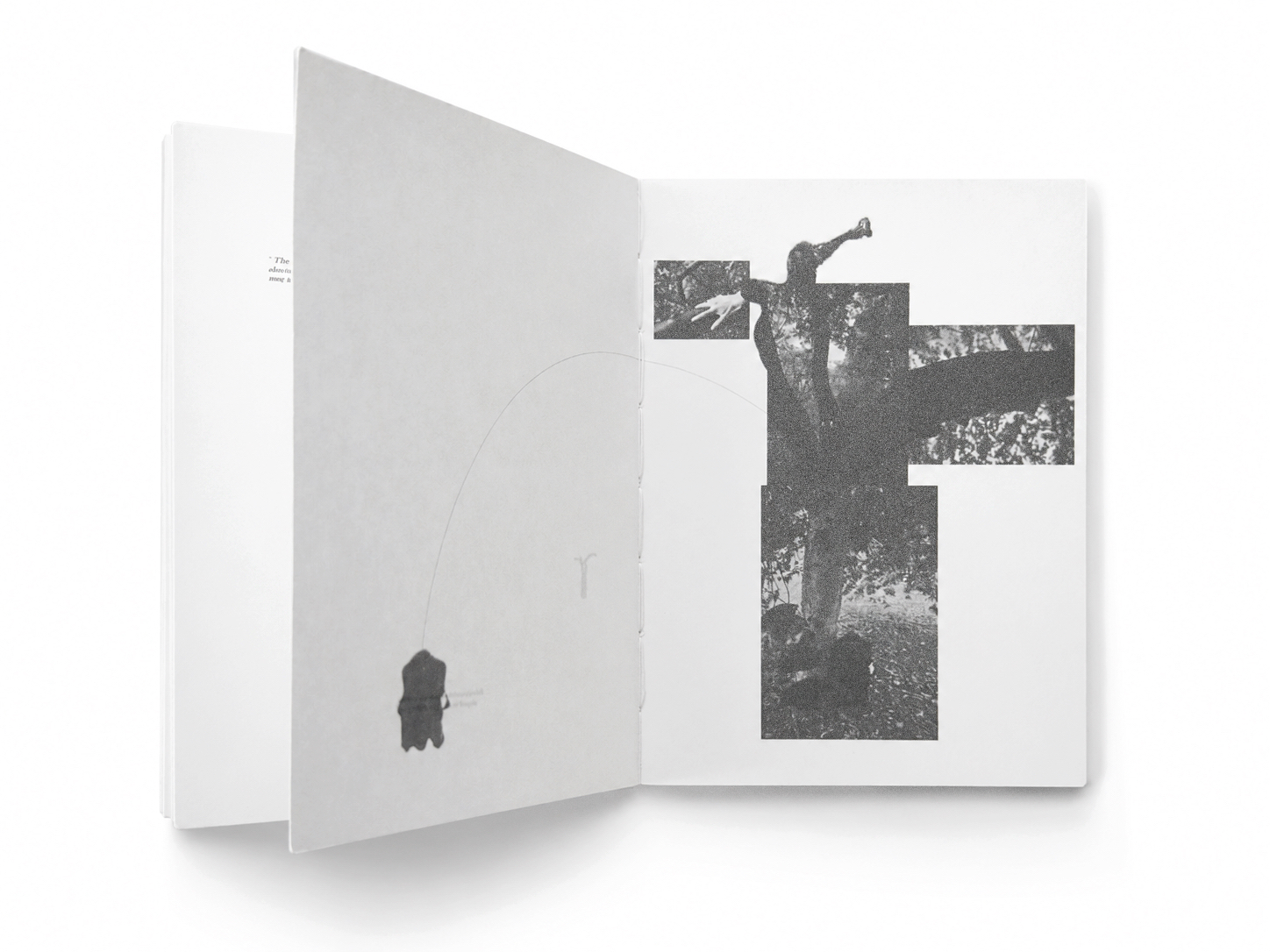
Spread five — a half-folded translucent page lifts to reveal a figure caught in the canopy.
fifth instant · departure

A space, quietly rearranged.

I leave without firmer answers. Only a faint sense that something has shifted — not the tree, not the air — but the way I now hold myself inside the world. The book closes on this small divergence: a space, quietly rearranged, and left that way.

I leave without firmer answers, only this faint sense
Close-up of the revised Coptic stitch — white linen threads pass through visible signatures along the exposed spine.
IV · The Binding

A revised Coptic stitch, nothing hidden.

The spine is exposed deliberately. Each signature is sewn through with linen using a revised Coptic stitch — an original adaptation of the ancient chain binding. Every knot, every place where a thread crosses, stays visible. The structure is the argument: nothing hidden, nothing finalised.

The pages turn flat and free, the way a small moment opens without ceremony. Kent paper at 140 gsm holds the ink lightly, and the bound spine lets each spread sit in its own time, then close back into the whole — a brief architecture needing no interpretation.

V · Departure

I leave without firmer answers, only the faint sense that what passes between myself and these quiet forms belongs to no act of knowing — a stillness older than my nearness, tilting the air and loosening my posture into its gentler accord.

The tree keeps its own nature — growing, withdrawing, untouched by my brief approach. I only place myself within its field, and it is not the tree that shifts, but some small alignment in me.

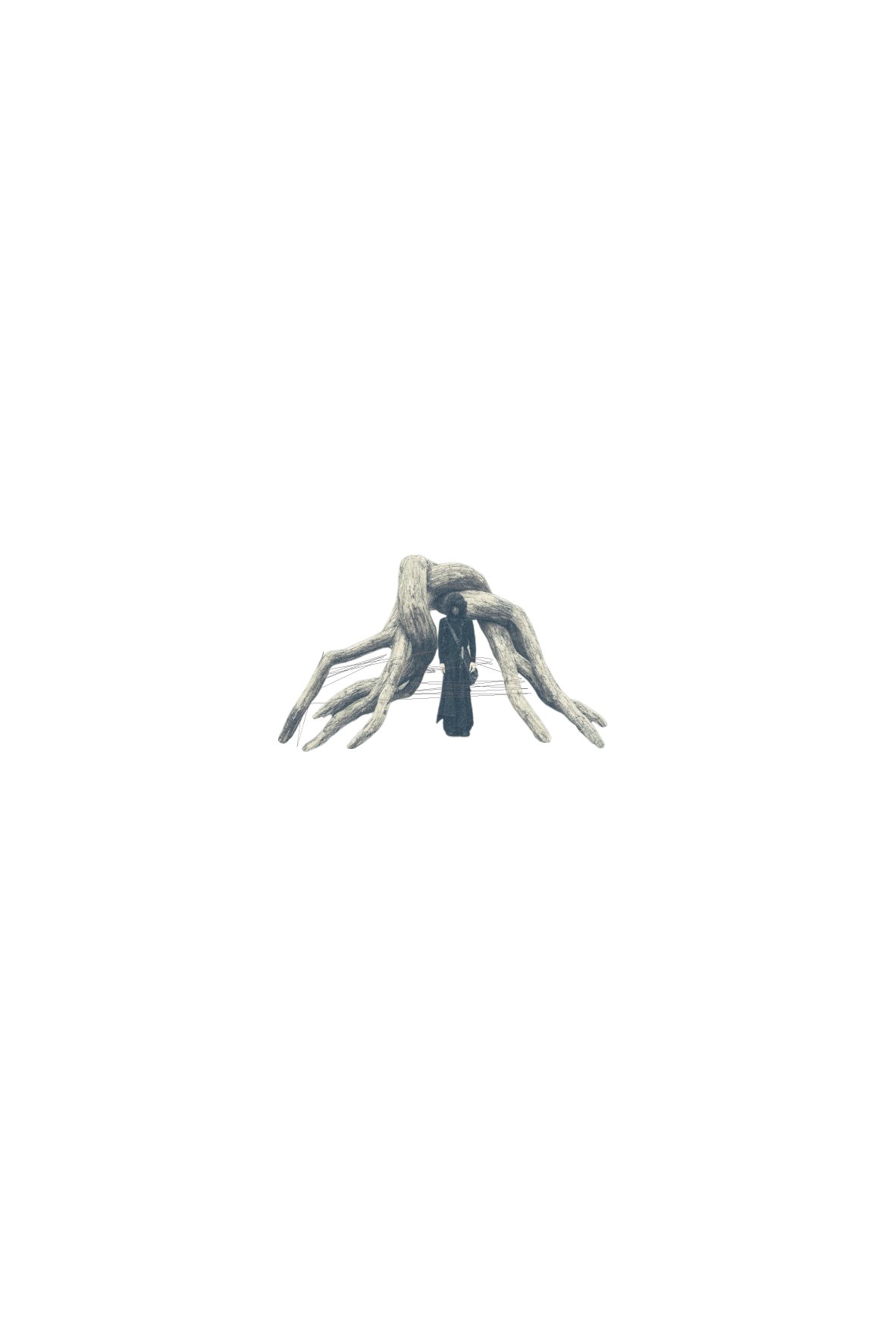
A small figure stands at the centre of an outstretched root system, fine threads radiating out across the page.
In that slight divergence the moment gathers its shape — not mine not the tree's but suspended between us a small architecture of being needing no interpretation leaving in me a space quietly rearranged.
VI · Colophon
Title
haeccity
Form
Artist book · A6 · 130 × 230 mm
Paper
Kent paper, 140 gsm
Print
Offset, single-colour ink
Binding
Revised Coptic stitch · exposed spine, linen thread
Pages
32 (5 spreads + colophon)
Year
2026
Zhanyi · Hu
← back to the cabinet
Nature Palimpsest · Artist Book
fol. 001 — 036
Verge · Prelude An artist book · 2026

Between Root / and Thought.
An inquiry that overwrites itself.

This book grew out of a question I could not put down: what is my relationship to the natural world, and how has my understanding of it been shaped — and limited — by the frameworks I inherited?

What I had taken for closeness was, in many ways, a projection. The recognition became the engine of the work — a movement from an intuitive bond toward critical questioning, and from there into posthumanist thought.

I chose the word palimpsest as the governing concept because it describes exactly what happened to my thinking: each new encounter did not erase the previous one but wrote over it, through it.

Format
Artist book · Unique edition
Material
Newsprint · Tracing paper · Double-sided mount
Craft
Manual butterfly binding · Exposed spine
Dimension
130 × 230 mm
Pages
240 pages · 10 gatherings
Year
2026
scroll — let the page write over itself
I · the question, rewritten

what is nature to me?

what is what is my relation to nature?

and can the very word 'nature' — this category I inherited — still hold?

— a pull I had felt since childhood palimpsest: the page never fully erased — a frame I had not yet learned to see
II · three strata · sediment of thought
i. Intuitive

Affinity

Before language, there was pull. A pre-verbal closeness to leaves, soil, the smell of rain on stone. I trusted it without examining it.

This was the first writing on the page — soft, certain, unread.

topophilia — the affective bond between people and place; the body recognising support before the mind translates it into love.
ii. Critical

Projection

I read. The closeness I had trusted became visible as something — a frame, a habit of thought. What I had called nature was already a human shape laid over the world.

The page is being written over. The first lines remain, faintly.

anthropocentrism — the implicit centre against which my own care had been organised. To preserve is already to judge what is worth saving.
iii. Posthuman

Between

I move into the territory where the categories themselves loosen. Not just how humans relate to nature, but whether human and nature can still hold as separate names at all.

The page is now thick. Each layer present in the others.

chiasm · reversibility — to touch is to be touched. The forest is no longer dead object; it is the secret counterpoint of my body.
III · a vocabulary that drifted in

terms that rewrote me

These are the words that arrived during the inquiry and stayed. Each one is a small palimpsest in itself — a borrowed concept I keep returning to. Hover to read the gloss.

IV · the object

The book is also a palimpsest in matter.

Pages of newsprint and translucent tracing layer through one another, so that every spread is haunted by the spreads above and below it. The exposed butterfly binding lets the gatherings open completely flat — each opening becomes a section of sediment laid bare.

To turn a page is not to leave the previous page behind. It remains, visible through the next, the way thought never truly leaves an earlier thought.

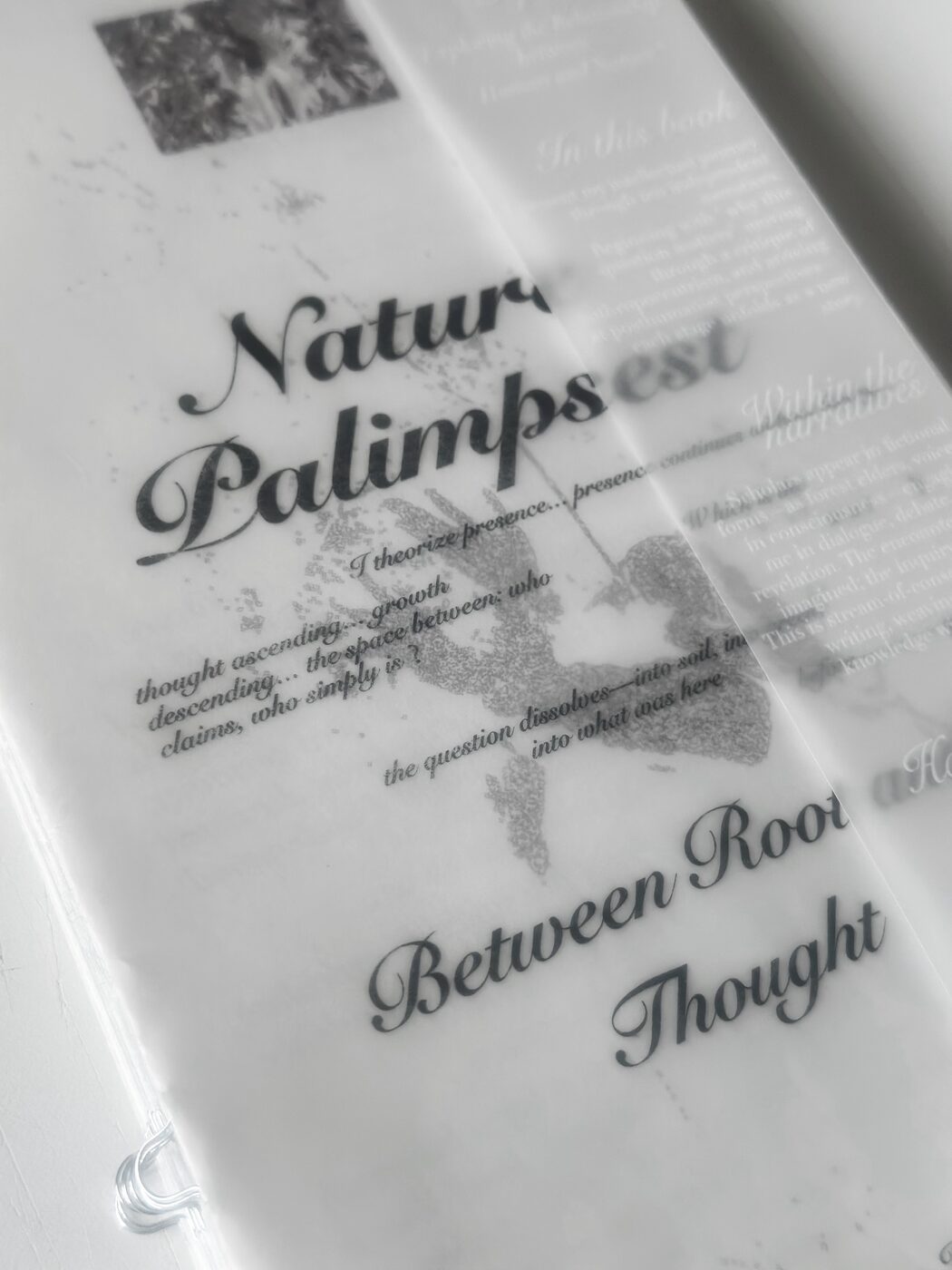
The title page: 'Nature Palimpsest — Between Root and Thought' shown through a tracing-paper overlay.
i · title pagetwo pages of type read through one of veil — the title arrives twice.
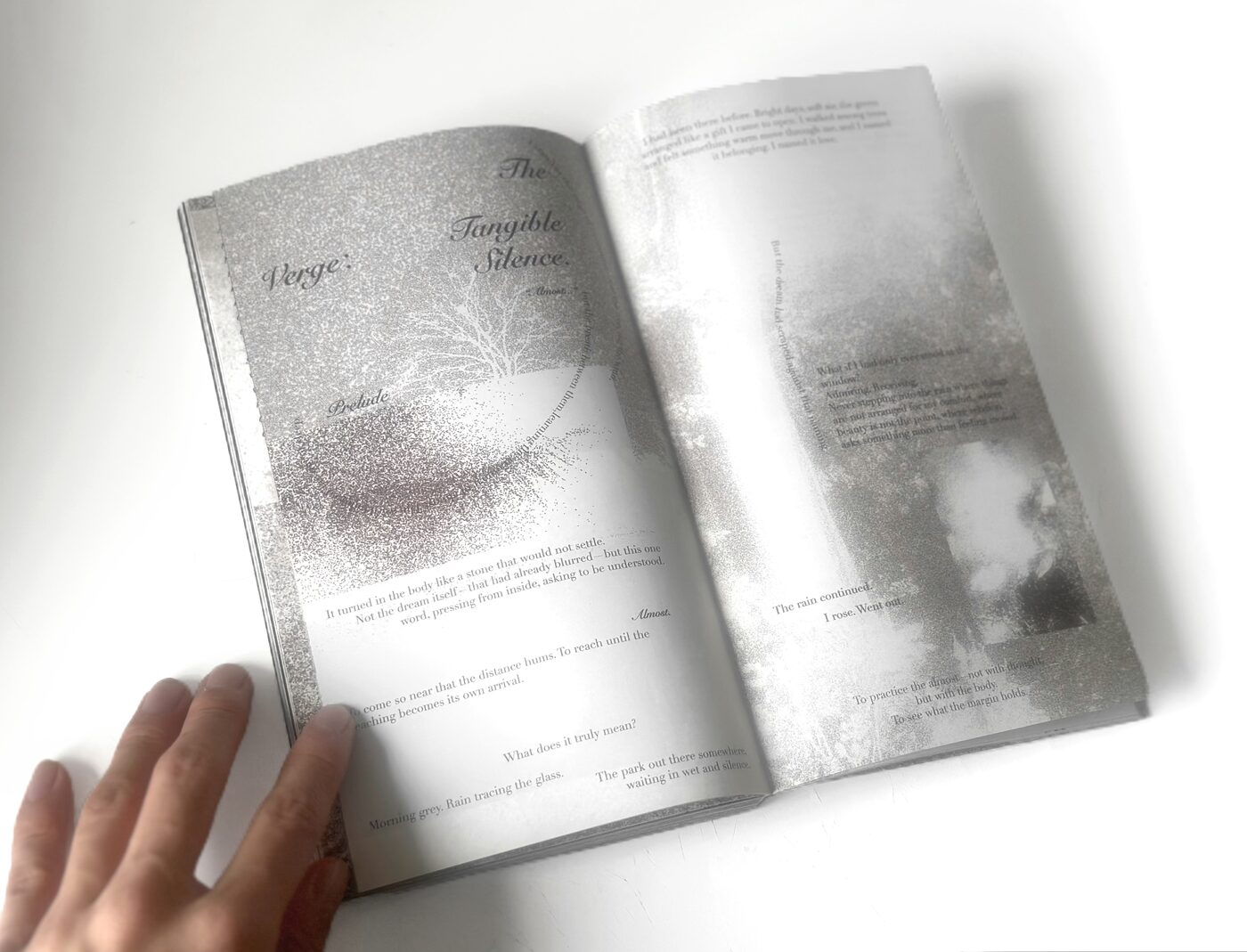
An opened spread — 'Verge: The Tangible Silence. Prelude.' set across two pages with a tree drawing.
ii · preludethe body's almost — to come so near that the distance hums.
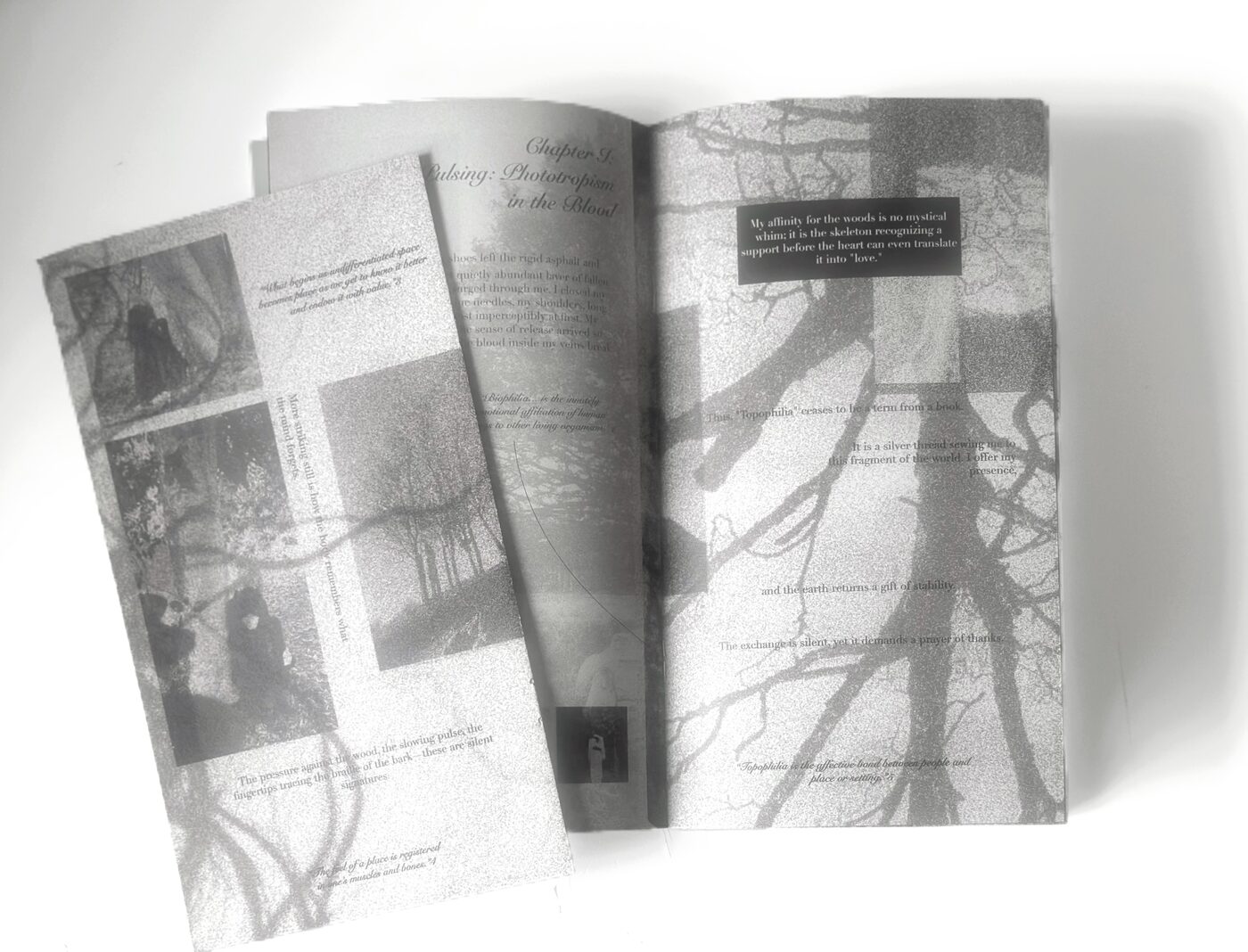
A spread from the chapter 'Pulsing: Phototropism in the Blood' — a tree silhouette layered with text fragments.
iii · phototropismmy affinity for the woods is no mystical whim — it is the skeleton recognising support.
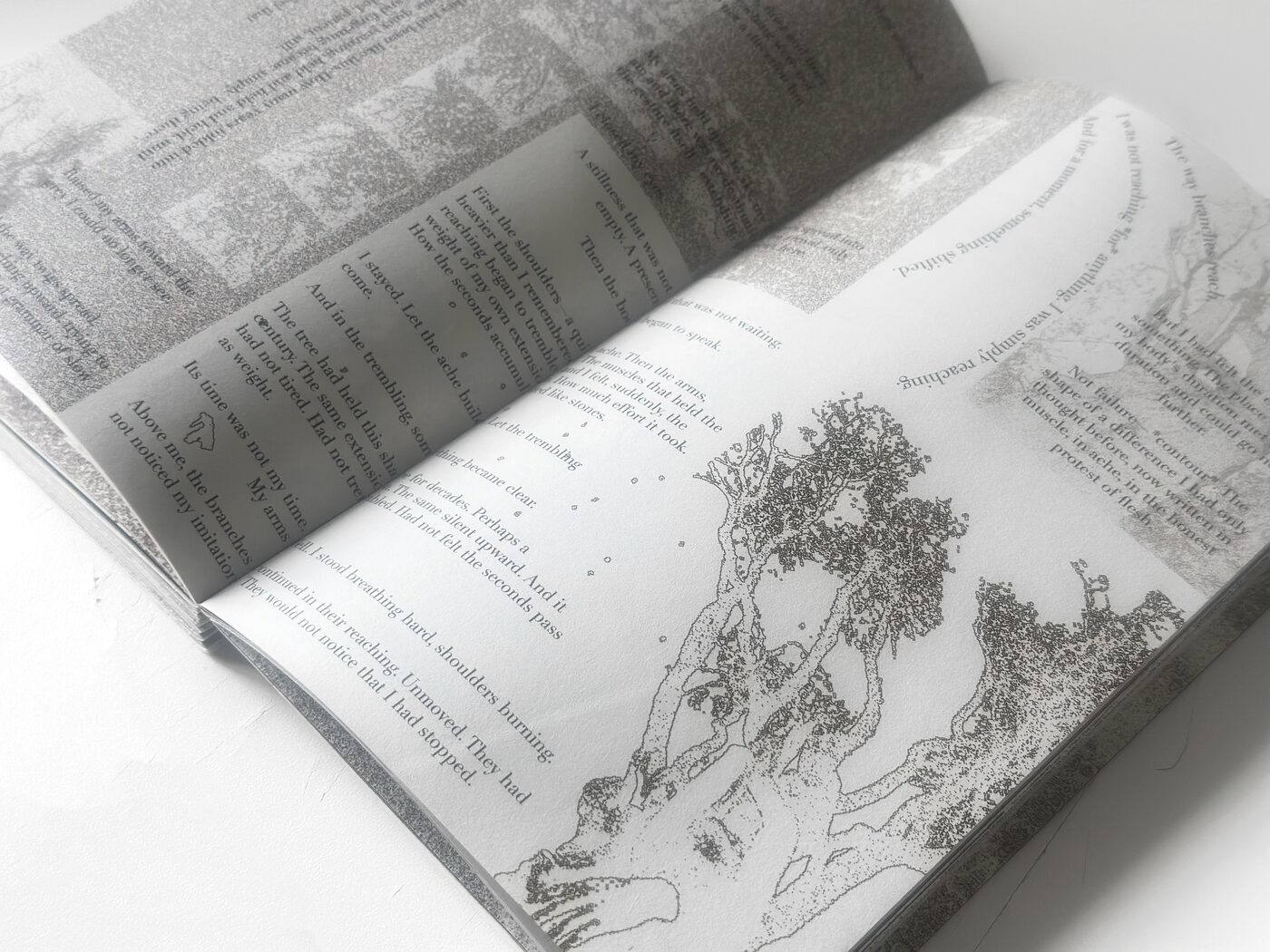
A spread with a tree drawing and text spiraling around its branches — the chapter on intertwining and reach.
iv · reachingthe tree had held this shape for decades — its time was not my time.
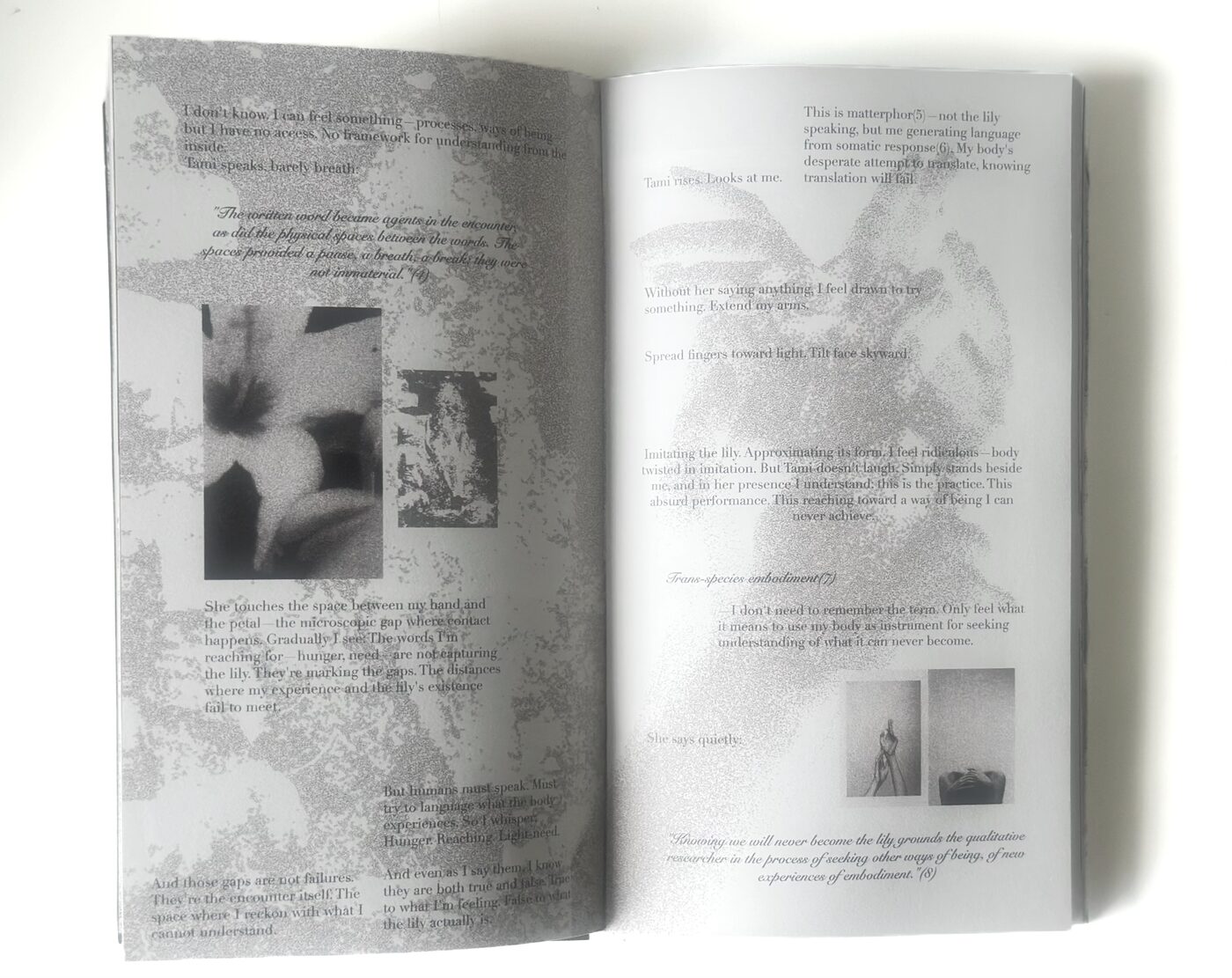
A double-page spread showing a still-life photograph of a lily fragment alongside notes on 'matterphor' and trans-species embodiment.
v · matterphormy body's desperate attempt to translate — knowing translation will fail.
spread — ch. v · intertwining
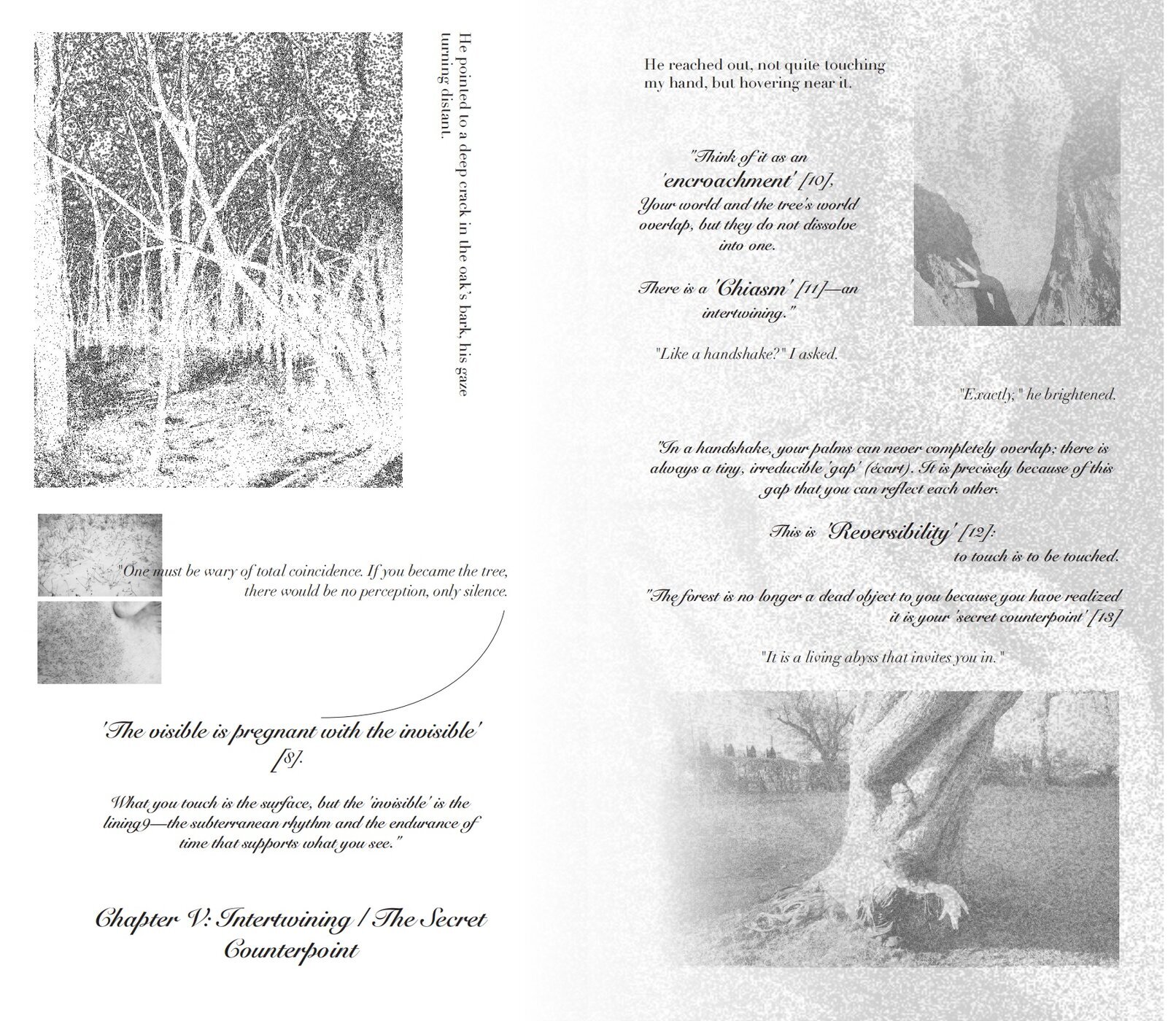
A complete book opening — Chapter V: Intertwining / The Secret Counterpoint. Left page: forest photograph and chapter title. Right page: encroachment, chiasm, reversibility — the philosophical dialogue.
Chapter V — pp. 22–23

The Secret Counterpoint

"The visible is pregnant with the invisible." What you touch is the surface; the invisible is the lining — the subterranean rhythm, the endurance of time that supports what you see.

In Merleau-Ponty's late writing, chiasm names the way perceiver and perceived intertwine without becoming one. A handshake: two palms can never fully overlap, and it is precisely the irreducible gap that lets them reflect each other.

The forest stops being a dead object. It becomes my secret counterpoint — a living abyss that invites me in.

spread — ch. viii · the covenant
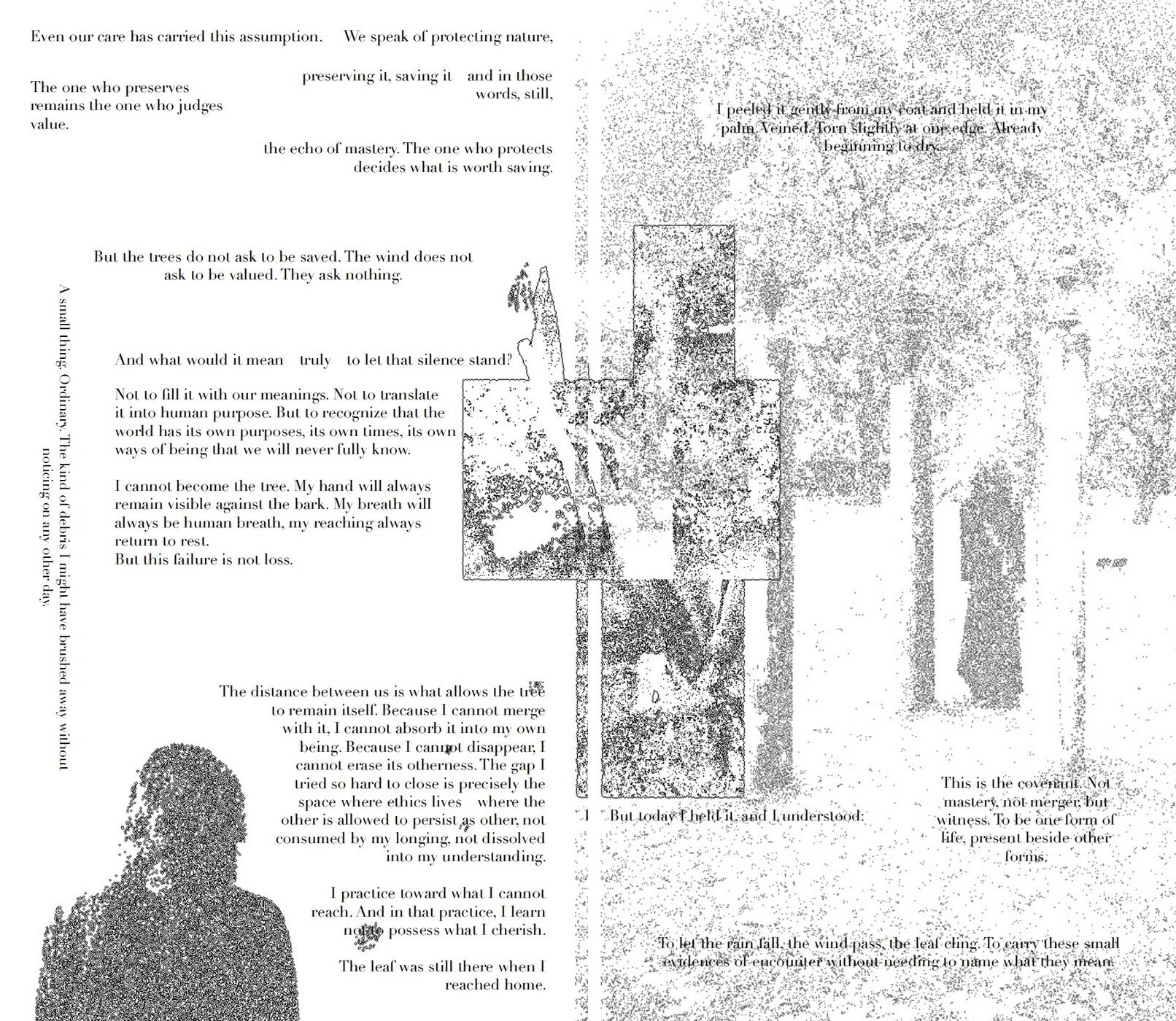
A complete book opening — Chapter VIII. Left page: 'I cannot become the tree. But this failure is not loss.' Right page: 'This is the covenant. Not mastery, not merger, but witness.'
Chapter VIII — pp. 29–30

This is the Covenant.

I cannot become the tree. My hand will always remain visible against the bark. But this failure is not loss — the distance between us is what allows the tree to remain itself.

The gap I tried so hard to close is precisely the space where ethics lives — where the other is allowed to persist as other, not consumed by my longing, not dissolved into my understanding.

The covenant: not mastery, not merger, but witness. To be one form of life, present beside other forms.

vi · the pages

Open the palimpsest — turn through the gatherings.

open
I cannot become the tree. My hand will always remain visible against the bark. But this failure is not loss. The distance between us is what allows the tree to remain itself. — and so the page is never finally written. it is only, always, written over.
Colophon
Title
Nature Palimpsest — Between Root and Thought
Series
Verge · Prelude
Form
Artist book · unique edition · 130 × 230 mm
Material
Newsprint · tracing paper · double-sided mount
Bind
Manual butterfly binding · exposed spine
Pages
240 pages · 10 gatherings
Year
MMXXVI
Zhanyi · Hu
← back to the cabinet
Publication · Artist Book · 2025
fol. 001 — 052
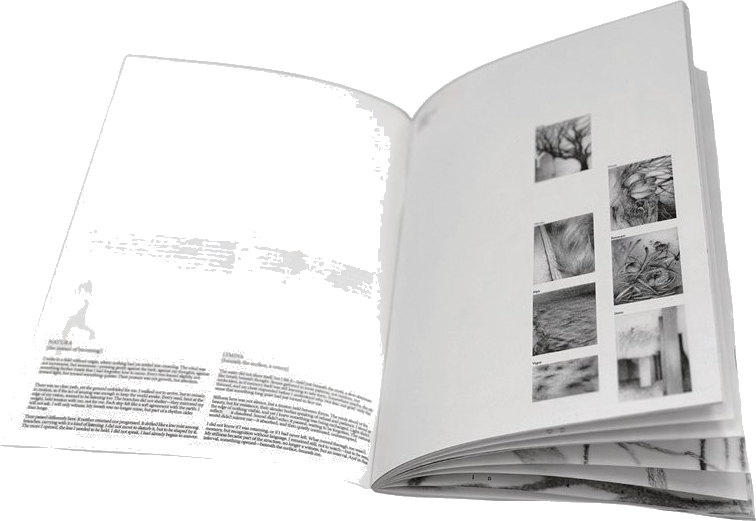
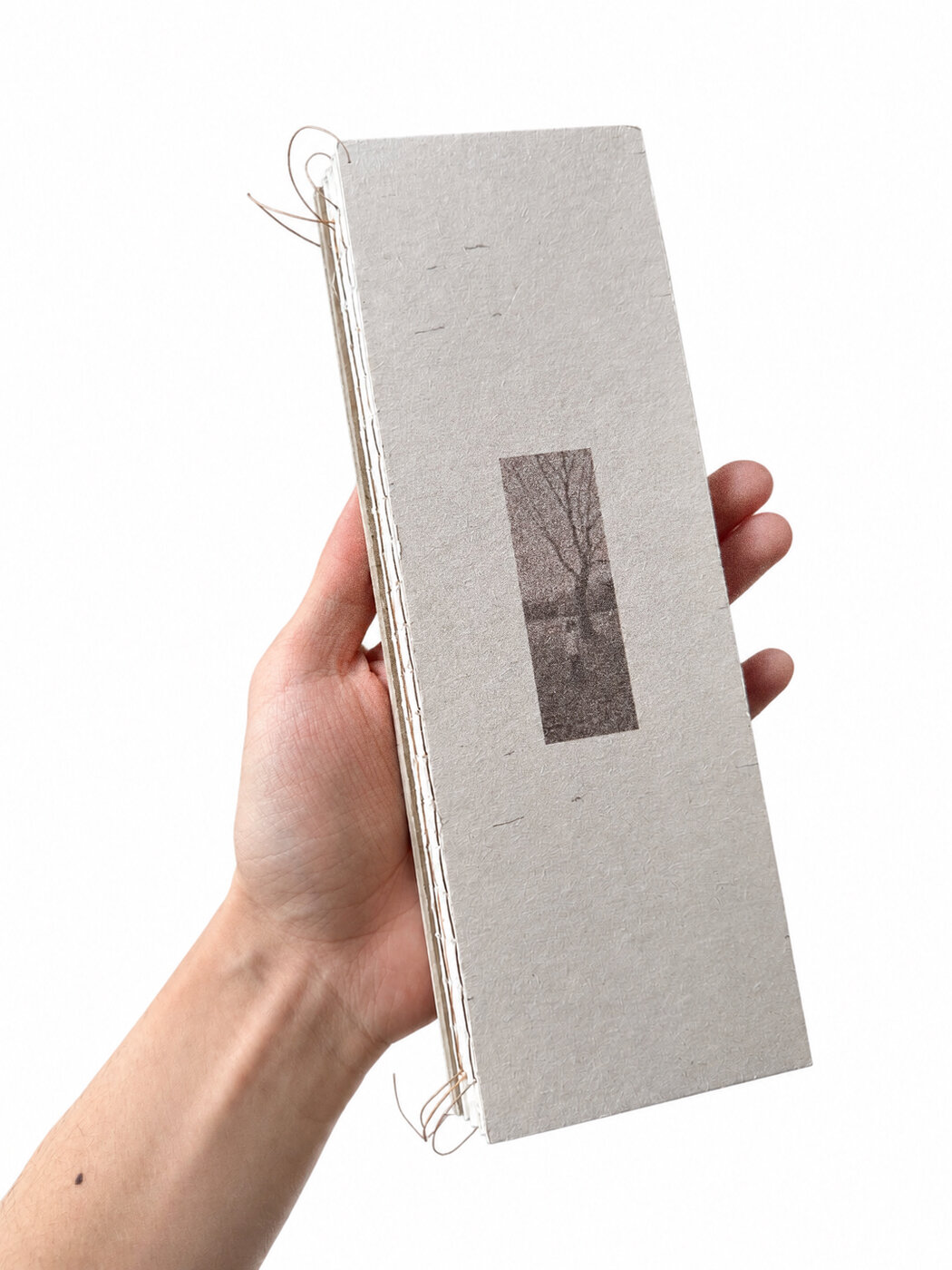
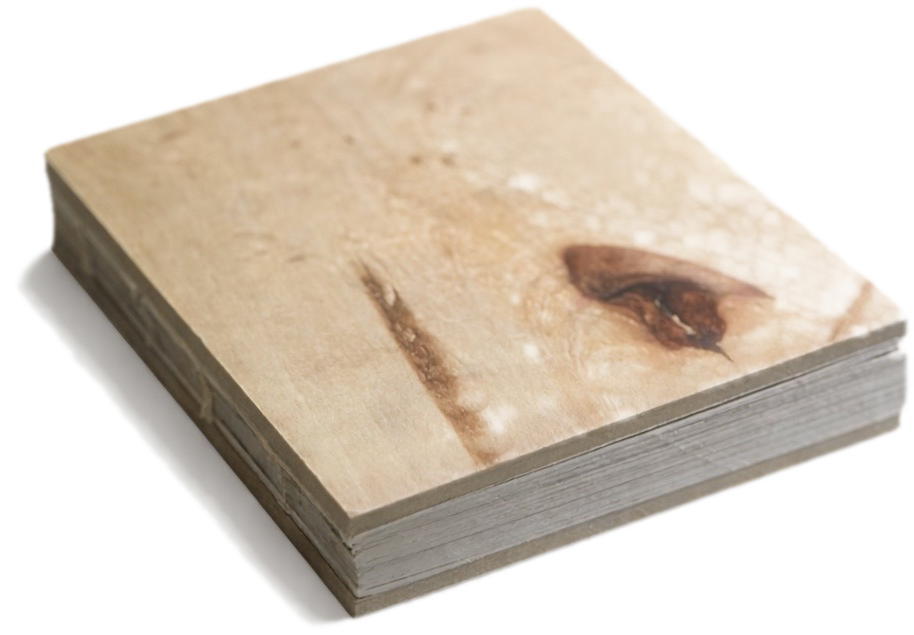
The closed book, narrow vertical format, held in the hand. The grey textured cover frames a small printed window of trees.
An artist book · Hand-bound · 2025

Between Nearness — and — Elsewhere

A hand-bound artist book on the unstable relation between the body and the tree — a quiet study of proximity, waiting, and the limits of closeness.

Format
Artist book · 75 × 225 mm narrow vertical
Pages
52 pages · 13 gatherings
Cover
210 g zen-coarse white paper, mounted on 3 mm grey board
Interior
210 g zen-coarse "earth-tone" paper
Bind
Manual butterfly stitching · exposed spine
Year
MMXXV
I · the proposition

Closeness does not require possession.
Coexistence does not require fusion.
To remain beside something whose depth cannot be fully entered.

proximity waiting threshold witness
II · a sequence of approach

The body moves toward the tree
in four slow movements.

Each step a deeper attention, each step a recognition of what cannot be crossed.

i
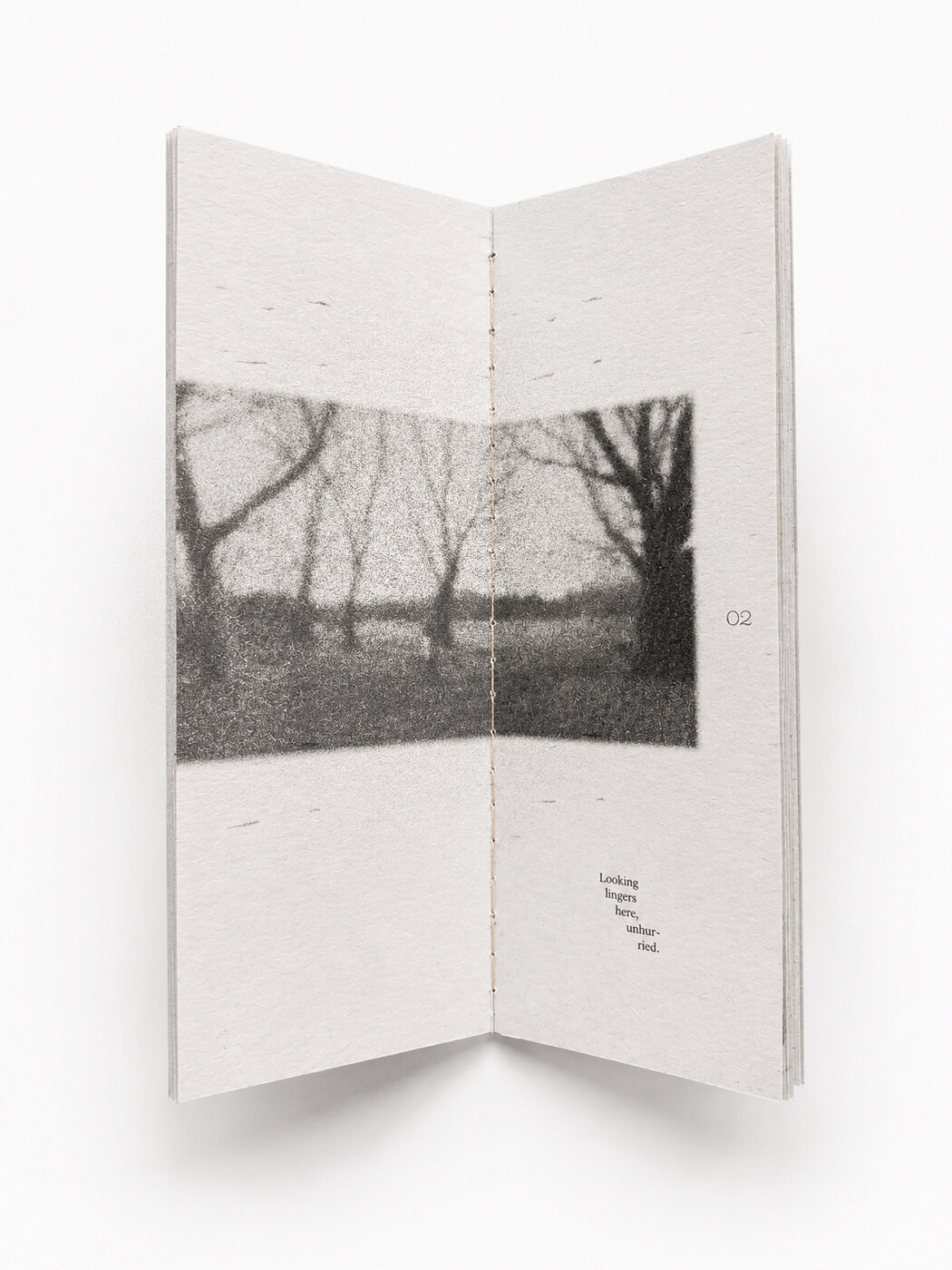
A spread with a soft, dotted photograph of trees seen from the field — distance softened but not erased.
distance, softened The tree appears through grain, blur, partial visibility. Looking lingers here, unhurried.
ii
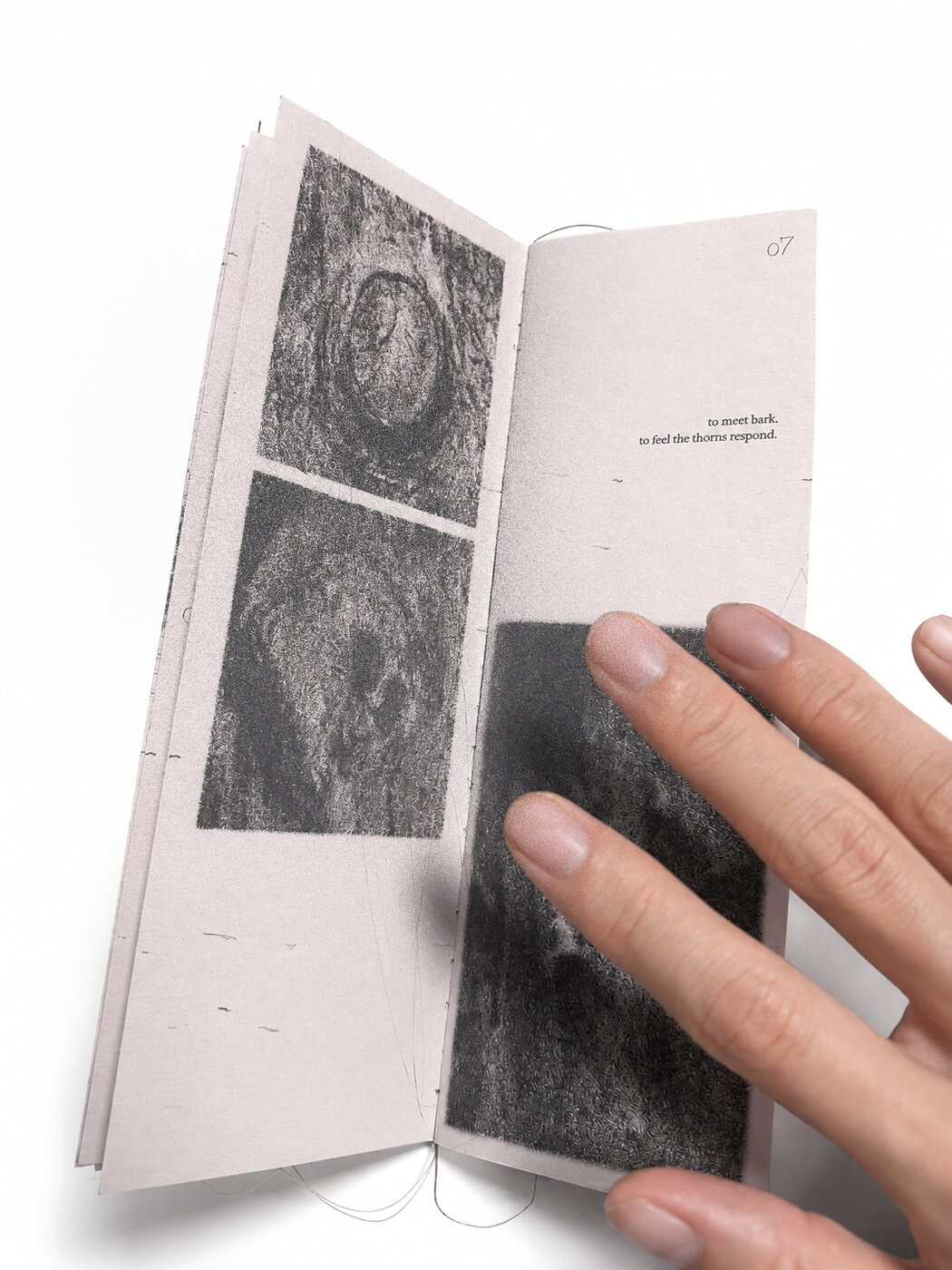
A spread showing the hand reaching toward bark — close-up details of knots and thorns.
contact, a limit The hand reaches toward bark, toward thorn. Touch as a limit learned — not as mastery.
iii
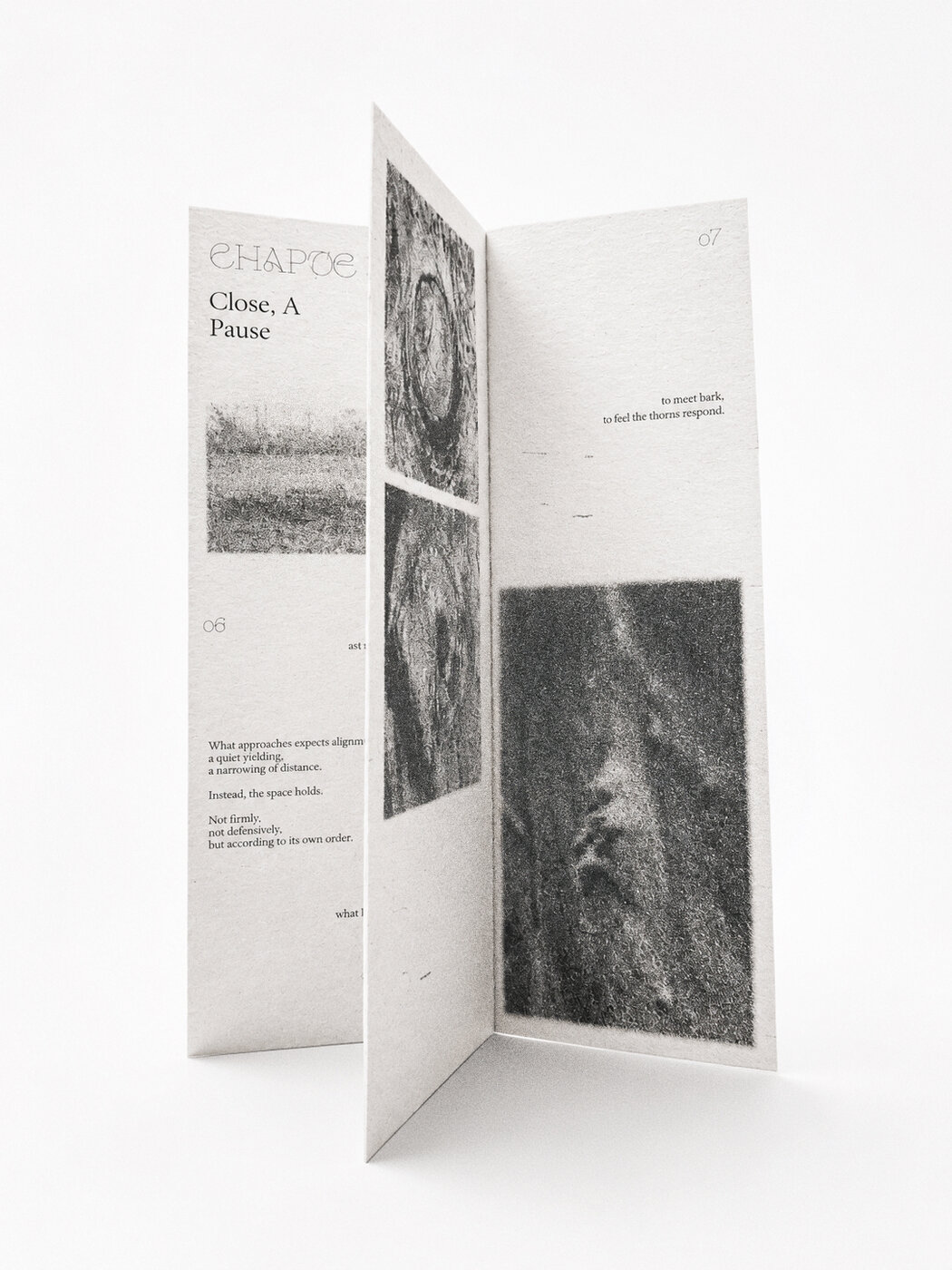
A folded spread, 'Close, A Pause' — the body waiting within the field of the tree.
waiting, beside The body stays within the tree's field, adjusting itself to a slower grammar of waiting.
iv
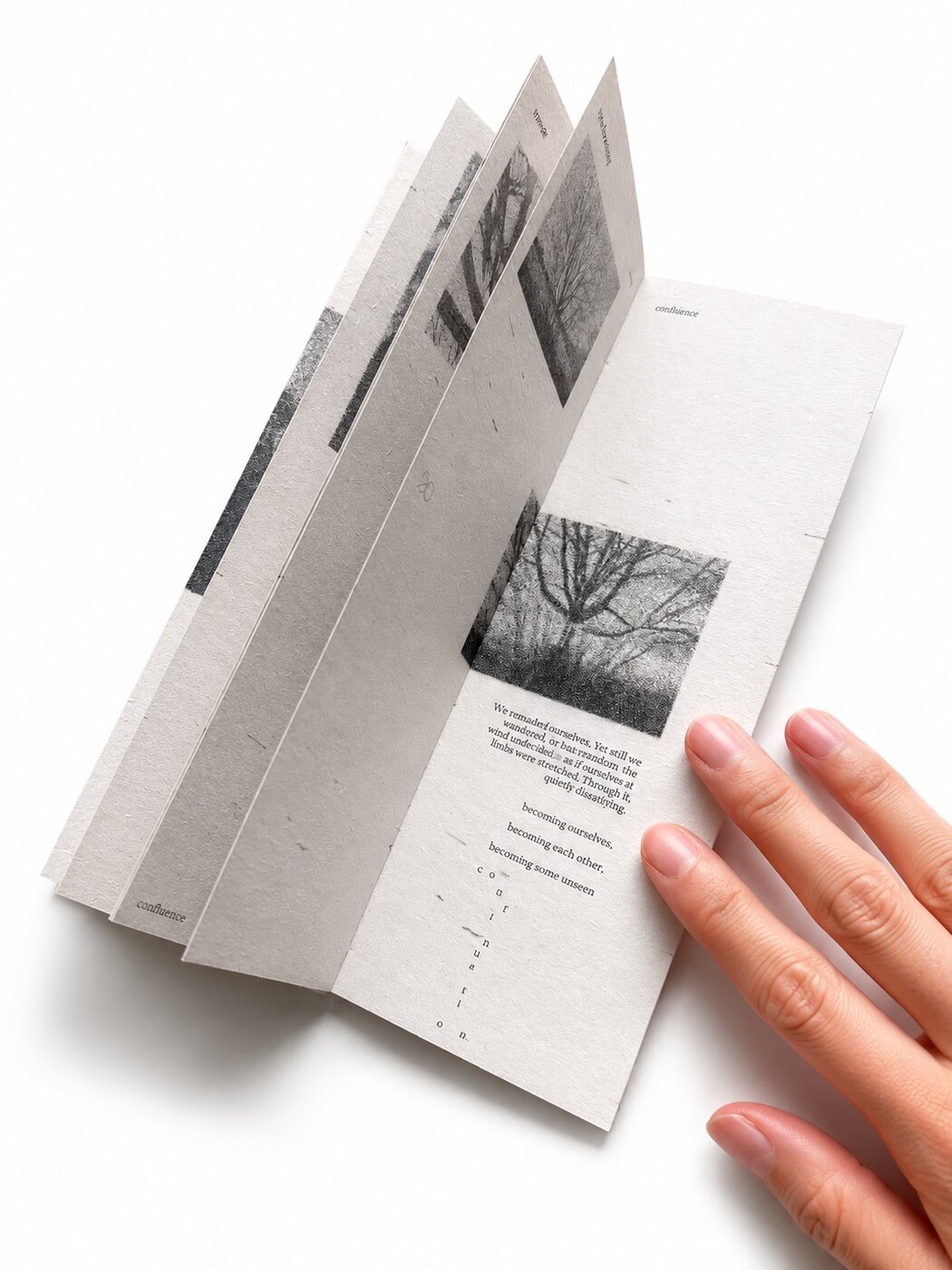
A multi-fold spread — arms echo branches, forms briefly continuous, yet still distinct.
resemblance, unstable Arms echo branches; shadows merge; the tree remains irreducibly itself.
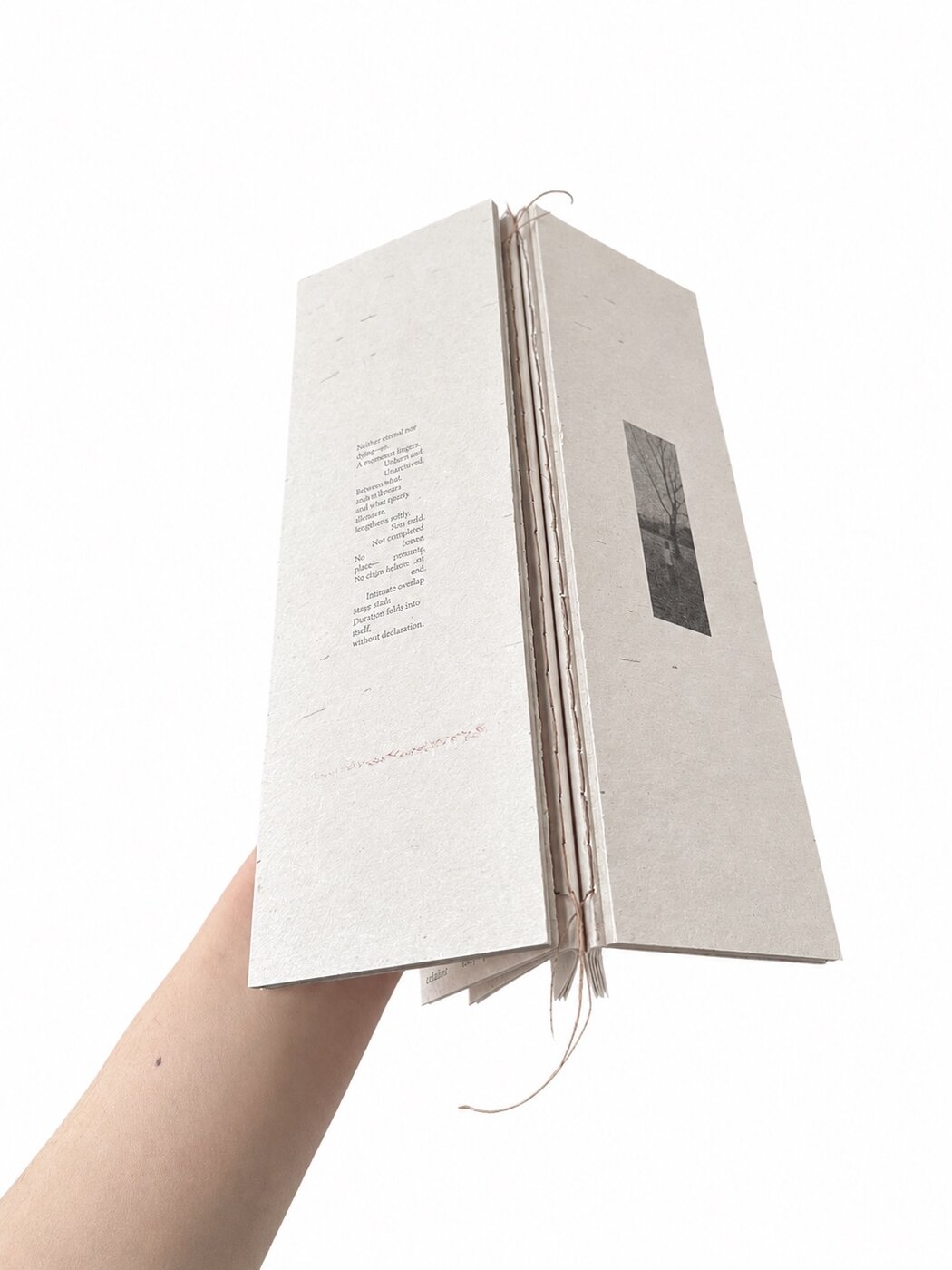
The closed book seen from the spine — exposed butterfly stitching visible along the edge.
The visible stitching interrupts the images like a line of contact that both joins and separates.
III · a quieter proposition

Not a declaration of harmony, but a question held open between two forms of life.

Rather than presenting nature as scenery, symbol, or emotional refuge, the book treats the tree as an independent presence with its own rhythm, scale, and opacity. The body does not enter the tree, possess it, or become one with it. It only remains near — touching bark, following branches, lowering itself into the field of the tree.

This nearness is never resolved into unity. It is held as a pause, a tension, a condition of coexistence.

What approaches expects alignment, a quiet yielding, a narrowing of distance. Instead, the space holds. Not firmly, not defensively, but according to its own order.

Materially, the book reinforces this idea of fragile proximity. The exposed spine, loose threads, textured paper, grey cover, and low-contrast images all resist polish and closure. The book feels held, suspended, slightly unfinished — as if its form were still negotiating between object, trace, and environment.

The long, narrow format recalls a fragment of bark, a vertical body, or a folded interval of landscape. To stand with another form of life without claiming it — to accept relation as something partial, temporary, unresolved.
IV · the book as object

Held, suspended, slightly unfinished.
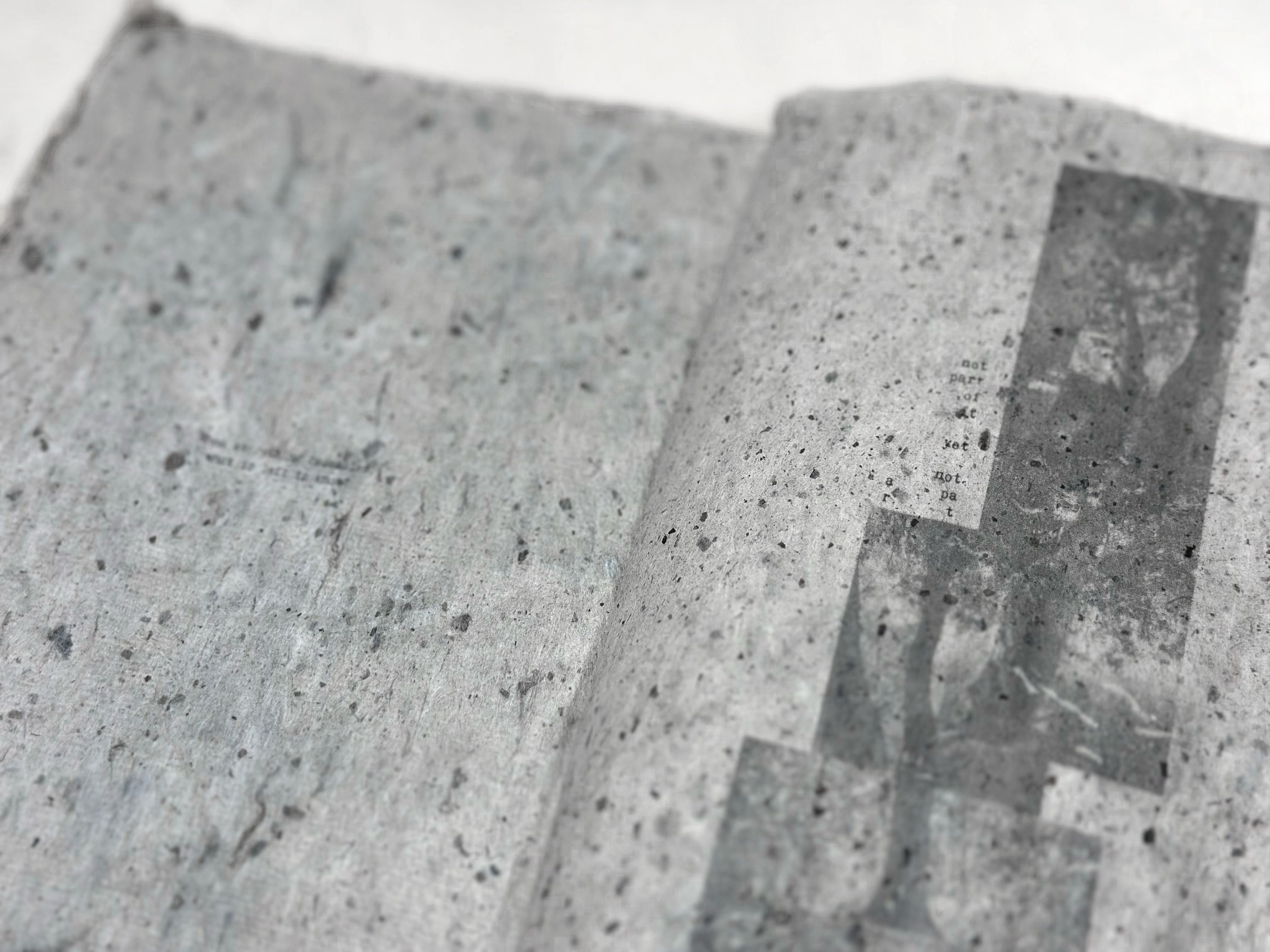
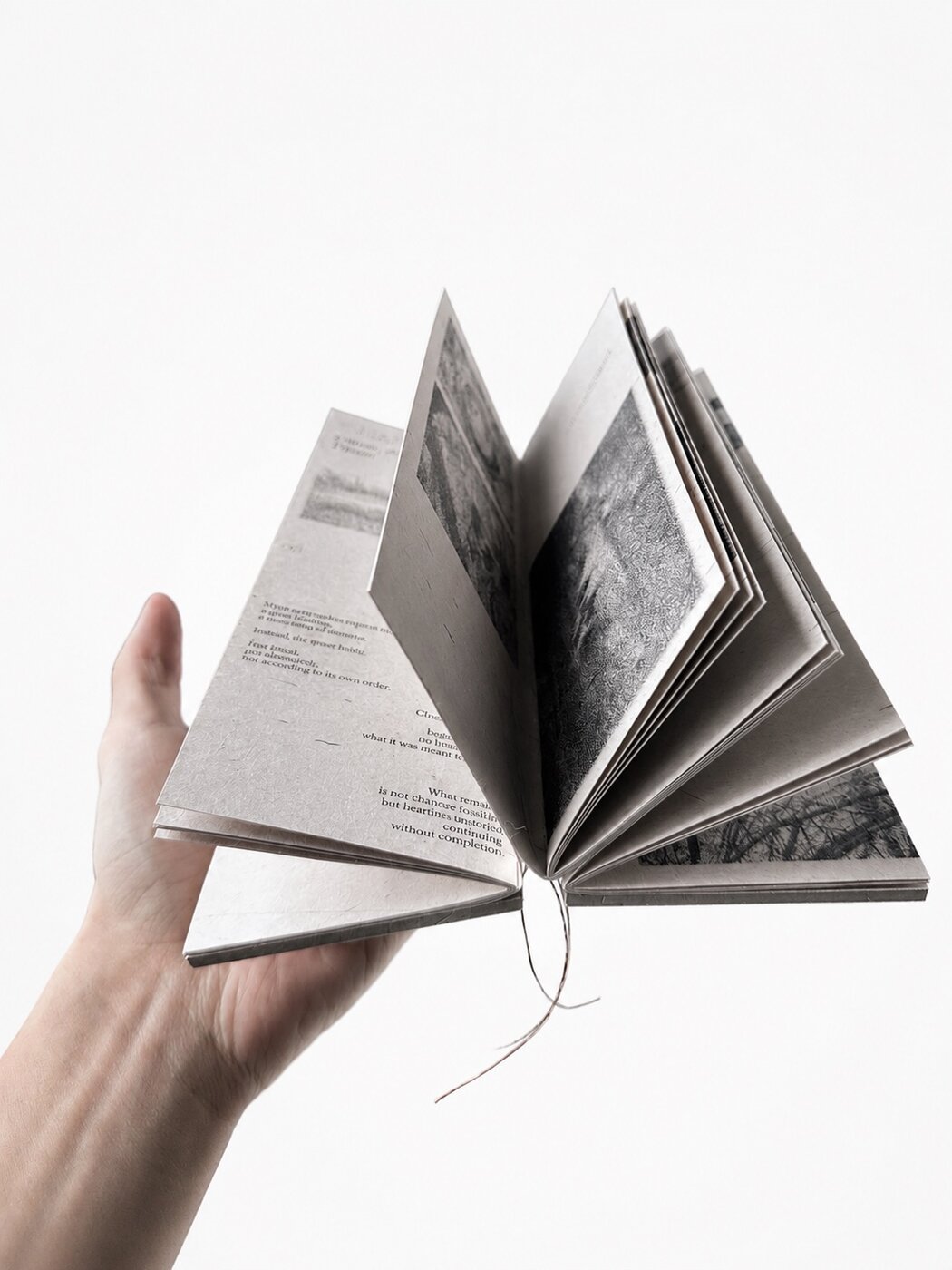
The book opened into a fan, all pages cascading outward from the exposed spine.
— the fan opening — all the gatherings at once, the spine still holding.
The cover, narrow vertical, framed in the hand — the small printed window of trees centred low on the grey board.
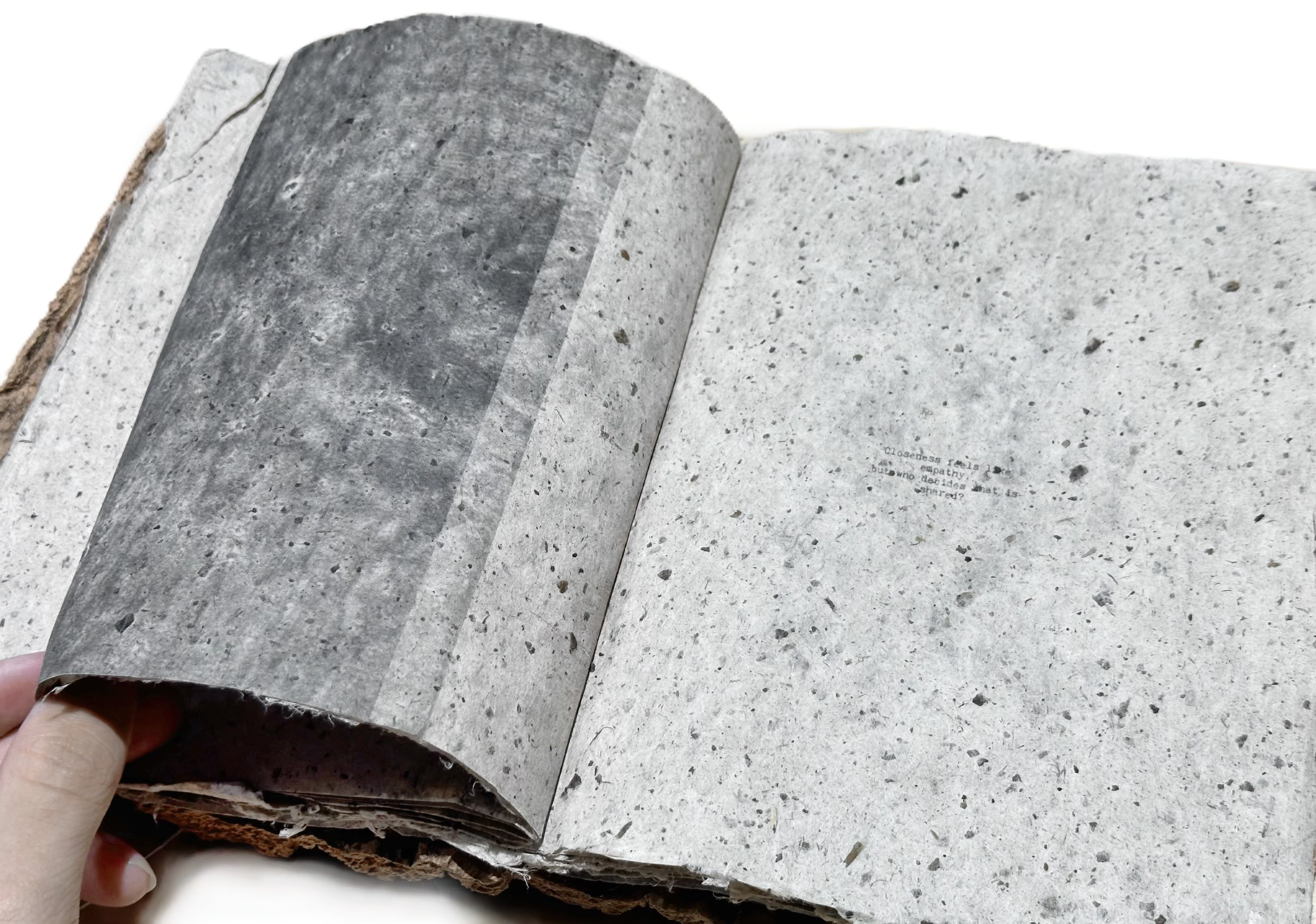
— the cover · 75 × 225 mm · a vertical body.
The accordion-fold spread, vertical pages stepping outward like the slatted shadow of a forest.
— the accordion · pages step outward like slats of light.
V · the pages

Open the book — turn through all the pages.

open
To stand with another form of life without claiming it. To remain beside something whose depth cannot be fully entered.
Colophon
Title
Between Nearness and Elsewhere
Form
Artist book · 75 × 225 mm · 52 pages
Cover
210 g zen-coarse white paper · 3 mm grey board
Interior
210 g zen-coarse earth-tone paper
Bind
Manual butterfly stitching · exposed spine
Year
2025
Zhanyi · Hu
← return
Chapter 01 / Illustration
Tracing the silent shadows

Before I know what I feel,
I draw.

A line arrives first —
lighter than speech,
closer than memory.

It carries the weight of a passing thought, the warmth of an unnamed feeling, the quiet distance between myself and all that I am touched by.

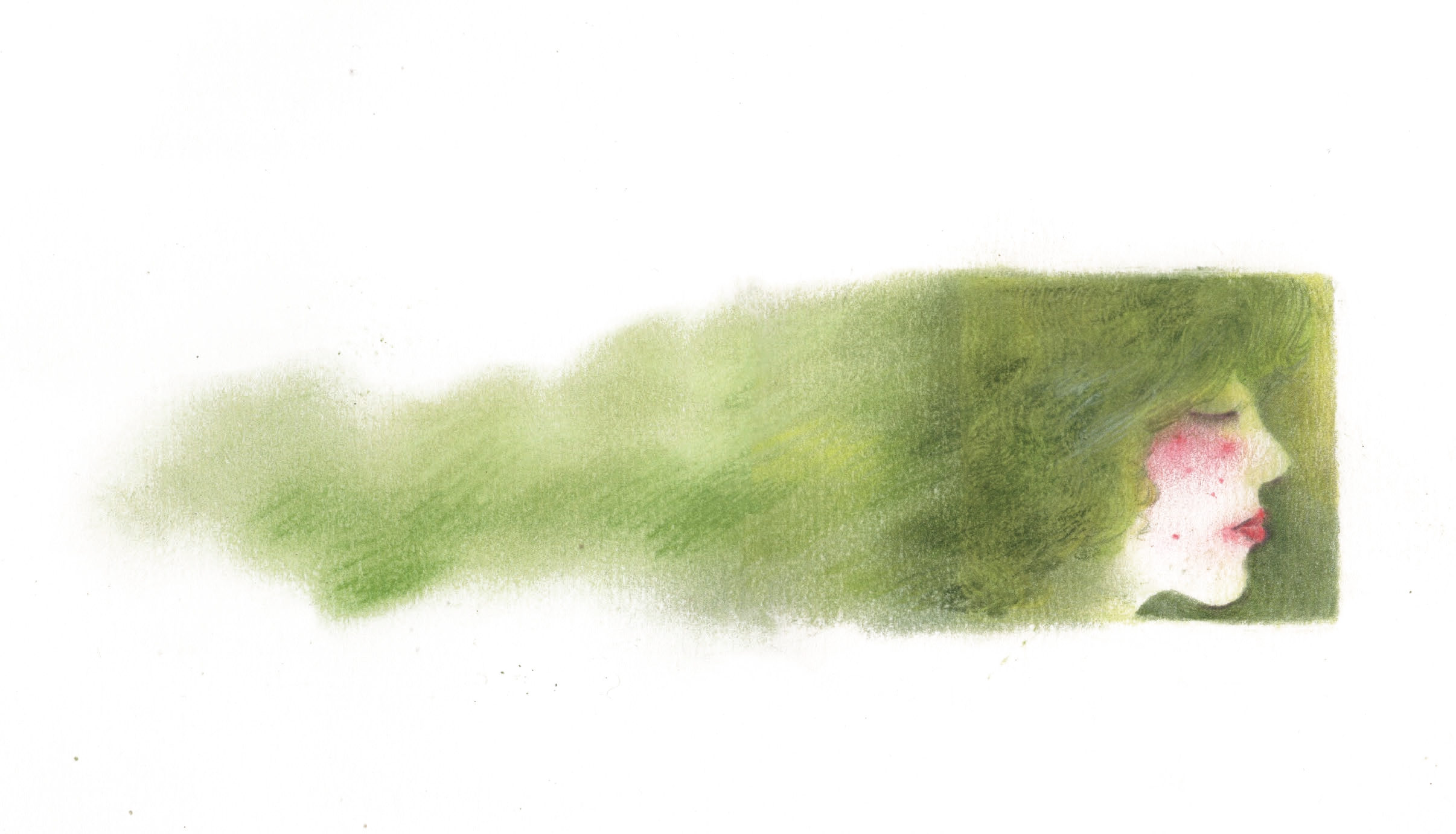
For me, illustration is not a way to describe the world, but a way to sense it more tenderly; to let the inner weather become visible, and to find, in each fragile mark, a breath shared between myself, nature, and another gaze.

↓ enter the series
Series 01 · Seven works · 2024 · graphite on paper
01
A series

Where thoughts
take root

My thoughts rarely arrive as words — they begin as a faint pressure, a line, a root, a hand reaching from somewhere I cannot name. Lines spread like nerves, stems, or murmurs; faces appear and fade as if carried by something larger than themselves.
7 works2024Graphite on paper
Series 02 · Eight works · 2026 · graphite on paper
02
A series

Monochrome gaze
in nature

The trees do not stand outside me. They arrive as a faint pressure, a shadow under the skin, a breath moving through the lines of the body — I remain there, quietly altered, held between what is human and what is growing.
8 works2026Graphite on paper
03
A series

We live in the
same pond

Lotus leaves overlap, open, darken, and return to water. Across the pond, every form carries its own season, yet all are held within the same quiet rhythm — the pond a mirror of living itself: cyclical, relational, unfinished.
8 works2025Watercolour · graphite
Series 03 · Eight works · 2025 · watercolour on paper
An interlude

Where the
Roots Listen

A private sketchbook — opened. Watercolour and pencil drift across spreads, where my consciousness meets the forest's. Trees become bodies. Bodies become trees. Something between us is always listening.
turn the page
01 / 14
2022
A picture book

Self‑filtering
Room

Negative emotions are often on the verge of collapse — they erode my original self and occupy my body like evil spirits. As a holy land for self purification, the "home" absorbs and filters the evil soul into a pure "spirit" to achieve redemption.

13 spreadsHardcover, A4Pencil & watercolour
› click the page to turn · ← →
01 / 09
04
A series

Self-portraits
as becoming

I return to myself through the language of nature. The face becomes a place of passage — touched by lines, breath, shadows, and organic traces. These portraits move away from likeness and toward sensation, holding the fragile moments when identity loosens and inner life grows outward.
5 works2024Pencil · pastel
Series 04 · Five works · 2024 · pencil and pastel on paper
Series 05 · Five works · 2025 · pencil and watercolour on paper
05
A series

Boredom

Boredom has its own shape. It settles quietly, then thickens inside the body — a slow heaviness, a room inside the mind with no clear exit. I translate it into a visual state: weight, pressure, pause, distortion, silence. A density beneath the skin, a private atmosphere that slowly occupies space.
5 works2025Pencil · watercolour
06
A pentad

Elemental Script

I return to the five elements as a way of sensing the body. Wood, fire, earth, metal, and water move through me as states of change — growth, heat, weight, fracture, flow. Drawn from the spirit of pictographic writing, these works search for a language before separation: image as body, body as sign, sign as something still alive.
5 works2025Pencil on paper
07
A field study

The Gap
In the Map

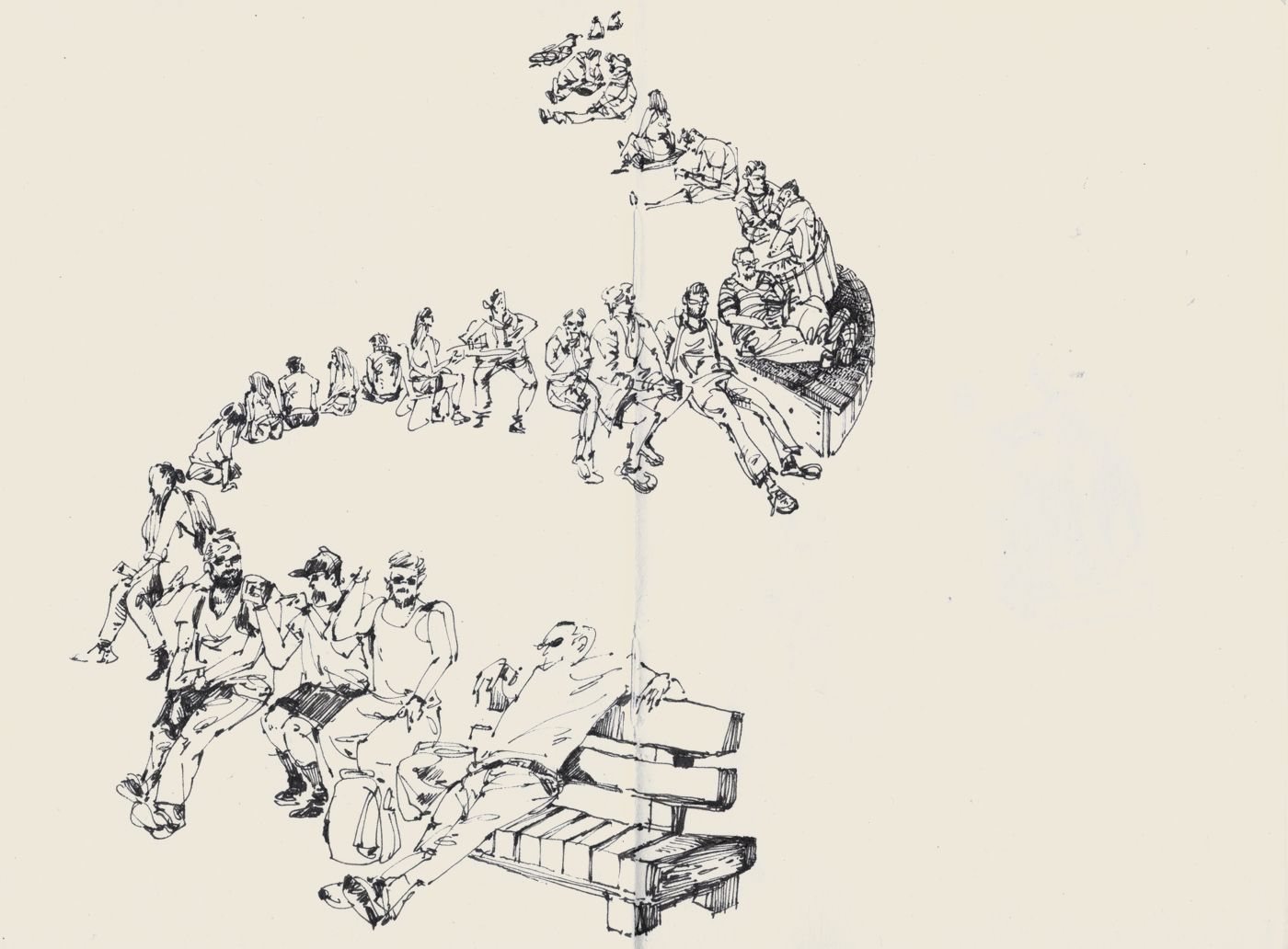
In the seam of London's map lies a pause —
where strangers drift, breathe, witness.

In Elephant Park, time exhales.
We are fluid, fleeting, one.

The grass remembers nothing,
yet we leave carrying light.

Everything softens. Everything slows.
Take it slowly.

13 spreads2025Coloured pencil & finelinerElephant Park, London
drag, scroll, or wander — the map continues

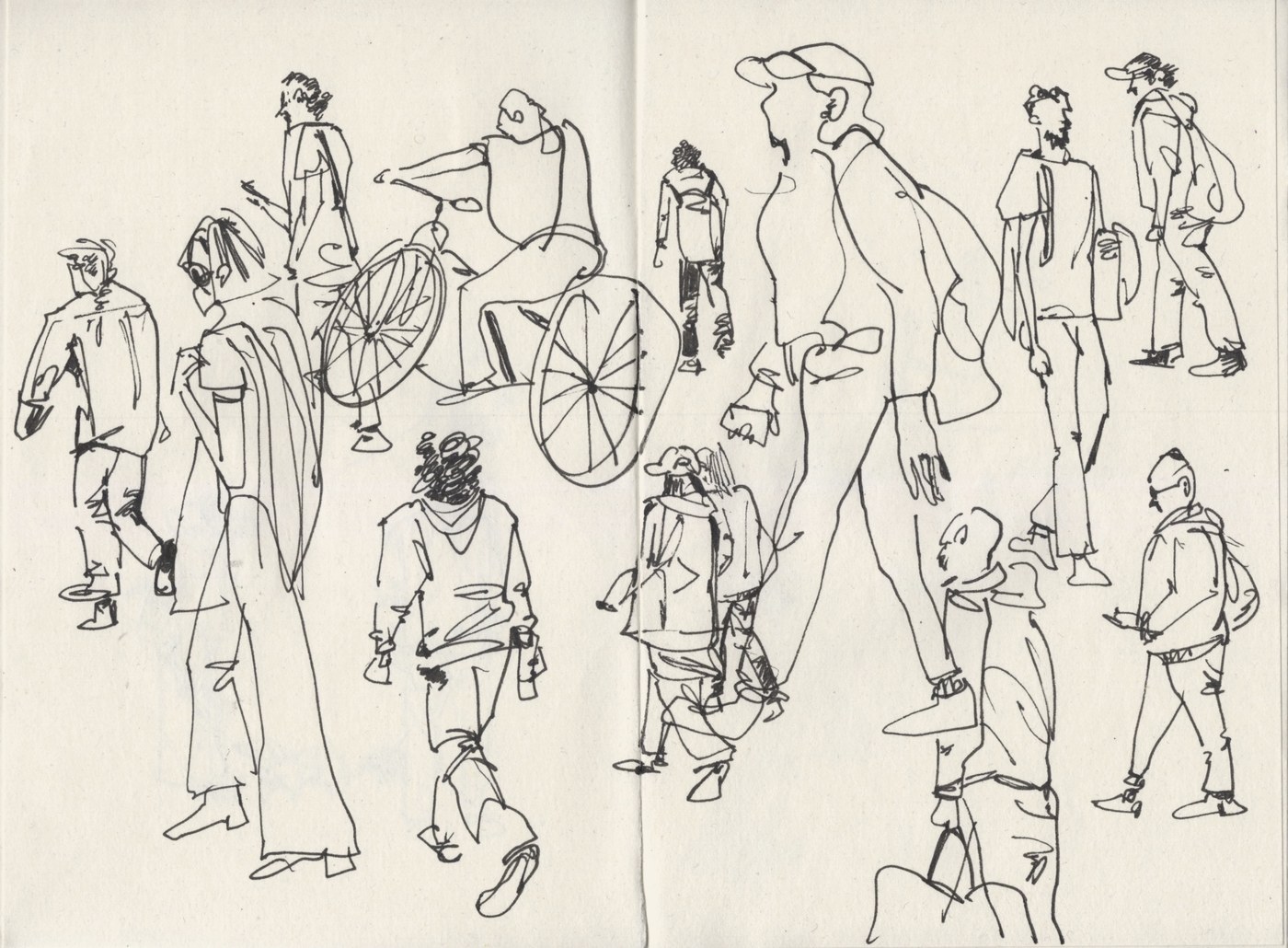
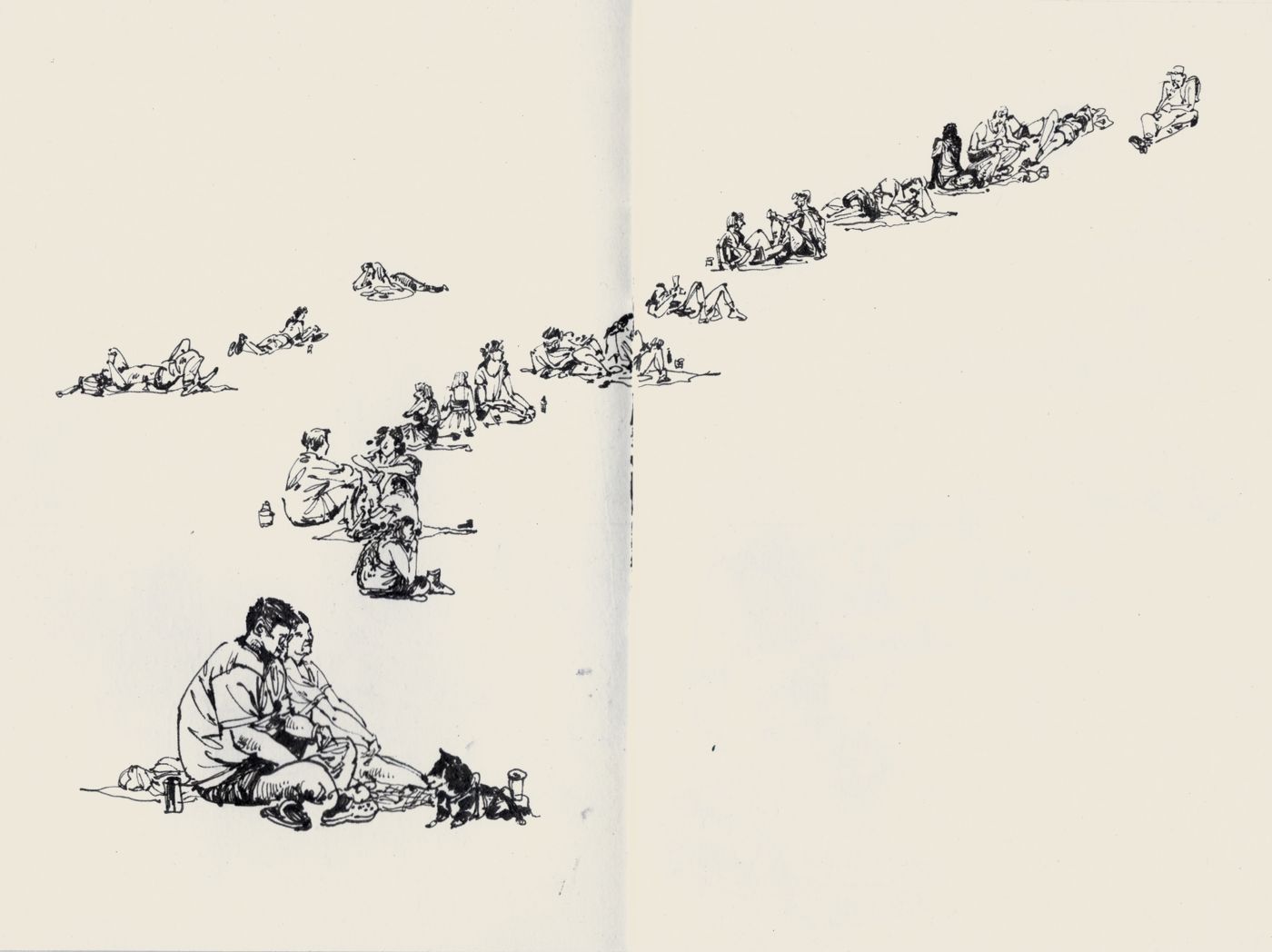
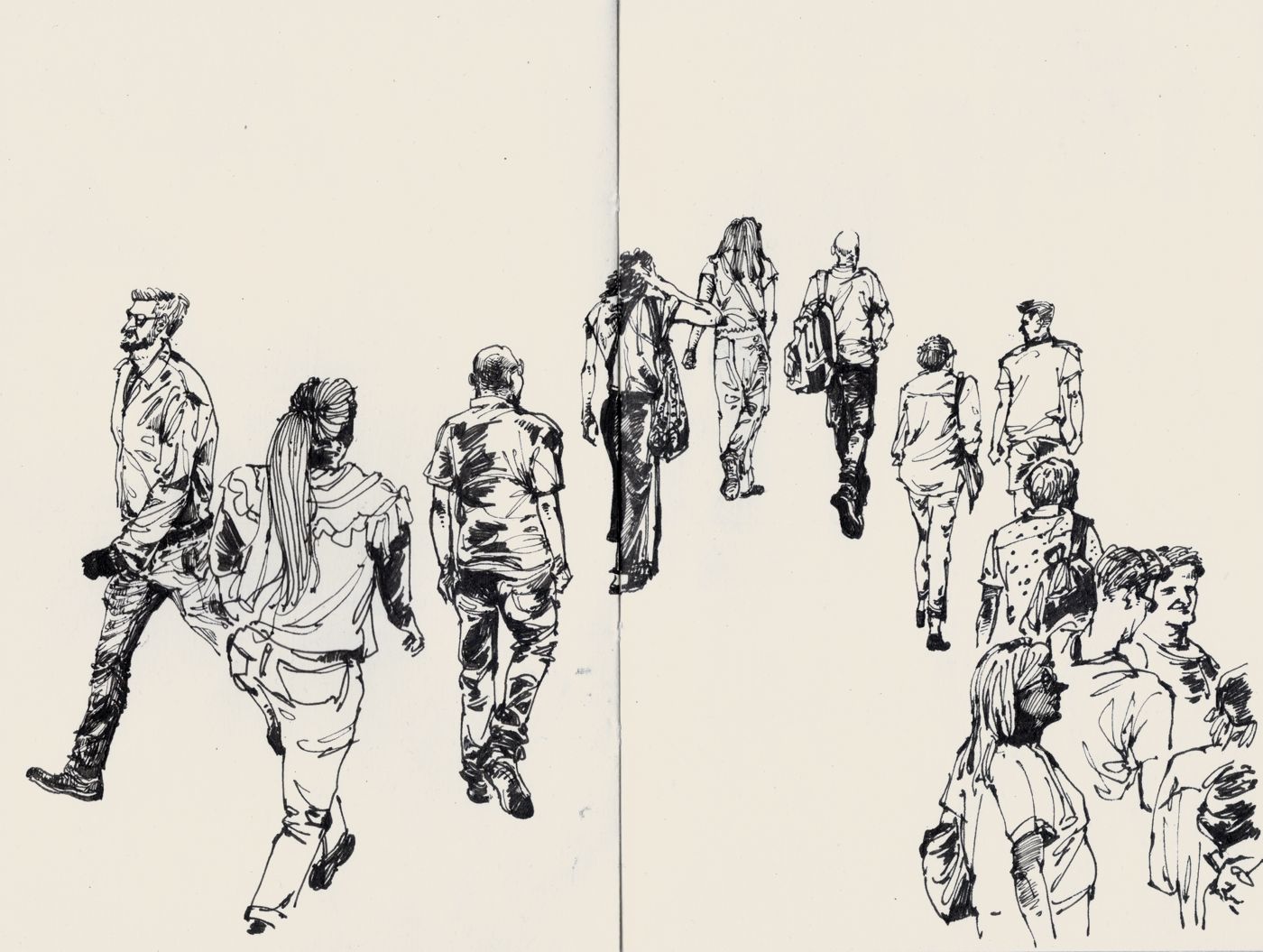
Drawn from direct observation, this composition traces the rhythms of public gathering within the park's courtyard. Figures are rendered as discrete yet interconnected presences — their postures and interactions mapped across an open spatial field. The layering of fine line and translucent colour records not only the visible arrangement of bodies, but also the intangible atmosphere shaped by light, movement, and collective pause.

— more to come —
more on instagram